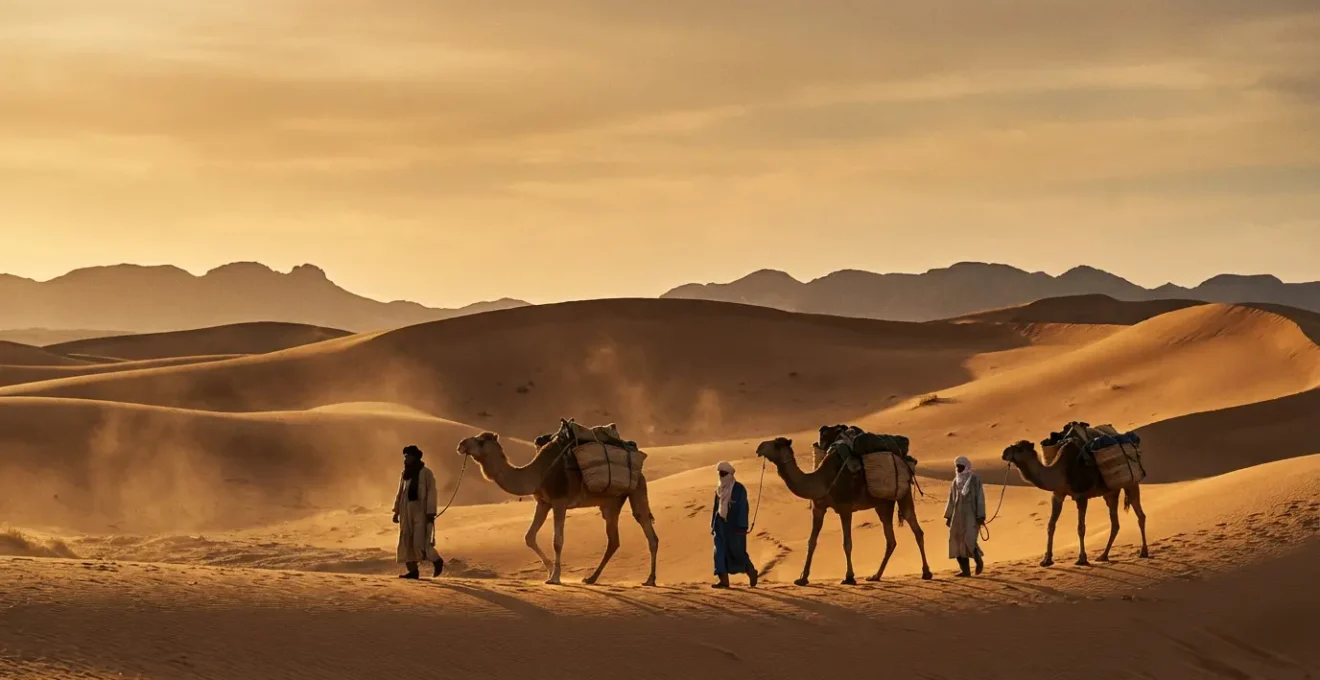
True desert mastery isn’t about finding more resources; it’s about radically redefining your relationship with the ones you already possess, especially those within your own body.
- Nomadic wisdom shifts the focus from external extraction (finding water) to internal preservation (managing sweat, breath, and energy).
- Traditional practices, from clothing to cleaning, are sophisticated systems designed for maximum efficiency in a resource-scarce environment.
Recommendation: Adopt a mindset of “metabolic economy” on your next adventure—view every drop of water and calorie of energy as an internal asset to be managed, not just an external supply to be consumed.
For the modern adventure traveler, the desert represents a final frontier—a landscape of stark beauty and unforgiving realities. The instinct, shaped by a world of abundance, is to prepare by packing more: more water, more gadgets, more supplies. We approach survival as an external challenge, a matter of bringing enough gear to conquer the environment. Conventional wisdom reinforces this, focusing on finding water, using GPS, and seeking shelter.
But what if this approach is fundamentally flawed? The Bedouin nomads, who have thrived in these environments for millennia, offer a profound counter-narrative. Their survival is not rooted in what they carry, but in how they think. It is a philosophy of deep adaptation, where the self is not an outsider imposing its will on the desert, but a harmonious part of the desert’s own rhythm. They demonstrate that the most critical resource isn’t in a canteen, but within our own physiology.
This is the core of their wisdom: true resource management begins with managing the self. Instead of asking “Where can I find more water?”, the nomad asks “How can I lose less water?”. This shift from external extraction to internal preservation is a powerful lesson for any traveler seeking not just to survive, but to connect more deeply with the world’s wild places. This article delves into this ancient mindset, translating nomadic techniques into practical lessons for contemporary adventurers.
Through an anthropological lens, we will explore the sophisticated logic behind their seemingly simple practices. This guide breaks down the core principles of the nomadic survival philosophy, offering a new framework for resource management that you can apply on your next journey.
Summary: Lessons in Resource Management from Desert Nomads
- Why Bedouin Nomads Never Wash Dishes with Water in the Deep Desert?
- How to Navigate Featureless Dunes Using Only Wind Direction and Stars?
- Wool or Synthetics: Why Nomads Wear Heavy Layers in 40°C Heat?
- The Clear Sky Warning Sign That Predicts a Deadly Flash Flood
- How to Adjust Your Circadian Rhythm to the “Desert Siesta” Schedule?
- How to Find an Independent Bedouin Guide Without Agency Markups?
- How to Construct a Solar Still to Collect Condensation in Sand?
- Arid Wilderness Survival: Critical Water Preservation Techniques for Stranded Hikers?
Why Bedouin Nomads Never Wash Dishes with Water in the Deep Desert?
In an environment where every drop of water is life, using it for something as mundane as washing a plate is unthinkable. This isn’t just a preference; it’s the cornerstone of a philosophy of resource perception. Where a modern traveler sees a dirty dish and a problem to be solved with water and soap, the Bedouin sees an equation of survival. The water inside their body is infinitely more valuable than a sterile cup. This mindset is borne out by stark data; studies show that traditional Bedouin nomads survive on just one liter of water daily, a stark contrast to the 19 liters often consumed by unprepared Westerners in the same conditions.
The solution is both elegant and effective: sand. Before prayers, Bedouins have traditionally used sand as an abrasive cleanser. It’s a highly efficient method that requires zero water. The dry, coarse grains act as a natural scourer, removing food residue without depleting precious hydration reserves. Following the scrubbing, utensils are often left in the direct, searing sunlight, where the high temperature of the sand provides a powerful thermal sterilization, killing bacteria far more effectively than a quick rinse would.
For the modern traveler, this practice offers a crucial lesson in metabolic economy. By adopting sand-cleaning, you not only conserve your drinking water but also prevent the creation of “greywater.” This contaminated runoff, filled with soap and food particles, can pollute fragile desert ecosystems. The Bedouin method is a closed-loop system: it uses a resource that is infinitely available (sand) to preserve one that is critically scarce (water), leaving no negative trace on the environment. It’s a powerful reminder that the most innovative solution is often the one that rethinks the problem entirely.
How to Navigate Featureless Dunes Using Only Wind Direction and Stars?
To the untrained eye, the sea of sand is a monotonous, disorienting void. To the Bedouin, it is a detailed and dynamic map. The modern reliance on compasses and GPS has atrophied our innate navigational senses. Nomadic wisdom, however, relies on a highly developed form of cognitive cartography, where the landscape’s subtle cues are read with the same fluency as a written language. This mental map is far more resilient than any piece of technology, which can fail, break, or lose power.
The primary tools are the wind and the stars. The wind, in particular, is the desert’s master architect. As Bedouins have long understood, sand dunes form at a predictable 90-degree angle to the prevailing wind. If the dominant wind blows from the east, the long, sharp crests of the dunes will run in a north-to-south line. By understanding this simple geophysical principle, a nomad can maintain a consistent direction of travel across a seemingly featureless expanse. It transforms the dunes from obstacles into a giant, natural compass.
At night, the celestial bodies provide an unerring guide. But this is more than just locating the North Star. Experienced navigators possess a deep, multi-generational knowledge of the stars’ movements throughout the seasons, allowing for precise orientation at any time of year. This knowledge isn’t abstract; it’s woven into stories, songs, and oral traditions. As desert guide Sam McConnell observes, this internal knowledge is absolute:
The Bedu don’t use any navigational aids as we know them. No maps – because they are all inside their heads.
– Sam McConnell, Desert guide and expedition leader
This approach teaches the adventure traveler to stop looking down at a screen and start looking up and around. It’s an invitation to engage the senses, to observe the direction of the wind, the shape of the land, and the patterns of the sky. It is about building a relationship with the environment so intimate that you no longer need an intermediary to interpret it for you.
Wool or Synthetics: Why Nomads Wear Heavy Layers in 40°C Heat?
The image of a Bedouin in dark, heavy wool robes under a blistering 40°C sun defies all modern logic about staying cool. Western convention dictates light, synthetic, and minimal clothing to promote airflow and reflect sunlight. Yet, this counter-intuitive practice is the result of a masterful understanding of thermodynamics. The nomadic wardrobe is not simply clothing; it’s a sophisticated, personal thermal regulation system designed to create a stable microclimate around the body.
The science is surprisingly straightforward. Thick, dark wool, particularly from goat hair, is exceptional at absorbing solar radiation on its outer surface. This heat absorption prevents the sun’s energy from reaching the skin. The loose-fitting nature of the garments then allows for a layer of air to be trapped between the fabric and the body. As the body sweats, the moisture evaporates into this trapped air layer, creating a cooling effect. Crucially, the thick wool slows down this evaporation process, making the cooling more efficient and prolonged, drastically reducing the rate of water loss from the body.
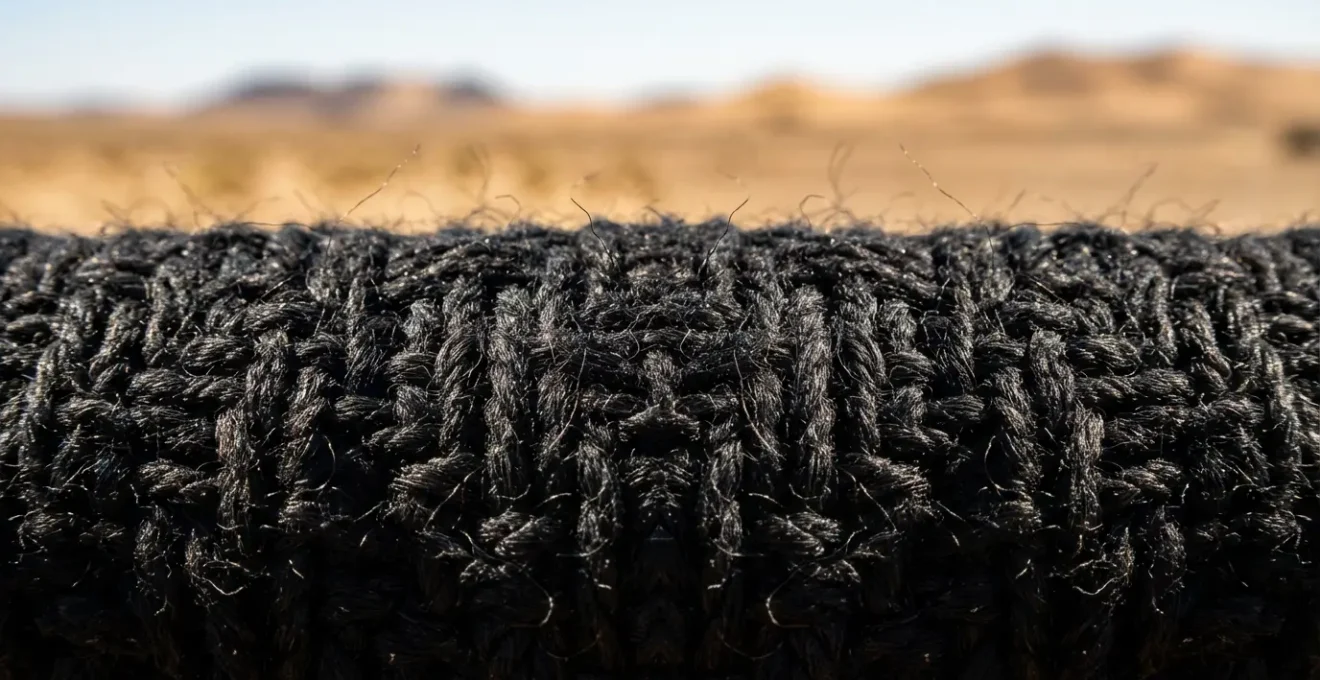
In contrast, a Westerner in shorts and a t-shirt exposes their skin directly to the sun and dry wind. This causes sweat to evaporate almost instantly, providing a momentary sensation of coolness but leading to rapid and dangerous dehydration. The clothing acts as an extension of the body’s own regulatory functions, a principle borne out by data on water consumption.
This comparative analysis highlights the profound efficiency of the traditional approach. By creating a personal “shade” and managing moisture, the Bedouin system prioritizes water retention above all else.
| Clothing Type | Daily Water Consumption | UV Protection | Moisture Retention |
|---|---|---|---|
| Traditional Bedouin (black wool layers) | 1 liter/day | High | Excellent |
| Modern Western (shorts & t-shirt) | 19 liters/day | Low | Poor |
The Clear Sky Warning Sign That Predicts a Deadly Flash Flood
One of the desert’s most terrifying paradoxes is the flash flood—a sudden, violent torrent of water that can fill a dry canyon in minutes, often under a perfectly clear, blue sky. For the unprepared, it is an unpredictable catastrophe. For the nomad, it is a predictable event whose signs can be read far in advance. This ability comes not from meteorological equipment, but from a heightened sensory awareness of the environment, a skill honed over generations of observation.
The clear sky flood is caused by a thunderstorm miles away, often hidden behind a mountain range. The rain from this distant storm funnels into the network of wadis (dry riverbeds) that crisscross the desert floor, gathering speed and power as it travels. While the storm itself may be invisible and inaudible, it sends subtle messengers ahead of it. A Bedouin guide will be attuned to these signals. They might notice a sudden shift in the smell of the air—the distinct scent of petrichor, or rain hitting dry earth, carried on the wind from a great distance. They may also feel a low-frequency rumble through the soles of their feet long before any sound is audible through the air.
Animal behavior provides another critical set of clues. Desert creatures are acutely sensitive to environmental changes. The sight of birds, insects, or mammals inexplicably fleeing to higher ground is an unambiguous warning sign that water is coming. These are not supernatural instincts, but an evolved response to the laws of physics and biology. By observing these patterns, the Bedouin reads the desert as an interconnected system. The most important rule, universally understood, is to never make camp in a wadi, no matter how sheltered or inviting it seems. It is the desert’s natural drainpipe, and a clear sky offers no guarantee of safety.
How to Adjust Your Circadian Rhythm to the “Desert Siesta” Schedule?
The modern world operates on a linear, nine-to-five schedule, a rhythm completely alien to the desert. The nomadic approach to time is cyclical, dictated by the sun’s oppressive power. The “desert siesta” is not a sign of laziness; it is a fundamental strategy of chronobiology adaptation. It is the deliberate act of aligning one’s own bodily rhythm with the rhythm of the environment to maximize energy and water conservation. The rule is simple: when the sun is at its most powerful, from late morning to late afternoon, all activity ceases.
This period of inactivity is critical to survival. To be active during peak heat is to wage a losing war against the sun, hemorrhaging water through sweat and expending precious energy. The Bedouin instead retreats to the shade of a tent or a rocky outcrop, entering a state of complete rest. This is more than a simple nap. It is a deep, physiological downshift. The heart rate slows, metabolism drops, and the body’s core temperature is allowed to stabilize. This allows for productive activity during the cooler hours of the early morning and late evening, effectively splitting the day into two more manageable “work” periods.
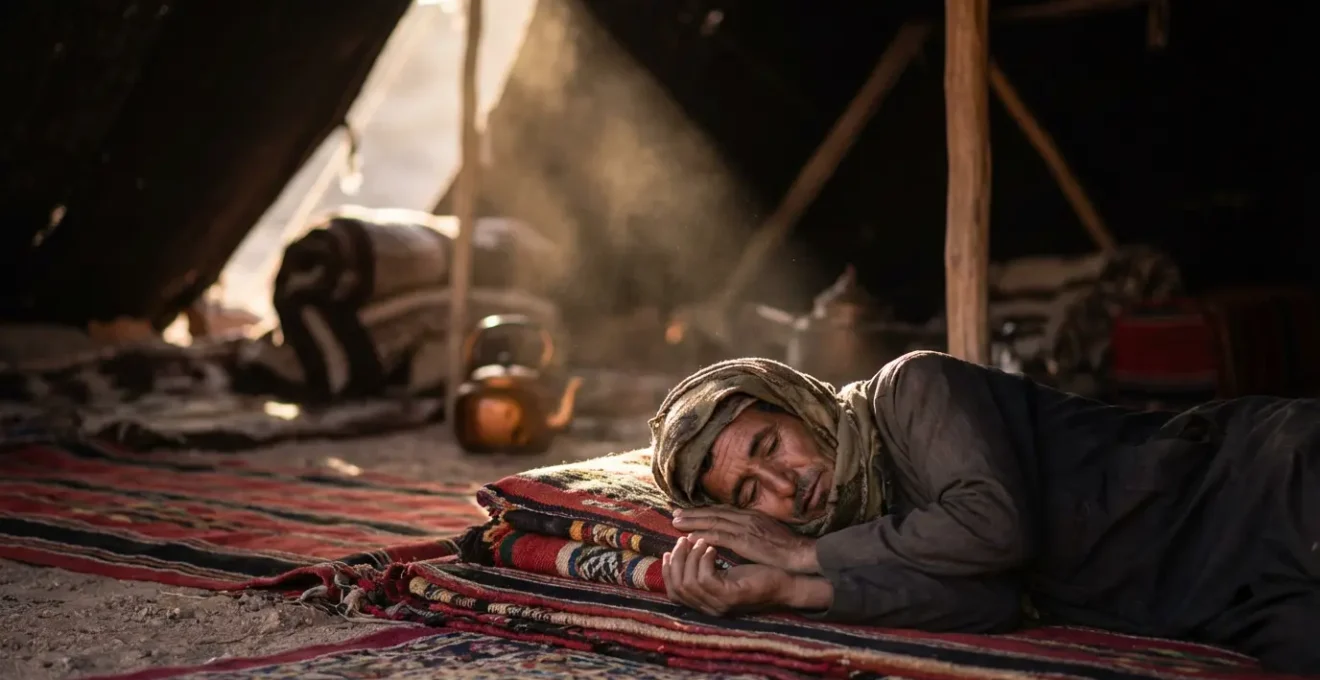
For the adventure traveler, accustomed to maximizing daylight hours, this can be a difficult adjustment. It requires a mental shift from “pushing through” to “harmonizing with.” The process begins by consciously forcing a halt to your day. Find the deepest shade possible, lie down, and focus on stillness. Breathe slowly through your nose to minimize moisture loss. Avoid eating a heavy meal, as digestion requires energy and water. Initially, it may feel like wasted time, but by the second or third day, your body’s circadian rhythm will begin to adjust. You will find you have more energy for the cooler parts of the day and feel a profound sense of being in sync with your surroundings.
How to Find an Independent Bedouin Guide Without Agency Markups?
For an authentic desert experience, the guide is everything. However, the commercialization of tourism often places a barrier of agencies and middlemen between the traveler and the true knowledge holders. Finding an independent Bedouin guide—one whose skills are rooted in nomadic heritage, not a tour operator’s script—is a process that requires patience and a different cultural approach. It is less a transaction and more the beginning of a relationship built on mutual respect.
The search should not begin in a glossy tourist office, but in the heart of the local community: a teahouse or a bustling market on the edge of the desert. This is where you can observe, listen, and begin to understand the local social dynamics. The goal is not to hire an employee, but to be accepted by a mentor. This process, which can take days, is a test of your character. A genuine Bedouin guide will be assessing your patience, your humility, and your intentions just as you are assessing their knowledge.
Engaging in this process requires a shift in communication. Instead of asking directly “Who is the best guide for hire?”, a more respectful and effective question is, “I wish to understand the desert. Who in this community do you trust to teach me?”. This frames your quest as one of learning, not consumption. The “tea test” is a vital part of this. You will likely be invited to share many glasses of sweet, hot tea. These are not just social niceties; they are interviews. They are opportunities to build the trust that is the currency of the desert. Rushing this process is the surest way to fail.
Action Plan: Finding Your Bedouin Guide
- Begin at the Source: Bypass tourist offices and start your search at local teahouses, cafes, and markets where community life unfolds.
- Ask for Trust, Not a Service: Frame your query around respect. Ask locals, “Who do you trust to show the desert’s true face?” rather than “Who is for hire?”.
- Embrace the ‘Tea Test’: Accept all invitations for tea. See these multiple, unhurried sessions as the primary method for building mutual trust and demonstrating your patience.
- Test for Knowledge, Not Language: Ask specific, knowledge-based questions (“Which plants here have medicinal use?”, “Where would we find water after a rain?”) to gauge deep expertise over English fluency.
- Observe and Wait: Understand that the right guide will choose you as much as you choose them. The selection process is a two-way street and cannot be rushed; it is an investment in your safety and experience.
How to Construct a Solar Still to Collect Condensation in Sand?
The ability to pull water from seemingly dry ground is a classic survival skill, and the solar still is its most well-known application. While modern innovations like the ‘waterpod’ device can purify brackish water through evaporation and condensation, the underlying principle is ancient. It is a technique of last resort, but one that demonstrates a deep understanding of how water behaves in the desert ecosystem. The key is realizing that even in arid sand, there is residual moisture that can be harvested.
Constructing a traditional solar still is a simple but labor-intensive process. You begin by digging a bowl-shaped pit in the sand, roughly one meter across and half a meter deep. The location is important; choose a spot that receives maximum sunlight and, if possible, in a place where moisture is more likely to be present, such as a dry stream bed. At the center of the pit, place a container—a cup, a bottle, or even a wide leaf—to collect the water.
Next, cover the pit with a sheet of clear plastic (a non-negotiable piece of modern kit for this method). The plastic should be sealed around the edges with sand or rocks to create an airtight dome. In the center of the plastic sheet, directly above your collection container, place a small stone. The weight of the stone will create an inverted cone shape, with its lowest point directly over the cup. As the sun heats the ground inside the pit, moisture from the sand evaporates. This water vapor rises, hits the cooler underside of the plastic sheet, and condenses into droplets. Due to the cone shape you created, these droplets will run down the plastic to the lowest point and drip into your container. It is a slow process, but over a day, it can yield a precious amount of life-sustaining water.
This same principle of condensation is used in simpler, more immediate ways. As survival experts studying Bedouin methods note, thirsty nomads sometimes dig up cool stones just before sunrise and collect the dew that settles on them. This direct observation of natural processes is the essence of desert resourcefulness.
Key Takeaways
- Internal vs. External: The core lesson is to shift focus from finding external resources to managing your body’s internal ones, primarily water and energy.
- Clothing as a System: Traditional wool garments are not a matter of style but a sophisticated technology for thermal regulation and moisture retention.
- Mindset over Gadgets: True navigation and environmental awareness come from developing your cognitive and sensory skills (cognitive cartography), not from relying on technology that can fail.
Arid Wilderness Survival: Critical Water Preservation Techniques for Stranded Hikers?
In a desert survival scenario, the clock is ticking mercilessly. The human body is a leaky vessel, and in extreme heat, that leak becomes a torrent. It’s a sobering fact that most people can only survive 24 hours without water in such conditions. Your priority, therefore, is not to immediately start a desperate search for a new source, but to radically slow down the rate at which you lose the water you already have. This is the ultimate expression of the nomadic mindset: focusing on preservation before acquisition.
The enemy is sweat. Every action, every moment of panic, every unnecessary breath through the mouth accelerates its loss. The first and most important step is to stop. Find shade immediately, even if it’s just the sliver cast by a small rock, and become completely still. Panic is a thirstier killer than the sun itself; it elevates your heart rate and body temperature, causing you to lose precious fluid. Calm observation is your most powerful tool. From this state of rest, you can begin to implement a strategy of metabolic economy.
This strategy is a series of small, deliberate actions that collectively have a massive impact on your water reserves. It is a disciplined approach to managing your internal environment, and it is far more critical than digging a well. The core tenets are:
- Prioritize Inactivity: Minimize all movement, especially during peak heat (10 a.m. to 4 p.m.). Think of yourself as a desert tortoise, not a frantic rabbit.
- Control Your Breathing: Consciously breathe through your nose. This simple act significantly reduces the amount of moisture lost with each exhalation.
- Fast from Food: Avoid eating. Digestion requires water, and consuming food will actively dehydrate you. Your body’s fat reserves can provide energy.
- Read the Land: Once you are calm and have conserved energy, you can begin to observe. Look for the signs of water the Bedouin use: flight patterns of birds, trails of animals, and patches of green vegetation, which indicate a higher water table.
This mindset transforms the survival equation. Instead of frantically expending energy to *find* water, you are calmly and intelligently *managing* the water within you. It is a profound lesson in control, patience, and humility, teaching the modern traveler that in the desert, stillness is the most powerful action.
By adopting these principles of metabolic economy and chronobiological adaptation, you can transform your relationship with extreme environments. The next step is to consciously apply this mindset of internal management on your next adventure, turning survival from a challenge of gear into a practice of awareness.