
Planning a family campervan trip in tropical Queensland means going beyond simple warnings about the wet season. The key to a safe and memorable adventure lies not in avoiding the tropics, but in understanding and mastering its unique rhythms. This guide provides a strategic framework for navigating everything from stinger season and flash floods to campsite booking and wildlife spotting, turning potential hazards into a well-managed part of your family’s journey.
The dream of a Queensland road trip often conjures images of sun-drenched beaches, vibrant coral reefs, and lush rainforests. For families planning the ultimate campervan adventure, especially around the Great Barrier Reef, this vision is absolutely achievable. However, many guides offer generic advice: “book ahead” or “watch out for stingers.” This often leaves families unprepared for the specific logistical and safety challenges of Australia’s tropical north, particularly between November and May.
The truth that locals know is that the “wet season” isn’t just about rain; it’s a fundamental shift in the environment’s rhythm. It dictates when you can swim, where you can drive, and what wildlife you’ll see. The common approach is to list these as dangers to be feared. But what if the real key to a successful family trip wasn’t just avoiding pitfalls, but strategically mastering these tropical patterns? Instead of simply being cautious, you can be smart, prepared, and confident.
This article moves beyond the standard warnings. We’ll provide a strategic guide to help you understand the ‘why’ behind the rules. You’ll learn how to secure the best campsites when they seem full, choose a travel route that keeps the kids engaged, interpret weather warnings like a local, and even contribute to reef conservation during your visit. It’s time to plan your Queensland adventure with the confidence of insider knowledge.
This guide breaks down the essential strategies for a safe and unforgettable family road trip. You’ll find practical advice organised into clear sections, helping you plan your journey from start to finish.
Summary: Your Strategic Guide to a Safe and Memorable Queensland Family Road Trip
- Why Swimming Without a Stinger Suit is Dangerous Between November and May?
- How to Secure National Park Campsites in Queensland During School Holidays?
- Bruce Highway vs Inland Way: Which Route Offers Better Scenery for Kids?
- The “If It’s Flooded, Forget It” Rule That Save Lives in North Queensland
- When to Visit the Daintree Rainforest to See Wildlife Without the Crowds?
- Why Your “Reef-Safe” Sunscreen Might Still Be Bleaching Corals?
- Why Visiting National Parks in Shoulder Season Reduces Environmental Stress?
- How Divers Can Contribute to Reef and Marine Conservation Without Scientific Degrees?
Why Swimming Without a Stinger Suit is Dangerous Between November and May?
The idea of a refreshing ocean swim on a hot tropical day is tempting, but in North Queensland, it comes with a critical safety rule during “stinger season.” From roughly November to May, the warm coastal waters become home to venomous jellyfish, including the tiny but incredibly dangerous Irukandji and the larger Box Jellyfish. This isn’t just a minor risk; it’s a serious hazard that requires a proactive risk mitigation mindset. Ignoring this can have severe consequences, as a staggering 83.4% of Irukandji stings in Australia occur in Queensland.
The danger of the Irukandji lies in its size—its bell is only 5-25mm wide—and its delayed symptoms. A sting might feel minor at first, but severe pain, nausea, and dangerously high blood pressure can develop up to 45 minutes later, a condition known as Irukandji syndrome. This requires immediate hospitalisation.
Case Study: The Palm Island Irukandji Surge
To understand the reality of this threat, consider the events on Palm Island. By December 2020, the community near Townsville had recorded 23 Irukandji stings, with seven victims requiring hospitalisation. These tiny jellyfish can cause fatal brain haemorrhages and are responsible for 50-100 hospital admissions across Australia each year. This highlights why local advice and safety protocols are not to be taken lightly.
So, how do you stay safe? The answer is simple: wear a full-body stinger suit (lycra suit) every time you enter the water. These suits provide a physical barrier against tentacles. All reputable Great Barrier Reef tour operators make these mandatory and provide them to all guests. If you’re swimming at a patrolled beach, always swim between the red and yellow flags and look for designated stinger-resistant enclosures. Even then, a suit is your best defence.
Should a sting occur, it’s vital to act quickly and correctly. Local lifesaving authorities provide clear first aid steps. The priority is to douse the area with vinegar for at least 30 seconds to neutralise the stinging cells, and immediately call for emergency medical help by dialling 000.
How to Secure National Park Campsites in Queensland During School Holidays?
One of the biggest logistical hurdles for families planning a Queensland road trip is securing campsites, especially in popular national parks during school holidays. Stories of coveted spots being booked out six months in advance are common, but giving up isn’t the only option. The key is to employ a strategic booking approach rather than just trying your luck. While Queensland Parks officially recommends booking 6 weeks in advance for popular spots, peak periods require a much more proactive plan.
The first step is to know when bookings open. For most Queensland national parks, the booking window opens six months prior to your intended stay. Set a calendar reminder for this date, as the most sought-after locations like Noah Beach in the Daintree or campsites on K’gari (Fraser Island) can be gone within minutes. Be ready on the Queensland National Parks Booking Service website the moment they become available.
If you miss out on the initial release, don’t despair. Many travellers book far in advance and their plans change. Monitor the booking website frequently, especially in the 30-60 days before your travel dates, as this is when cancellations often appear. Flexibility is your friend here. Consider breaking up your stay across several nearby campsites. Booking a few nights in one park and a few in another can be easier than securing a long block in a single, high-demand location.
For a more organised approach, consider these strategic techniques:
- Be Prepared: Have your account set up and be logged into the booking system before the release time.
- Modify, Don’t Cancel: If your plans shift slightly, you can often modify an existing booking (like changing dates or number of people) up to two days before arrival, provided space is available.
- Look Beyond the Famous Spots: While everyone wants the beachfront site, nearby state forests or regional council campgrounds can offer fantastic, less-crowded alternatives.
- Organised Groups: If travelling with another family, investigate whether an educational group account could be an option, as this sometimes opens up different availability.
Bruce Highway vs Inland Way: Which Route Offers Better Scenery for Kids?
When planning a road trip from Southern Queensland up to the Cairns and Great Barrier Reef region, families are faced with a major decision: stick to the coastal Bruce Highway or venture onto the Inland Way? There’s no single “best” route; the right choice depends entirely on your family’s priorities, particularly what keeps the kids engaged. The Bruce Highway is direct and coastal, while the Inland Way offers a journey through the heart of the Outback, providing vastly different experiences.
The Bruce Highway (A1) is the most common choice. It’s a fully sealed, 1,700km road that connects Brisbane to Cairns, hugging the coastline for much of the way. Its main advantage is access to famous coastal towns, beaches, and Australia’s “Big Things” like the Big Banana in Coffs Harbour (just south of the QLD border) and the Big Mango in Bowen. Mobile coverage is generally reliable, and you’re never far from services. However, it’s also a major freight route with heavy truck traffic, and the scenery can become monotonous for long stretches.
The Inland Way, a network of roads including the Carnarvon Highway and Gregory Developmental Road, offers a complete change of pace. This route takes you through classic Outback landscapes, historic towns, and unique attractions like the Australian Age of Dinosaurs trail in Winton. The traffic is significantly lighter, creating a more relaxed driving experience. The trade-offs are longer distances, some unsealed road sections (check conditions before you go), and large mobile phone blackspots where you’ll be completely off-grid.
This side-by-side comparison helps to clarify the choice for your family:
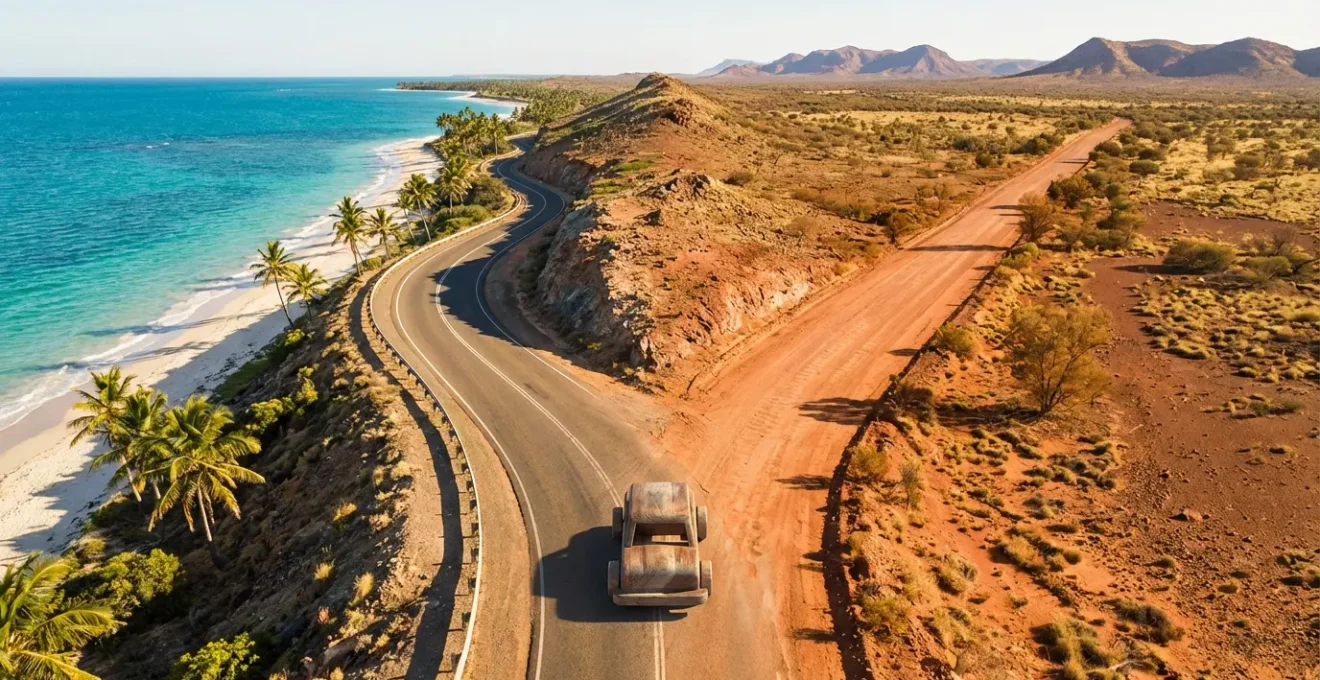
Ultimately, the decision comes down to what kind of adventure you’re after. Do you want the convenience and beach access of the coast, or the vast, educational, and rugged experience of the Outback? Many families find a hybrid approach works best: take one route on the way up and the other on the way back down to experience the best of both worlds.
The following table breaks down the key differences to help you decide which path best suits your family’s travel style.
| Aspect | Bruce Highway | Inland Way |
|---|---|---|
| Distance Brisbane-Cairns | 1,700km coastal | Longer but more varied |
| Kid-friendly stops | Big Things (Banana, Mango) | Dinosaur trails, outback towns |
| Road conditions | Fully sealed, heavy truck traffic | Mixed surfaces, less traffic |
| Mobile coverage | Better coverage overall | Multiple blackspots |
| Swimming options | Beach access, coastal towns | Fewer water stops |
The “If It’s Flooded, Forget It” Rule That Save Lives in North Queensland
In tropical Queensland, the phrase “If It’s Flooded, Forget It” is more than a catchy slogan; it’s a life-saving rule deeply ingrained in the local mindset. During the wet season, intense rainfall can cause creeks and rivers to rise with astonishing speed, turning a dry causeway into a raging torrent in minutes. For visiting families in a campervan, understanding and respecting this rule is non-negotiable. Driving into floodwaters is one of the leading causes of death during flood events, as it’s impossible to know the depth of the water or if the road underneath has been washed away.
A successful trip requires a risk mitigation mindset that starts before you even turn the key. This means being prepared for unexpected delays. It’s entirely possible to be cut off by a flooded road for 24-48 hours, so your campervan must be equipped for self-sufficiency. This goes beyond standard supplies and involves having a dedicated flood-proof kit ready to go.
Technology is your greatest ally in avoiding these situations. Before you lose signal in remote areas, download the official QLDTraffic app. Managed by the Department of Transport and Main Roads, this app provides real-time updates on road closures, flood warnings, and even live traffic camera feeds. It allows you to make informed decisions and change your route before you get stuck. Alongside this, save offline maps for your entire planned route using an app like Google Maps or Hema Maps, ensuring you can navigate even without a mobile connection. Constantly monitor the Bureau of Meteorology (BOM) website for the latest weather forecasts and warnings.
Your Flood-Proof Kit Checklist: Essential Items for a QLD Road Trip
- Emergency Water: Carry water purification tablets or a filter, enough for a 48-hour isolation scenario.
- Extra Food: Stock high-energy, non-perishable food that doesn’t require cooking, beyond your standard meal plans.
- Light & Power: Pack a powerful torch with extra batteries and ensure all power banks are fully charged for emergency communication.
- Stay Informed: Download the QLDTraffic app and save your route for push notifications before heading into areas with poor signal.
- Offline Navigation: Download offline maps of your entire route on multiple devices (e.g., Google Maps, Hema Maps).
When to Visit the Daintree Rainforest to See Wildlife Without the Crowds?
A visit to the Daintree Rainforest is a highlight of any Queensland trip, offering a chance to see incredible wildlife, including the majestic and prehistoric cassowary. However, navigating tour bus schedules and crowds can diminish the magic. To truly experience the rainforest’s natural rhythm and maximise your family’s chances of wildlife sightings, strategic timing is everything. The secret, as locals know, is to visit during the “golden hours” and explore the areas less travelled by day-trippers.
For the best wildlife viewing opportunities, plan your excursions for early morning and late afternoon. According to local tourism experts, the hours between 6-8 AM and 4-6 PM are when animals are most active. This is especially true for the elusive Southern Cassowary. A dawn drive through the rainforest, before the tourist traffic picks up, offers the most serene atmosphere and the highest probability of spotting one of these magnificent birds foraging along the roadside.
To escape the crowds, focus your exploration north of the Daintree River. Most large tour buses from Cairns and Port Douglas have a set circuit that often turns around at Cape Tribulation. By continuing north towards Emmagen Creek, you’ll enter a quieter, more authentic part of the rainforest. The roads may be more basic, but the reward is a more personal and immersive experience. For a truly special family memory, book a guided night walk. These small-group tours are led by experts who can help you spot nocturnal creatures like possums, bandicoots, and sleeping birds that you would otherwise miss.

Here are a few more strategies for a memorable Daintree visit:
- Target Fruiting Seasons: Cassowaries are drawn to certain areas when their favourite foods, like the bright blue Quandong fruit, are in season. Ask locals or at your accommodation about recent sightings.
- Explore Mossman Gorge: For a rich cultural experience, book a Dreamtime Walk at Mossman Gorge with an indigenous Kuku Yalanji guide who can share the deep connection between their people and the rainforest.
- Stay Locally: Staying overnight in a small guesthouse or campsite within the Daintree itself allows you to easily take advantage of the dawn and dusk golden hours.
Why Your “Reef-Safe” Sunscreen Might Still Be Bleaching Corals?
As a family visiting the Great Barrier Reef, you’re undoubtedly conscious of protecting this natural wonder. You’ve likely purchased “reef-safe” sunscreen, believing you’re making the right choice. However, the term “reef-safe” is largely unregulated, and many products carrying this label can still contain chemicals harmful to coral. Understanding what truly makes a sunscreen safe for the reef is a crucial part of responsible tourism.
The primary culprits are chemical UV filters. Scientific studies have shown that certain common ingredients can cause coral bleaching, damage coral DNA, and disrupt their reproductive cycles, even in very small concentrations. The most well-known harmful chemicals are often referred to as the “Big 4”: Oxybenzone, Octinoxate, Octocrylene, and 4-methylbenzylidene camphor (4-MBC). When you see a product labelled “reef-friendly,” the first thing you should do is turn it over and check the ingredient list. If any of these are present, the product is not truly reef-safe.
So, what’s the alternative? The safest options for marine life are mineral-based sunscreens. These use physical blockers, specifically zinc oxide or titanium dioxide, to create a barrier on top of the skin that reflects UV rays. However, there’s another layer of complexity: nanoparticles. To make these mineral sunscreens less white and chalky, some manufacturers use “nano-sized” particles. These tiny particles can be ingested by corals and cause internal damage. Therefore, the gold standard is a sunscreen that is labelled as “non-nano” zinc oxide or “non-nano” titanium dioxide.
To ensure you’re making the best choice, follow these steps:
- Read the Ingredients: Always check for the “Big 4” and avoid them completely.
- Look for “Non-Nano”: Choose mineral sunscreens and verify the label explicitly states “non-nano”.
- Choose Certified Brands: Look for Australian-certified brands that are transparent about their formulations.
- Cover Up: The most effective way to protect yourself and the reef is to reduce your reliance on sunscreen altogether. Wear UV-protective clothing like rash guards, hats, and sunglasses as your primary form of sun protection.
Key takeaways
- The “shoulder season” (April-May and September-October) offers the best balance of good weather and fewer crowds.
- Visiting during off-peak times directly reduces stress on fragile ecosystems and local infrastructure.
- A lower tourist density enhances the quality of your nature experience, allowing for more authentic wildlife encounters.
Why Visiting National Parks in Shoulder Season Reduces Environmental Stress?
Choosing when to visit Queensland’s national parks involves more than just avoiding crowds or chasing perfect weather. Your timing has a direct and measurable impact on the environment. While the peak season (June to August) and school holidays bring a surge of visitors, opting to travel during the “shoulder seasons”—specifically April-May and September-October—is one of the most effective ways to reduce your environmental footprint and practice responsible tourism.
High visitor numbers, concentrated in a short period, place immense pressure on park ecosystems. Walking trails become compacted, vegetation on the edges is eroded, and wildlife behaviour is disrupted during crucial feeding or mating periods. Remote infrastructure, such as toilets, water tanks, and waste management systems, can be overwhelmed. By visiting in the shoulder season, you help to distribute this impact over a longer period, giving the environment time to recover. As experienced outback travelers confirm, the period from April to September generally offers ideal conditions with comfortable mid-20°C temperatures, making the shoulder months particularly pleasant.
The benefits of this choice are twofold. Environmentally, you are actively contributing to the conservation of these precious places. This allows for:
- Soil De-compaction: Less foot traffic gives the soil on popular trails a chance to breathe and recover.
- Vegetation Regrowth: Fragile plants along track edges are less likely to be trampled.
- Reduced Wildlife Stress: Animals are less disturbed, leading to more natural behaviours and better chances for respectful observation.
- Support for Local Economies: Your visit provides a more consistent, year-round income for local businesses, rather than a short, intense boom.
For your family, the reward is a more authentic and enjoyable experience. With fewer people around, the sense of peace and connection to nature is profoundly deeper. You’re more likely to have that waterfall, lookout, or walking trail all to yourselves. It’s an opportunity to teach your children about the importance of sustainable travel by making a conscious choice that benefits both your family and the places you’ve come to admire.
How Divers Can Contribute to Reef and Marine Conservation Without Scientific Degrees?
Exploring the Great Barrier Reef is a life-changing experience, but it also comes with a sense of responsibility. Many divers and snorkelers feel a deep desire to help protect this fragile ecosystem but assume that conservation is a job best left to marine biologists. The good news is that you don’t need a scientific degree to make a meaningful contribution. Through citizen science programs, every visitor to the reef can become a valuable part of the monitoring and protection effort.
One of the most accessible and impactful programs is Coral Watch, developed by the University of Queensland. It’s a simple, user-friendly tool that allows anyone to monitor coral health. The process involves using a specially designed Coral Health Chart, which features a series of colours from dark to light. During a dive or snorkel, you simply compare the colour of a coral to the chart and record the corresponding code. This data, along with photos, can be uploaded to a global database via the Coral Watch app. Your observations help scientists track coral bleaching events across the vast expanse of the reef, providing critical information on a scale they could never achieve alone.
Beyond monitoring coral health, you can also contribute by reporting sightings of specific species. The “Eye on the Reef” app, managed by the Great Barrier Reef Marine Park Authority, allows you to report sightings of Crown-of-Thorns Starfish, a native but destructive coral predator. Rapid reporting helps management teams to target and control outbreaks before they cause widespread damage. You can also report on other marine life, providing valuable data on species distribution.
Here’s how you can get involved:
- Download the Apps: Before your trip, download the Coral Watch and Eye on the Reef apps to your phone.
- Choose Certified Operators: When booking a tour, look for operators who employ Master Reef Guides. These guides are specially trained to provide up-to-date information and can help you participate in citizen science activities.
- Practice Perfect Buoyancy: One of the most direct contributions is to ensure you never touch the coral. Maintain good buoyancy control to avoid accidental breakage.
- Share Your Story: After your trip, share your photos and conservation stories on social media. Spreading awareness is a powerful way to inspire others to become stewards of the reef.
By participating in these simple activities, you transform your holiday from a passive viewing experience into an active contribution to the future of the Great Barrier Reef.
Start planning your family’s adventure today by choosing a tour operator with Master Reef Guide certification and downloading the citizen science apps. Your family’s holiday can be an unforgettable journey and a meaningful contribution to the future of our oceans.