
Contrary to popular belief, achieving financial sovereignty is not about owning alternative assets—it’s about architecting a system that makes them liquid and seizure-proof during a crisis.
- The modern banking system operates on a zero-reserve basis, meaning your cash is an illusion backed only by fragile confidence.
- Physical gold offers true crisis liquidity, while self-sovereign crypto enables a circular economy outside of bank control.
Recommendation: The first step is not to buy, but to build a legal and operational framework, starting with understanding when and how to use tools like asset protection trusts to insulate your wealth *before* a threat emerges.
The promise of traditional banking is one of safety and stability. You deposit your money, and it remains yours, accessible whenever you need it. This is the foundational trust upon which the entire system is built. But for those who question the narrative, a disquieting reality emerges: your money in the bank isn’t truly yours. It’s an entry in a ledger, a liability on the bank’s balance sheet, and its availability is contingent on a level of systemic stability that is far from guaranteed.
Many turn to the standard advice: diversify into gold, buy some cryptocurrency. While a step in the right direction, this approach is dangerously incomplete. It focuses on the “what” but completely ignores the “how.” Owning these assets is meaningless if they can be frozen, seized, or rendered illiquid precisely when you need them most. True financial sovereignty isn’t about escaping the system; it’s about building a parallel one that is resilient by design.
This is not a theoretical exercise. It is a rebellion against a fragile and coercive financial order, grounded in legal strategy and operational security. The core principle is simple: you cannot control what you do not possess. This guide moves beyond the platitudes to provide a strategic framework for reclaiming that control. We will dismantle the illusion of bank safety, explore the mechanics of true crisis liquidity, and detail the legal structures that place your assets beyond the reach of failing institutions and overreaching governments.
This article provides a detailed roadmap for constructing your own sovereign financial system. Below is a summary of the key pillars we will explore, from the fundamental flaws of the banking system to the advanced strategies for securing your decentralized assets.
Summary: A Strategic Framework for Financial Independence
- Why Your Bank Does Not Actually Have Your Cash on Hand During a Run?
- Gold Coins or Bullion Vaults: Which Offers Better Liquidity in Crisis?
- How to Live off USDC Without Off-Ramping to a Bank Account?
- The Data Trail Your Credit Card Leaves vs Cash and Privacy Coins
- When to Move Assets into a Trust to Prevent Seizure?
- Why Hot Wallets Are Unsafe for Holdings Exceeding $1,000?
- How to Maintain a Tier-1 Bank Account Without a Utility Bill in Your Name?
- How to Secure Decentralized Crypto Assets Against Smart Contract Vulnerabilities?
Why Your Bank Does Not Actually Have Your Cash on Hand During a Run?
The concept of a bank run feels like a black-and-white photo from the Great Depression, a historical artifact irrelevant to our modern, insured financial system. This is a dangerous illusion. The system’s fragility has not been fixed; it has been codified and amplified. The core vulnerability lies in fractional reserve banking, the practice where banks hold only a fraction of deposits and lend out the rest. For decades, this fraction was around 10%. However, the situation is now far more precarious.
Since March 2020, the game has changed entirely. The Federal Reserve quietly reduced the reserve requirement for all depository institutions to zero. Analysis from Federal Reserve data shows that the 0% reserve requirement is still in effect. This means your bank is not legally required to hold *any* of your cash in reserve. When you deposit $2,000, the bank can lend out the entire $2,000. Yet, your account balance still shows a $2,000 credit, creating money from thin air. The system is no longer fractional reserve; it’s a zero-reserve confidence game.
This framework guarantees collapse during a widespread loss of confidence. Unlike the 1929 bank runs, where banks at least held a small fraction, today’s institutions hold nothing. FDIC insurance is often cited as the ultimate backstop, but it is a psychological tool, not a financial one. It is funded to cover a tiny percentage of total deposits and would be instantly overwhelmed in a systemic crisis, leading to bail-ins, capital controls, and account freezes. Your “safe” bank account is, by design, the first place your assets will be trapped.
Understanding this foundational risk is the first and most critical step toward financial sovereignty. It is not paranoia; it is a rational response to the documented mechanics of the system. The question is not if this system will face another crisis, but what you have done to insulate yourself when it does.
Gold Coins or Bullion Vaults: Which Offers Better Liquidity in Crisis?
For those seeking refuge from the fiat system, gold is the timeless answer. But owning gold is not a monolithic strategy. The form in which you hold it determines its utility in a crisis. The debate between holding physical gold coins yourself versus storing bullion in a third-party vault is not about preference; it’s about crisis liquidity and counterparty risk. A vault offers convenience and security from physical theft, but it reintroduces the very problem you are trying to solve: reliance on a third party.
The image below highlights the fundamental choice: direct, physical possession versus a certificate of ownership. One is a bearer asset you control absolutely; the other is a promise that is only as good as the institution behind it and the legal system that governs it.
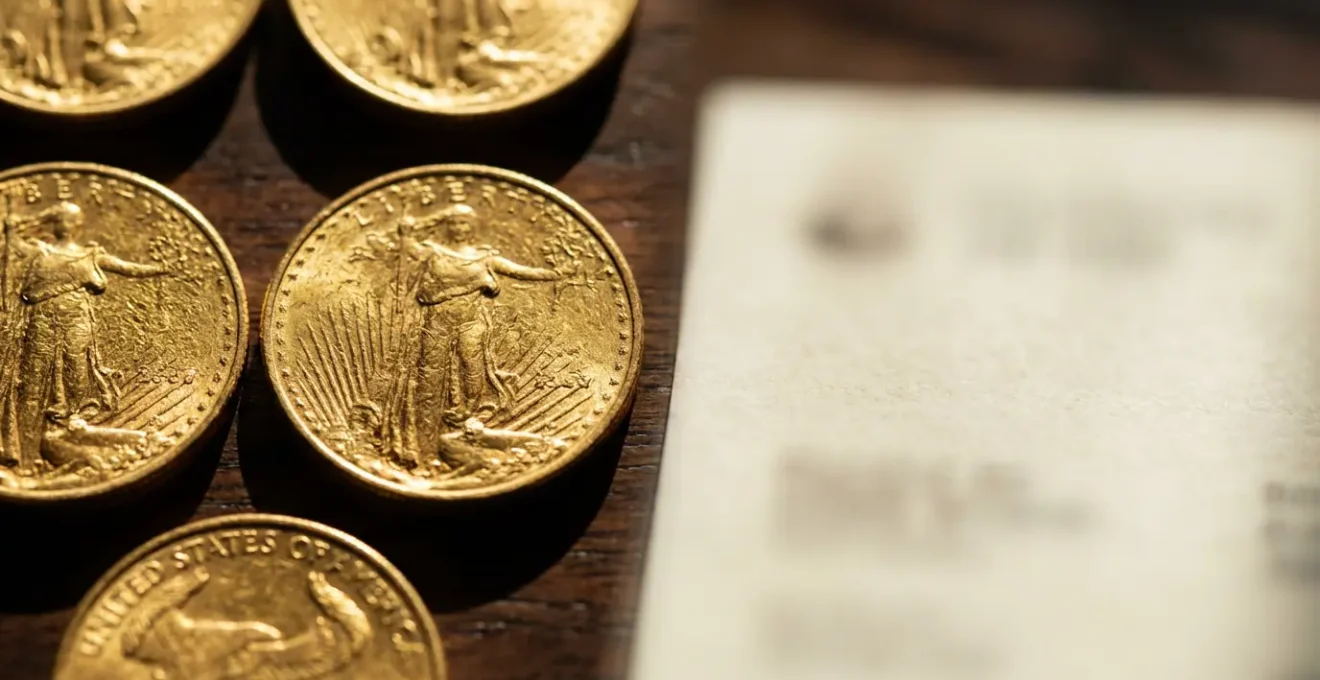
In a true systemic crisis—think bank holidays, capital controls, or political instability—a vault storage certificate becomes just another piece of paper. Access could be denied, liquidation processes frozen, or the assets themselves nationalized. Physical gold coins in your possession, however, retain their function as a medium of exchange and store of value, completely independent of any financial system. Their value is intrinsic and their liquidity is determined by your ability to transact directly with another person.
The following table, based on a recent market analysis, breaks down the critical differences. It clarifies that while vaults seem secure in peacetime, they represent a significant point of failure during a sovereign debt or currency crisis.
| Aspect | Gold Coins | Bullion Vaults |
|---|---|---|
| Liquidity in Crisis | Immediate local barter potential | Complex liquidation process during banking holidays |
| Physical Control | Direct possession | Dependent on vault provider access |
| Counterparty Risk | None when self-stored | Provider insolvency, nationalization risk |
| Crisis Premium | Bid-ask spreads can explode during panic | May face restricted access or delays |
| Divisibility | Small denominations for transactions | Requires formal liquidation process |
The choice is clear. For an asset to serve as a true hedge against systemic collapse, it must be free from all counterparty risk. Bullion vaults are a component of a wealth preservation strategy, but for crisis liquidity, nothing replaces the sovereignty of physical gold in your direct control.
How to Live off USDC Without Off-Ramping to a Bank Account?
Achieving sovereignty requires not just holding alternative assets, but being able to use them for daily life without returning to the traditional banking system. This is where stablecoins like USDC come into play, creating a parallel financial rails. The goal is to build a circular crypto economy where you can earn, spend, and generate yield entirely on-chain, making bank off-ramps an option, not a necessity.
This isn’t a futuristic fantasy; it’s a present-day reality. For example, rather than selling USDC for dollars to pay for groceries, you can use a service like Bitrefill to convert it directly into gift cards for major retailers, from Amazon to your local supermarket. For larger expenses or paying contractors, peer-to-peer (P2P) transfers in USDC bypass the banking system entirely. This strategy is about severing dependencies one by one.
Furthermore, your stablecoins should not be idle. The decentralized finance (DeFi) ecosystem offers powerful tools for generating yield. Instead of letting your principal sit, you can deposit it into battle-tested lending protocols. For instance, the Aave platform currently offers a 3.54% APR on USDC deposits. This isn’t a speculative return; it’s yield generated from overcollateralized lending, a core function of a new financial system. Major players are already deep in this space; a prime example is a large fintech cap firm which has become one of Aave’s largest depositors, supplying over $360M in USDC to generate yield on its idle reserves, proving the institutional viability of this strategy. This transforms your holdings from a static store of value into a productive asset.
Here are practical ways to build your own bankless financial life:
- Spend on Essentials: Convert USDC to gift cards for groceries, gas, and online shopping via platforms like Bitrefill.
- Use Crypto Debit Cards: Utilize cards that allow you to spend your crypto directly at the point-of-sale without first converting to fiat in a bank account.
- Pay and Get Paid: Use P2P platforms to pay freelancers, contractors, or business partners directly in USDC, avoiding bank transfer fees and delays.
- Generate Passive Income: Deposit assets into established DeFi lending protocols like Aave or Compound to earn yield on your principal, effectively creating your own high-yield savings account.
The Data Trail Your Credit Card Leaves vs Cash and Privacy Coins
Financial sovereignty is incomplete without financial privacy. Every time you swipe a credit or debit card, you leave an indelible data trail that paints a detailed picture of your life. This isn’t just about the amount spent; it’s about the Merchant Category Code (MCC), the transaction time, and the location. This data reveals your consumption patterns, your political affiliations, your health concerns, and even your daily movements. This information is collected, analyzed, and often sold by banks and data brokers, creating a permanent record you do not control.
The contrast between the different modes of payment, as visualized below, is stark. On one end is the surveillance-by-default model of the banking system. On the other end is the true privacy of physical cash and the pseudonymous or anonymous nature of certain cryptocurrencies.

Physical cash is the gold standard of privacy. It is a bearer instrument with no history and no identity attached. However, it is impractical for a digital world. This is where cryptocurrencies offer a spectrum of privacy. Most mainstream cryptocurrencies like Bitcoin and Ethereum operate on a public, transparent ledger. While your real-world identity is not directly attached to your wallet address, all transactions are publicly viewable, and sophisticated chain analysis can often de-anonymize users.
For true digital privacy, one must look to privacy-enhancing technologies. This includes privacy coins specifically designed to obscure transaction details (sender, receiver, amount) and mixing services that break the link between your on-chain activities. Using these tools is a conscious act of reclaiming the privacy that was once the default. It’s about choosing which transactions require the anonymity of cash and which can tolerate the pseudonymity of a standard blockchain, while actively minimizing your reliance on the surveillance-native credit card system.
When to Move Assets into a Trust to Prevent Seizure?
Owning sovereign assets like physical gold and self-custodied crypto is the first half of the equation. The second, and arguably more critical, half is ensuring they are legally insulated from seizure, whether from a predatory lawsuit, a creditor, or a desperate government. The most powerful tool for this is an Asset Protection Trust (APT). However, a trust is not a magical shield you can raise at the last minute. Its effectiveness hinges almost entirely on one factor: timing.
The cardinal rule of asset protection is that you must act *before* a threat materializes. Moving assets into a trust after you’ve been sued or when a liability is known or foreseeable can be deemed a “fraudulent conveyance” by a court. This can invalidate the transfer, rendering the entire structure useless. The time to build the fortress is during peacetime, not while the enemy is at the gates. This requires foresight and proactive legal structuring.
Choosing the right jurisdiction is also critical. Domestic APTs offer some protection, but for the highest level of security, many look to offshore jurisdictions like the Cook Islands or Nevis. These locations have laws specifically designed to be hostile to foreign judgments, creating immense legal and financial barriers for anyone attempting to seize the trust’s assets. For a creditor, the cost and complexity of fighting a case in a Cook Islands court can make the pursuit of assets prohibitively expensive. The following checklist outlines the key strategic considerations for using a trust to secure your sovereign wealth.
Action Plan: Structuring Your Asset Protection Trust
- Timing is Everything: Move assets into the trust BEFORE any threat or liability is known or foreseeable to avoid fraudulent conveyance claims.
- Jurisdictional Analysis: Compare the protections of domestic asset protection trusts against robust offshore jurisdictions like the Cook Islands or Nevis.
- Proper Titling: Ensure all assets, including self-custodied crypto, are correctly titled and legally held by the trust entity.
- Control Structure: For crypto assets, implement multi-signature wallets with the trustee and trusted family members as keyholders to decentralize control and prevent a single point of failure.
- Create Barriers: Structure the trust to leverage jurisdictional advantages that make seizure attempts legally complex and financially unviable for potential creditors.
A properly constructed and funded APT transforms your assets from personal property into property of the trust, placing them legally beyond the reach of future, unforeseen claims. It is the ultimate legal layer in a true financial sovereignty strategy.
Why Hot Wallets Are Unsafe for Holdings Exceeding $1,000?
In the world of self-custody, the distinction between a “hot” wallet (online, connected to the internet) and a “cold” wallet (offline, typically a hardware device) is fundamental to security. While the $1,000 figure is a common rule of thumb, it’s not a magic number. The real principle is a matter of personal risk tolerance and operational security. A hot wallet should be treated like the cash in your physical wallet: it’s for daily spending, not for storing your life savings.
The inherent vulnerability of a hot wallet is its constant connection to the internet. This exposes it to a vast attack surface, including malware, phishing attacks, and software vulnerabilities on your computer or smartphone. No matter how secure the wallet software claims to be, it is only as secure as the device it runs on. A single piece of sophisticated malware can compromise your private keys and drain your funds in seconds. For this reason, keeping any significant amount of capital in a hot wallet is an unnecessary and avoidable risk.
The correct approach is to determine your personal “Sleep-at-Night” number. This is the amount of money you could afford to lose without it causing you significant financial or emotional distress. For some, that might be $500; for others, it might be $2,000. Any amount exceeding this number has no business being in a hot wallet. The vast majority of your crypto assets should be secured in a cold storage hardware wallet, a device that keeps your private keys completely offline, even when you are signing a transaction.
This framework provides a clear mental model for managing your crypto funds:
- Define Your Limit: Calculate your “Sleep-at-Night” number based on your portfolio size and personal risk tolerance. This is your absolute hot wallet maximum.
- Think ‘Spending,’ Not ‘Storing’: Treat your hot wallet as a daily spending account or a digital pocketbook, not a savings account.
- Prioritize Cold Storage: The bulk of your holdings—the capital you cannot afford to lose—must reside in a hardware wallet (cold storage).
- Assess Device Security: The security of your hot wallet is directly tied to the security of your phone or computer. If your device hygiene is poor, your hot wallet limit should be even lower.
How to Maintain a Tier-1 Bank Account Without a Utility Bill in Your Name?
While the ultimate goal is a circular, sovereign financial system, the reality is that on-ramps and off-ramps to the traditional world are still periodically necessary. Maintaining a Tier-1 bank account is a strategic tool, but doing so without compromising your privacy or creating a domicile in an undesirable jurisdiction can be challenging, especially when faced with stringent Know Your Customer (KYC) requirements like providing a utility bill in your name.
For libertarians, digital nomads, and privacy advocates, being tied to a physical utility bill is a significant constraint. Fortunately, there are several legally sound strategies to satisfy proof-of-address requirements without a traditional lease or utility service. The key is to understand that banks are looking for a verifiable address, but the method of verification can be flexible if you know which tools to use.
One of the most effective methods is to use a digital mailbox service that provides a real street address, not a P.O. Box. These services can receive your mail, scan it, and forward it, satisfying the bank’s need for a physical address while giving you geographic flexibility. For those operating through a business entity, using a registered agent’s address can also be a viable solution for opening a business bank account. These strategies are about legally navigating the rules of a system you aim to transcend.
Here are several alternative solutions to establish a proof of address:
- Digital Mailbox Service: Sign up for a service like Earth Class Mail or Traveling Mailbox that provides a real, physical street address that can be used for banking purposes.
- Registered Agent Address: If you have an LLC or corporation, use the address of your registered agent to open a business bank account.
- Notarized Affidavit of Residence: If you live with someone else, you can often provide a notarized letter from the landlord or property owner confirming your residence, sometimes along with their utility bill.
- International Neobanks: Leverage accounts with banks like Wise, Revolut, or N26, which often have more flexible and digitally-native verification processes designed for international customers.
The strategy is to use this account minimally—only as a necessary bridge to the fiat world—while keeping a low balance to minimize risk from bail-ins or freezes.
Key Takeaways
- The modern banking system’s 0% reserve requirement makes it inherently fragile and reliant on confidence alone.
- True crisis liquidity comes from direct physical possession of assets like gold coins, which eliminates all counterparty risk.
- Financial sovereignty requires building a circular crypto economy to spend, earn, and generate yield without relying on bank off-ramps.
How to Secure Decentralized Crypto Assets Against Smart Contract Vulnerabilities?
Once you’ve moved your assets into the decentralized world, a new set of risks emerges: smart contract vulnerabilities. A bug in a protocol’s code can be exploited to drain billions of dollars in assets. Therefore, securing your crypto is not just about using a hardware wallet; it’s about conducting rigorous due diligence on the platforms where you deploy your capital. This is the final frontier of personal operational security.
The first line of defense is a principle known as the “Lindy Effect”: the longer a protocol has operated without a major hack, the more likely it is to continue operating securely. New, unaudited protocols promising astronomical yields are often the riskiest. Instead, prioritize established, battle-tested platforms like Aave or Uniswap that have managed billions in assets for years. The institutional adoption of these platforms is a strong signal of their robustness; for example, Aave’s institutional adoption shows its TVL (Total Value Locked) surged from $8 billion to over $40 billion at its peak, a testament to the trust placed in its security model.
However, no protocol is completely immune. A multi-layered defense is essential. This includes purchasing on-chain insurance from protocols like Nexus Mutual, which allows you to pay a small premium to cover your deposits against smart contract failure. Furthermore, you should never concentrate all your assets in a single protocol or on a single blockchain. Diversifying across 2-3 vetted protocols on different chains mitigates the risk of a single point of failure wiping out your portfolio.
A sophisticated risk mitigation strategy involves continuous monitoring and proactive defense:
- Apply the Lindy Effect: Prioritize protocols that have been operating for multiple years without significant hacks. Time in the market is a powerful audit.
- Verify Security Audits: Only use protocols that have undergone multiple security audits from reputable firms and have an active bug bounty program to incentivize white-hat hackers.
- Purchase On-Chain Insurance: Use platforms like Nexus Mutual to buy smart contract cover for your specific deposits in DeFi protocols.
- Diversify Everything: Spread your assets across 2-3 different vetted protocols on different blockchains (e.g., Ethereum, Solana, Avalanche) to avoid systemic risk.
- Monitor Protocol Health: Keep an eye on key metrics like Total Value Locked (TVL) and collateralization ratios. A sudden, drastic drop in TVL can be a red flag.
You now have the strategic blueprint. Achieving financial sovereignty is an active, ongoing process of building a resilient, multi-layered system. It requires vigilance, education, and a willingness to take personal responsibility for your wealth. The first step is to move from passive concern to active preparation. Begin by evaluating your current exposure to the traditional banking system and take one concrete action from this guide to reduce it today.