The common advice to ration water in the desert is a fatal mistake; survival depends on preserving your body’s function, not the water in your canteen.
- Mild dehydration begins to impair critical thinking and motor skills long before you feel severely thirsty, compromising your ability to make life-saving decisions.
- Every physical action has a “sweat cost.” The core of desert survival is a ruthless audit of energy expenditure versus potential water gain.
Recommendation: Drink when you are thirsty to maintain your cognitive baseline. Focus all energy on minimizing water loss by ceasing all movement and finding shade during peak heat hours (10 AM – 5 PM).
The sun beats down, the landscape is a monotonous canvas of rock and sand, and your water bottle feels unnervingly light. For any hiker stranded in an arid wilderness, this scenario is the dawn of a terrifying calculus. The conventional wisdom passed down through campfire stories and outdated manuals screams a single, simple rule: ration your water. Make it last. This advice, however, is one of the most dangerous myths in survival lore. It is a logic that prioritizes the liquid in the container over the life-sustaining fluid that constitutes 60% of your body.
The fundamental error in this thinking is the failure to recognize your most important survival tool: your brain. Your ability to think clearly, assess your situation, recall your training, and make sound decisions is the only thing that will get you out alive. That ability is directly dependent on your hydration level. The moment you begin to ration water against your body’s thirst signals, you begin to systematically degrade your own cognitive function. You are, in effect, sacrificing your queen to save a pawn.
This guide dismantles that deadly paradigm. As a SERE (Survival, Evasion, Resistance, and Escape) instructor, my objective is to re-wire your thinking from one of resource scarcity to one of metabolic efficiency. We will not focus on how to make your water last longer; we will focus on how to make *you* last longer. This involves a ruthless “water audit” of every action, understanding the true indicators of water in the environment, and mastering the art of heat management. Your body is the primary vessel you must keep full; the canteen is just its refueling tank.
This article provides a structured approach to desert water preservation, moving from immediate physiological needs to the practical skills of water acquisition, energy conservation, and signaling. Each section is a critical component of a holistic survival system designed to keep you functional, thinking, and alive until rescue arrives.
Summary: A SERE Instructor’s Guide to Arid Wilderness Water Survival
- Why You Should Drink Your Water Instead of Rationing It When Thirsty?
- How to Construct a Solar Still to Collect Condensation in Sand?
- Palm vs Acacia: Which Desert Tree Indicates Shallow Groundwater?
- The Mistake of Hiking During the Hottest Hours to “Get Out Faster”
- How to Create a Ground-to-Air Signal Visible from 5000 Feet?
- Why Bedouin Nomads Never Wash Dishes with Water in the Deep Desert?
- The Mild Headache That Can Escalate to HACE Within 12 Hours
- Managing Intense Acclimatization Symptoms During Rapid Ascents Without Medication?
Why You Should Drink Your Water Instead of Rationing It When Thirsty?
The order to “drink when thirsty” is not a suggestion; it’s a critical command for maintaining your operational capability. Thirst is a lagging indicator. By the time you feel it, your body is already entering a state of dehydration. The most immediate and dangerous consequence is not physical fatigue but cognitive decline. Survival is a mental game, and you cannot afford to play with a compromised intellect. Your ability to navigate, signal, and improvise solutions degrades rapidly with water loss.
To understand the severity, consider the clinical data. A landmark study confirmed that being dehydrated by just 2% impairs performance in tasks requiring attention, psychomotor skills, and immediate memory. In a survival situation, a 2% deficit is the difference between remembering to use a signal mirror and wandering aimlessly into the heat. Your physiological reserve of water is what fuels your brain. Protecting it is your primary mission.
Thinking of water in your canteen as a “backup” is a fatal error. That water has one purpose: to keep your internal systems, especially your brain, fully functional. You must store water in your body, not in your bottle. This means implementing a proactive hydration schedule. Take small, regular sips of water throughout the day, even before you feel intense thirst. A clear indicator of your status is urine color; if it’s dark yellow, you are already behind schedule and must hydrate immediately. Your brain is your weapon. Keep it sharp.
How to Construct a Solar Still to Collect Condensation in Sand?
A solar still is a classic survival technique, but its portrayal as a magic bullet is dangerously misleading. It is a tool of last resort, and its effectiveness is entirely dependent on a brutal cost-benefit analysis of your metabolic cost. The energy you expend digging the pit, in the form of sweat, can easily exceed the water you will collect. You must approach this task with surgical precision and realistic expectations.
To construct a basic still, dig a bowl-shaped pit about three feet across and two feet deep. Place a collection container at the center. Cover the pit with a sheet of clear plastic, anchoring the edges with rocks and placing a small weight in the center of the plastic, directly over your container. The sun heats the ground, causing moisture to evaporate, condense on the underside of the plastic, and drip into your container. The U.S. Air Force, in extensive tests, found that a well-made still can work. A 6×6 foot plastic sheet yielded about one quart (0.95 liters) per day. However, they also confirmed the enormous energy cost. The lesson is clear: do not attempt to build a still during the heat of the day. The water lost to sweat will be far greater than any potential gain.
The transpiration bag is a far more energy-efficient alternative if leafy, non-poisonous plants are available. This method involves simply tying a clear plastic bag tightly around a leafy branch. The plant breathes, and the bag collects the transpired moisture. While the yield is often lower than a solar still, the energy expenditure is virtually zero.
| Method | Water Yield (24h) | Energy Required | Materials Needed | Best Conditions |
|---|---|---|---|---|
| Solar Still | 0.5-1 liter | High (digging) | Plastic sheet, container, rocks | Moist soil, vegetation available |
| Transpiration Bag | 0.3-0.5 liter | Very Low | Clear plastic bag, cord | Leafy non-toxic vegetation |
| Combined Method | 0.8-1.5 liters | Moderate | Both materials | Mixed terrain with plants |
Palm vs Acacia: Which Desert Tree Indicates Shallow Groundwater?
The ability to read the landscape for signs of water is a critical skill, but it is fraught with “false positives” that can lead to fatal energy expenditure. The question of Palm versus Acacia is a perfect example. The answer is unequivocal: palm trees, as phreatophytes, are direct indicators of shallow groundwater. Their entire existence depends on having roots that can tap into a permanent water source. An Acacia, by contrast, is a xerophyte, brilliantly adapted to survive in arid conditions with deep taproots and minimal water. Hiking towards a lone Acacia in search of water is a fool’s errand.
However, your search should not be for a single tree, but for a “convergence zone” of life. Look for clusters of water-indicating plants, not isolated specimens. In North American deserts, these include:
- Cottonwoods
- Willows
- Sycamores
These species, like palms, require significant water and their presence in a group, especially in the outer bend of a dry riverbed or wash, signals a high probability of water within a few feet of the surface. Look for the greenest, most vibrant cluster of vegetation and focus your digging efforts there.
But before you take a single step, you must perform the energy calculation. As desert survival instructor Tony Nester emphasizes, hiking to a suspected water source costs precious sweat. In the Sonoran Desert, his field courses demonstrate that finding water in rock depressions (tinajas) after a rain is often a more reliable and energy-efficient strategy than digging. Always weigh the certainty of water loss from hiking against the possibility of water gain at your destination. If you see a lush green patch a mile away, first ask yourself: “Can I afford the sweat equity to get there?”
The Mistake of Hiking During the Hottest Hours to “Get Out Faster”
Panic is a potent enemy in a survival situation. It fuels the irrational desire to “get out faster” by pushing onward, no matter the conditions. In the desert, this is a death sentence. The single most effective water preservation technique is not a piece of gear, but a simple action: cease all movement during peak heat. Your body’s primary cooling mechanism is sweating. When you exert yourself under the midday sun, your rate of water loss becomes catastrophic.
To put this in perspective, consider that a person can lose up to a quart of water per hour simply sitting in the shade on a hot day. Add strenuous activity like hiking, and that number skyrockets. The pavement on an Arizona highway can reach 160°F, and in those conditions, a stranded motorist can burn through a gallon of water per hour just trying to change a tire. The sun is an engine of dehydration, and your only defense is to deny it fuel. You must operate on the sun’s schedule, not your own.
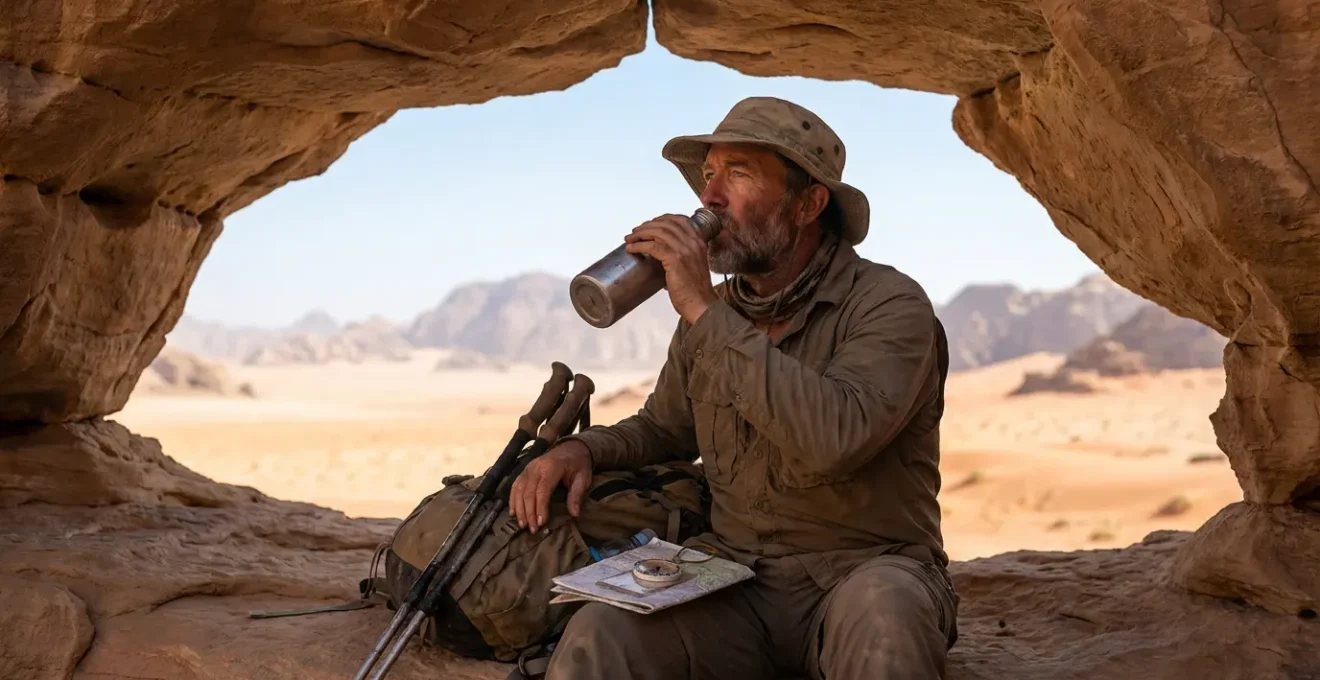
The protocol is non-negotiable. Restrict all movement between 10 AM and 5 PM. Find shade—an overhang, the shadow of a large boulder, or even a shelter you construct. Elevate yourself off the ground if possible; the ground surface can be up to 30°F hotter than the air just a foot or two above it. Keep your clothing on. Exposed skin accelerates moisture loss. Use this forced downtime for planning, gear maintenance, and mental rest. Your journey is made in the cooler hours of the early morning and late evening. The midday is for survival.
How to Create a Ground-to-Air Signal Visible from 5000 Feet?
Once you have stabilized your immediate situation—found shade and managed your hydration—your next priority is facilitating your rescue. You must make yourself visible from the air. Search and Rescue (SAR) pilots are not looking for you; they are looking for an anomaly, something that breaks the natural pattern of the landscape. Your signaling efforts must be based on three principles: Shape, Shine, and Smoke.
These principles must be executed with scale and contrast in mind.
- Shape: Create large, unnatural geometric forms on the ground. The universal signal for distress is a large ‘X’ or ‘SOS’. Make it at least 10 feet across, using materials that contrast sharply with the ground—dark rocks on light sand, or light-colored clothing on dark rock.
- Shine: A signal mirror is the most effective daytime signaling tool, visible for miles. If you don’t have one, use any reflective surface: a phone screen, a piece of foil from a wrapper, a belt buckle. The key is to actively sweep the horizon. When you see or hear an aircraft, aim the flash in its direction.
- Smoke: Smoke creates a vertical plume that is highly visible. The standard is three fires in a triangle formation. During the day, add green vegetation to your fire to produce thick, white smoke that contrasts against the terrain. At night, the bright flames are your signal.
As SAR pilots and survival instructors will attest, movement is the most critical element. A static ‘SOS’ made of rocks can blend in, but the flash from a signal mirror or the waving of a brightly colored emergency blanket is an immediate attention-grabber. Position your signals on the highest ground available to maximize line-of-sight. The best times for ground signals are morning and evening, when long shadows can enhance the visibility of your shapes.
Why Bedouin Nomads Never Wash Dishes with Water in the Deep Desert?
The practices of desert-dwelling cultures like the Bedouin are not arbitrary traditions; they are a masterclass in survival forged over millennia. The reason a Bedouin nomad would never use precious drinking water to wash a pot is that they operate under a strict, unspoken principle: the water audit. Every drop of water is categorized by its potential use, and drinking is the highest and often only acceptable category. This mindset is critical for survival.
For a stranded hiker, this means you must immediately re-categorize water. There is “drinking water,” and there is nothing else. All other tasks that normally consume water must be accomplished with non-water alternatives. Cleaning cookware is the classic example. Instead of water, use coarse sand as a scouring agent to remove food residue, followed by a quick heat sterilization over a fire. Instead of washing your hands with water, use an alcohol-based hand sanitizer if you have it. The rule is absolute: if the water is not going inside your body, it is being wasted.
This philosophy was perfectly demonstrated by Australian survival expert Bob Cooper, who successfully crossed a desert by adhering to a strict water audit. His team’s motto became the cornerstone of modern desert survival: “Ration sweat, not water.” They understood that the most significant water loss comes from exertion and that saving a few milliliters by not drinking is pointless if you lose a liter by hiking in the heat. To survive, you must audit and ruthlessly cut every activity that costs you sweat.
Action Plan: Your Personal Water Audit
- Categorize Uses: Immediately classify all water in your possession as “for drinking only.” Verbally commit to this rule.
- Inventory Cleaning Alternatives: Identify sand, grit, or even smooth stones that can be used for scouring pots and utensils. Plan for heat sterilization.
- Minimize Personal Hygiene Water: Halt all “washing.” If you have hand sanitizer, use it. Otherwise, accept the grime. It is irrelevant to your survival.
- Audit Every Movement: Before you stand up, ask: “What is the water cost of this action?” Is it essential for shade, shelter, or signaling? If not, do not do it.
- Calculate Sweat Equity: For any proposed task (e.g., building a still, seeking water), estimate the time and exertion required and weigh it against the uncertain reward. Always err on the side of conserving sweat.
Key Takeaways
- Drink when thirsty; your brain is your primary survival tool, and it requires constant hydration to function.
- Audit your sweat, not your water. Every physical action has a metabolic cost; minimize all non-essential movement to conserve your body’s water.
- Shade is your most valuable resource. Rest during peak heat (10 AM to 5 PM), even if your instincts urge you to keep moving.
The Mild Headache That Can Escalate to HACE Within 12 Hours
The title mentions HACE (High Altitude Cerebral Edema), a life-threatening condition caused by rapid ascent to high altitude. Let me be clear: HACE is not a primary threat in a low-altitude desert environment. However, the underlying principle—a seemingly mild symptom escalating into a fatal condition—is dangerously relevant. In the desert, a mild headache is the first warning sign of two different but equally lethal threats: severe dehydration (heatstroke) and hyponatremia (over-hydration/low sodium).
Mistaking one for the other can be fatal, as their treatments are opposites. Heat is the number one weather-related killer, and according to NOAA data, it causes an average of 162 deaths annually in the U.S. A simple headache can be the opening act. If you ignore it and continue to exert yourself, it can progress to heat exhaustion and then full-blown heatstroke—a medical emergency characterized by confusion, a high body temperature, and a lack of sweating. The treatment is immediate and aggressive cooling.
Conversely, a hiker who drinks excessive amounts of water without replacing electrolytes can develop hyponatremia. This dilution of the body’s sodium levels also presents with a headache and confusion, but can be distinguished by swelling in the hands and feet and the production of copious, clear urine. Giving more water to someone with hyponatremia can lead to seizures, coma, and death. You must be able to differentiate the symptoms.
| Symptom | Dehydration | Hyponatremia | Action Required |
|---|---|---|---|
| Urine Color | Dark yellow/amber | Clear/very pale | Check frequency |
| Headache Type | Throbbing, increases with movement | Persistent, with confusion | Monitor progression |
| Hands/Feet | Normal or dry | Swelling present | Critical differentiator |
| Treatment | Water with electrolytes | Stop water, add salt | Opposite approaches |
Managing Intense Acclimatization Symptoms During Rapid Ascents Without Medication?
Acclimatization is a process for adapting to high altitude. In the desert, your battle is not with a lack of oxygen, but with an overwhelming surplus of heat. The principles of managing a crisis without specific medication, however, are universal. When you experience intense symptoms like dizziness, severe headache, nausea, or cessation of sweating, you are on the verge of system failure. Your immediate response is not to push through it, but to execute the S.T.O.P. crisis management protocol.
This is a non-negotiable, immediate action drill:
- S – Stop: Immediately cease all activity. Do not take one more step.
- T – Think: Objectively analyze your situation. When did you last drink? How long have you been in the sun? What were you just doing?
- O – Observe: Assess your symptoms and any visible signs. Are you sweating? Is your skin hot and dry, or cool and clammy? Are you thinking clearly?
- P – Plan: Formulate an immediate, simple plan to address the crisis. In a heat emergency, the plan is always the same: get into shade and cool down.
The Department of Defense protocols for heat casualty prevention are direct and effective. Once in the shade, the priority is active cooling. If you have any water to spare, soak a bandana or a piece of clothing and apply it to your pulse points: the neck, wrists, groin, and armpits. This uses evaporative cooling to lower your core temperature. A person sitting in the shade on a 90°F day can still lose 6 quarts of water in 24 hours. The military also emphasizes consuming small amounts of sugar and salt with water when possible to activate the SGLT1 co-transporter system in your gut, which dramatically speeds up water absorption.
Your survival journey begins before you ever step into the desert. Start practicing these principles now. Mentally rehearse the S.T.O.P. protocol. Build a survival kit and know how to use every item. The will to survive is forged in preparation, not in panic.