
Contrary to what the fitness magazines show you, building an impressive physique naturally has almost nothing to do with perfecting your bicep peak or carving out your abs.
- Systemic growth is triggered by massive hormonal and neurological signals sent by heavy, full-body compound movements, not isolated muscle fatigue.
- Excessive isolation work (“junk volume”) actively hinders recovery, raises cortisol, and can actually shrink your gains by stealing resources from real growth.
Recommendation: Ditch the 20-set arm workouts and prioritize getting brutally strong on foundational lifts like squats, deadlifts, and loaded carries. Your arms will grow as a side effect of your whole body getting stronger.
You’re doing everything “right.” You hit the gym consistently, you follow a detailed split that gives your arms their own dedicated day, and you chase the pump with every concentration curl and tricep kickback. Yet, you’re stuck. The scale isn’t moving, your t-shirt sleeves feel just as loose, and the overall size you’re chasing remains frustratingly out of reach. You see others in the gym, maybe even those who seem to train less, packing on size. What gives?
The common advice is to add more volume, try a new “shocking” principle, or buy the latest supplement. You’re told to focus on the mind-muscle connection, to really *feel* the bicep working. But this obsession with detail is the very thing holding you back. For a natural lifter, the rules are fundamentally different. You don’t have the pharmacological assistance to turn junk volume into muscle tissue. Your body doesn’t respond to localized fatigue; it responds to systemic crisis.
What if the key to unlocking your growth isn’t about adding more, but about doing less—less of the wrong thing? The truth is, your body grows as a complete system. It doesn’t care about your bicep pump if your nervous system and hormonal environment aren’t getting the right signals. This is the principle of systemic demand: you must create a challenge so significant that your entire body has no choice but to adapt by getting bigger and stronger, everywhere.
This guide will dismantle the myths that keep natural lifters small and weak. We will explore how to create a powerful, body-wide hormonal cascade, why foundational strength is non-negotiable, and how to structure your training, recovery, and nutrition to build a dense, powerful frame, not just bigger individual parts.
This article provides a comprehensive roadmap for the natural athlete looking to break through frustrating plateaus. Below is a summary of the key pillars we will deconstruct to rebuild your approach to building real, systemic muscle mass.
Summary: Unlocking Systemic Growth for the Natural Lifter
- Why Your Arms Won’t Grow Until Your Legs Get Stronger?
- How to Use Farmer’s Walks to Trigger Growth in Traps and Forearms?
- Full Body or Split: Which Frequency Signals Growth Better for Naturals?
- The 20-Set Arm Workout That actually Shrinks Your Gains
- How to Time Rest Intervals to Allow for Heaviest Systemic Loads?
- Why Some People Build Muscle Faster Than Others Due to Genetic Myonuclei?
- Magnesium Bisglycinate vs Melatonin: Which Aids Architecture Without Grogginess?
- Is Anabolic Nutrient Timing Relevant for Recreational Lifters Eating 3 Meals a Day?
Why Your Arms Won’t Grow Until Your Legs Get Stronger?
You want bigger arms, so you do more curls. It’s a logical thought, but for a natural lifter, it’s a trap. Your body operates on a budget of recovery and hormonal resources. True, systemic growth is triggered by a powerful anabolic signal, not by simply fatiguing a small muscle group. The most potent signals you can send come from movements that challenge the entire system, and nothing does that better than heavy leg training.
When you perform a heavy set of squats or deadlifts, you’re not just working your legs and back. You’re placing an immense stress on your central nervous system (CNS) and creating a massive hormonal demand. This isn’t gym lore; it’s a physiological fact that compound lifts produce more growth hormone (GH) and testosterone (T), placing the body in a highly anabolic state. This hormonal cascade doesn’t just stay in your legs; it circulates throughout your entire body, creating the perfect environment for growth in your arms, shoulders, and chest. Your arm workout is just a suggestion; the heavy squats are the command that forces your body to allocate resources to building tissue.
Think of it this way: your body’s primary goal is survival and adaptation. A 30-pound dumbbell curl is an annoyance. A 400-pound squat is a systemic crisis that signals a need for the entire structure to get stronger and more resilient. This is the foundation of building a powerful physique naturally, as Dr. Joel Seedman of Advanced Human Performance states:
If you’re looking to maximize your physique, size, strength, and muscularity particularly without the use of steroids or other illegal drugs, the key is getting stronger on foundational compound movements such as squats, deadlifts, chest presses, pullups, rows, overhead presses, farmers walks, lunges, and hinges.
– Dr. Joel Seedman, Advanced Human Performance
Stop seeing arm growth as an isolated event. It is a downstream effect of building a powerful, systemically strong body. Prioritize adding weight to your squat and deadlift, and you’ll provide the anabolic stimulus that makes your arm training finally effective.
How to Use Farmer’s Walks to Trigger Growth in Traps and Forearms?
While squats and deadlifts lay the hormonal groundwork, loaded carries like the farmer’s walk are a masterclass in building raw, functional density. If you want imposing traps that stretch your collar and forearms that look like they could crush rocks, there is no substitute. This isn’t just about grip strength; it’s about creating structural integrity from your hands to your shoulders while under brutal, continuous tension.
The farmer’s walk forces every muscle in your upper back, shoulders, core, and arms to fire isometrically to stabilize the load while you move. This prolonged time-under-tension for the traps and forearms is a growth signal that no amount of shrugging or wrist curling can replicate. Furthermore, the challenge to your core is immense. For instance, the single-arm variation, the suitcase carry, is exceptionally effective. In fact, a 2024 study found the suitcase carry outperformed both the traditional farmer’s carry and the plank in activating crucial spinal stabilizers like the quadratus lumborum.
This core stability isn’t just for show; it’s what allows you to maintain posture and transfer force on your other heavy lifts, creating a virtuous cycle of strength. To implement these effectively, you need a clear, progressive plan.
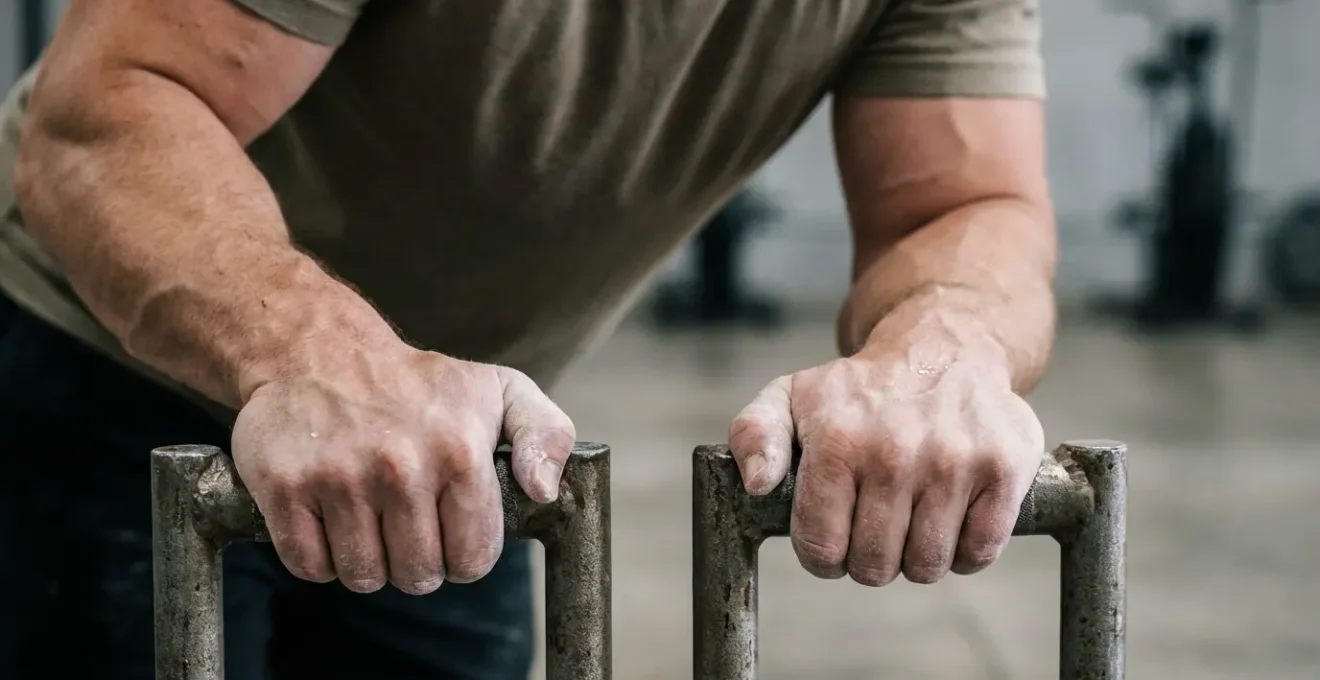
As the image demonstrates, the tension required is total. From the white-knuckle grip engaging the forearm flexors and extensors to the bulging traps fighting to keep your shoulders from being pulled from their sockets, the farmer’s walk is a full-body exercise disguised as a grip test. It is the epitome of creating systemic demand.
Your Action Plan: Auditing Your Systemic Training Protocol
- Points of Contact: List every exercise in your current program. Categorize each as either ‘Systemic’ (e.g., Squat, Deadlift, Overhead Press, Loaded Carry) or ‘Isolation’ (e.g., Bicep Curl, Leg Extension, Tricep Pushdown). What is the ratio?
- Collecte: Inventory your current numbers on your main systemic lifts. Log your 5-rep max for squats, deadlifts, and bench press. This is your baseline for systemic demand.
- Cohérence: Look at your training frequency. Are you hitting these systemic lifts with enough frequency (2-3x per week) and recovering adequately, or is your schedule clogged with isolation work that drains recovery?
- Mémorabilité/Emotion: Be honest. During your heavy sets, are you truly pushing your limits to create a systemic crisis, or just going through the motions? The goal is a powerful neurological and hormonal signal, not just moving weight.
- Plan d’intégration: Identify where you can replace low-impact isolation work with a high-impact systemic driver. Swap 10 sets of shrugs and wrist curls for 5 heavy sets of farmer’s walks at the end of your session.
Full Body or Split: Which Frequency Signals Growth Better for Naturals?
The “bro-split,” where each muscle group gets its own day once a week, is an artifact of enhanced bodybuilding culture. For a natural lifter, it’s one of the most inefficient ways to train. Muscle protein synthesis (MPS), the process of rebuilding and growing muscle tissue, is elevated for only 24-48 hours after a workout. Hitting a muscle group once a week means it spends five days doing nothing, waiting for the next signal.
To maximize growth, you need to send the growth signal more frequently. This is where full-body training or upper/lower splits shine. By hitting each muscle group 2-3 times per week with heavy, compound movements, you keep MPS elevated more consistently throughout the week. You’re creating more opportunities for growth. The key is managing volume and intensity. You can’t annihilate a muscle group three times a week; instead, you stimulate it with a few heavy, high-quality sets.
This isn’t just theory; it’s backed by expert observation. According to Coach Christian Thibaudeau, a frequency of 3-4 weekly workouts using a whole-body approach with 4-5 main exercises per session is often optimal for natural athletes. This approach ensures you’re prioritizing the big, systemic lifts that drive the hormonal cascade we discussed earlier, while providing the frequent stimulus needed for consistent MPS.
The consensus among coaches working with natural athletes is clear: focus on frequency and quality over single-session annihilation. As noted in a training analysis on Muscle & Strength, natural lifters benefit most from cutting down on excessive volume and focusing on big compound lifts. Cycling through different rep schemes while hitting each muscle group up to 3 times per week can maximize results by keeping the body in a constant state of adaptation and growth, rather than a cycle of extreme damage and prolonged, resource-draining recovery.
The 20-Set Arm Workout That actually Shrinks Your Gains
More is not better. In fact, for a natural lifter, more is often worse. That 20-set arm workout you pulled from a pro bodybuilder’s magazine is doing more harm than good. It’s what we call “junk volume”—work that creates a lot of localized fatigue and muscle damage but provides a negligible growth signal, all while draining your limited recovery capacity.
As a natural athlete, your ability to recover is finite. Every set you perform is a withdrawal from your recovery “bank account.” Systemic, heavy compound lifts are a high-return investment. They cost a lot but trigger a massive anabolic response. High-rep, isolation exercises are low-return expenditures. They still cost you recovery resources (especially CNS fatigue and inflammation), but the growth signal is minimal. When you spend all your resources on junk volume for your arms, you have nothing left to recover from the squats and deadlifts that actually tell your body to grow.

This is why it’s critical to be strategic. The experts at Advanced Human Performance advise naturals to use isolation movements sparingly but strategically. Many lifters get carried away and allocate excessive time and recovery to exercises that don’t produce significant muscle mass. The result is overtraining, elevated cortisol (a muscle-wasting hormone), and a frustrating lack of progress. Your body is too busy dealing with the inflammatory damage to build new tissue.
There is a ceiling on productive volume, especially within a single session for a single muscle group. Coach Christian Thibaudeau provides a clear guideline:
Naturals can likely go up to 20 total sets per session (but should not exceed 10-12 for a single muscle).
– Christian Thibaudeau, Thibarmy – Recommendations for Natural Lifters
That 20-set arm day is not only ineffective, but it’s actively sabotaging your growth by putting you into a catabolic state. A few hard, heavy sets of chin-ups and dips after your main lifts will do more for your arms than an hour of dedicated “pump” work.
How to Time Rest Intervals to Allow for Heaviest Systemic Loads?
You’re focused on lifting heavy to create systemic demand, but your rest periods are sabotaging you. Rushing through your workout with 60-second rests between heavy sets of squats is a rookie mistake. You might feel a great “burn” and get a good sweat, but you’re fundamentally limiting your ability to lift the heaviest possible weight with good form. And for a natural lifter, load is king.
Short rest intervals don’t allow for sufficient recovery of the central nervous system or replenishment of immediate energy stores like phosphocreatine. This means on your next set, you’re weaker. You either have to drop the weight or cut reps, reducing the very mechanical tension and systemic stress you need to signal growth. The metabolic fatigue you feel is not the primary driver of hypertrophy; progressive tension overload is.
For maximal strength and the hypertrophy that follows, longer rest periods are not lazy; they are strategic. They allow you to perform each set with maximum force, ensuring the quality of the stimulus remains high. This is not a matter of opinion. A landmark 2016 study by Schoenfeld et al. found that 3-minute rest intervals produced greater increases in both muscle strength and hypertrophy compared to 1-minute intervals over an 8-week period in trained men.
While some research suggests that for pure sarcoplasmic hypertrophy (the “pump”), rest periods of 60-90 seconds can be effective, our goal is different. We are chasing systemic growth triggered by the heaviest possible loads on foundational movements. For your main compound lifts—the squats, deadlifts, presses, and rows—resting 3 to 5 minutes between sets is not just acceptable; it’s optimal. This ensures you can approach each set with the neurological and physiological readiness to produce maximum force, sending the strongest possible signal for your entire body to grow.
Why Some People Build Muscle Faster Than Others Due to Genetic Myonuclei?
It’s the frustrating truth of the gym: some people just seem to look at a dumbbell and grow. While training, nutrition, and consistency are huge factors, we can’t ignore genetics. One of the most significant genetic factors influencing muscle growth potential is the concept of myonuclei and the myonuclear domain theory.
Think of your muscle fibers as long, cylindrical factories. Each factory needs managers to oversee production (protein synthesis). The myonuclei are these managers. A muscle fiber can only grow as large as its “managers” can effectively control. This is the “myonuclear domain.” To get bigger, the muscle fiber needs more myonuclei. These are donated by satellite cells, which are muscle stem cells that fuse with the muscle fiber in response to training-induced damage.
Here’s the genetic lottery: some individuals are born with a higher number of myonuclei per muscle fiber or have a more robust satellite cell response to training. They have more “managers” from the start, or they can recruit them more easily. This gives them a significantly higher ceiling for muscle growth and a faster rate of adaptation. This is a primary reason for the “hyper-responder” phenomenon. It’s not about a “secret” workout; it’s cellular architecture.
This genetic advantage also ties into how efficiently someone can use nutrients for growth. While everyone benefits from adequate protein, someone with a superior myonuclear setup might get more anabolic bang for their buck. For example, recent 2024 research in the American Journal of Physiology shows that as little as 20g of protein can be sufficient to maximally stimulate muscle protein synthesis in some individuals. While you can’t change your genetics, understanding this helps you focus on what you can control: providing the most potent and consistent training stimulus to maximize your own satellite cell activation over the long term.
Key takeaways
- Systemic growth for natural lifters is driven by the hormonal and neurological demand of heavy compound lifts, not localized isolation work.
- Excessive volume, especially from isolation exercises (“junk volume”), drains recovery resources and can increase catabolic hormones like cortisol, actively hindering growth.
- Higher training frequency (hitting each muscle group 2-3 times per week) is superior to single-day “bro-splits” for keeping muscle protein synthesis consistently elevated.
Magnesium Bisglycinate vs Melatonin: Which Aids Architecture Without Grogginess?
You can have the perfect training program, but if you don’t recover, you won’t grow. The most critical part of recovery happens while you sleep, specifically during deep sleep (also known as slow-wave sleep). This is when your body releases the highest amount of natural growth hormone, a key player in repairing muscle tissue and promoting an anabolic environment. Many athletes turn to supplements for help, with melatonin and magnesium being the most common.
Melatonin is a hormone that primarily regulates your circadian rhythm, signaling to your body that it’s time to sleep. It’s effective at helping you fall asleep, but it doesn’t necessarily improve the quality or *architecture* of your sleep. In fact, at higher doses, it can sometimes disrupt REM sleep and often leads to next-day grogginess, which can impair your performance in the gym.
Magnesium, particularly in the highly bioavailable bisglycinate form, works differently. It doesn’t force sleep; it facilitates it by calming the central nervous system. Heavy lifting puts your CNS into a “fight or flight” (sympathetic) state. Magnesium helps shift you back into a “rest and digest” (parasympathetic) state by acting on GABA receptors in the brain, which have an inhibitory, calming effect. This calming of the CNS is crucial for allowing your body to enter and stay in deep sleep. The result is improved sleep architecture, enhanced GH release, and physical recovery without the “hangover” effect of melatonin.
The following table breaks down the fundamental differences between these two popular sleep aids for athletes.
| Supplement | Primary Action | Effect on Sleep Architecture | Recovery Benefits | Side Effects |
|---|---|---|---|---|
| Magnesium Bisglycinate | GABA agonist, promotes parasympathetic activity | Increases deep sleep (slow-wave) | Enhanced growth hormone release | Minimal, no grogginess |
| Melatonin | Circadian rhythm regulation | Aids sleep onset, may disrupt REM at high doses | Variable | Morning grogginess possible |
For the natural athlete whose goal is to maximize systemic recovery and hormonal output, magnesium bisglycinate is the clear winner. It addresses the physiological aftermath of intense training—an over-stimulated nervous system—and promotes the specific type of sleep most conducive to muscle growth.
Is Anabolic Nutrient Timing Relevant for Recreational Lifters Eating 3 Meals a Day?
The concept of the “anabolic window”—the idea that you must consume a protein shake within 30-60 minutes post-workout or you’ll miss your chance for gains—is one of the most pervasive and overrated myths in fitness. For the average recreational lifter eating 3-4 solid meals a day, obsessing over this window is a waste of mental energy that distracts from what truly matters: total daily protein intake and consistent training.
The body is far more resilient and responsive than this myth gives it credit for. The sensitization of muscle tissue to protein intake lasts much longer than a mere hour. In fact, the anabolic response to training is a process that unfolds over 24-48 hours. This is powerfully illustrated by research from Burd et al., cited by the International Society of Sports Nutrition:
Rates of myofibrillar protein synthesis were still sensitized (responsive) to 15 grams of protein consumed 24–27 hours post-exercise in young, healthy adults. Thus, even waiting an entire day (post-exercise) to consume a small amount of protein still has muscle anabolic effects.
– Burd et al., International Society of Sports Nutrition
What is far more important than precise timing is the overall distribution of your protein throughout the day. Instead of worrying about a 30-minute window, focus on a 24-hour window. The evidence consistently shows that an even distribution of protein across several meals is superior for maximizing 24-hour muscle protein synthesis. Research demonstrates that evenly spaced protein feedings (e.g., ~0.3g/kg per meal, 3-4 times a day) promote greater gains in muscle mass and strength compared to skewed patterns where most protein is consumed in one large meal.
For the natural lifter, this is great news. It means you don’t need to rush home from the gym to slam a shake. As long as you have a quality protein-containing meal within a few hours before and a few hours after your workout—which is standard for anyone eating regular meals—your bases are covered. Focus on hitting your total daily protein goal and spreading it out reasonably. Let go of the timing anxiety and put that focus back on lifting heavy.
Frequently Asked Questions on Systemic Muscle Growth
Why is deep sleep crucial for muscle recovery?
Deep sleep (slow-wave sleep) is when the majority of physical repair and growth hormone release occurs, making it critical for muscle protein synthesis and recovery from systemic training.
How does magnesium support recovery differently than melatonin?
Magnesium works by calming the CNS that was fired up by heavy lifting through GABA activation, while melatonin primarily affects circadian rhythm without directly addressing nervous system recovery.
What’s the optimal dosage for athletes?
Magnesium bisglycinate: 200-400mg before bed. Melatonin: 0.5-3mg, though lower doses often work better to avoid grogginess.