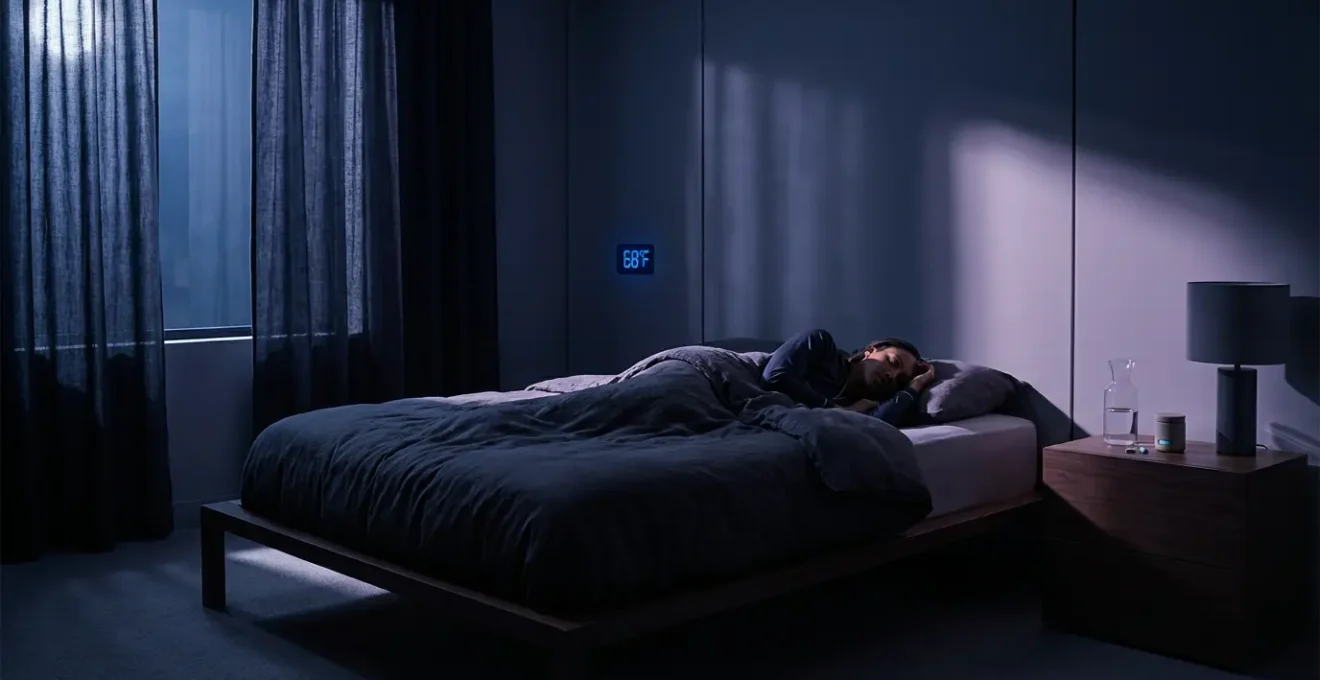
For elite athletes, logging 8 hours of sleep is meaningless if your sleep architecture is broken.
- Deep sleep (SWS) is governed by core body temperature and meal timing, not just darkness.
- REM sleep is sabotaged by even a single alcoholic drink and can be targeted for skill acquisition.
Recommendation: Stop tracking duration and start actively managing your sleep stages with data-driven protocols.
You follow the playbook. Eight, sometimes nine hours of sleep per night. You avoid caffeine past noon. You invest in blackout curtains. Yet, you wake up feeling sore, mentally foggy, and your performance metrics have plateaued. This is a common frustration among high-level athletes who treat sleep as a passive requirement rather than an active system. The prevailing wisdom focuses on sleep duration, a crude and often misleading metric. Getting “enough” sleep is just the entry ticket; it doesn’t guarantee quality recovery.
The secret weapon of elite performers isn’t just more sleep; it’s better-structured sleep. The real challenge lies beyond the platitudes of standard sleep hygiene. What if the key to unlocking your recovery potential wasn’t in the total hours you spend in bed, but in the precise minutes you spend in each specific stage of sleep? This is the science of sleep architecture—the nightly pattern of light, deep (Slow-Wave Sleep or SWS), and REM sleep. For an athlete, each stage serves a distinct, non-negotiable purpose: SWS for physical repair and growth hormone release, and REM for mental consolidation and motor skill learning.
This guide abandons the generic advice. Instead, we will deconstruct the physiological triggers you can manipulate to actively engineer your sleep architecture. We will explore how to use environmental controls, targeted supplementation, nutritional timing, and wearable data to build a sleep regimen that directly translates to improved Heart Rate Variability (HRV), faster muscle repair, and accelerated skill acquisition. This is not about sleeping more; it’s about sleeping smarter.
For those who prefer a condensed visual format, the following video with Dr. Matt Walker provides a comprehensive overview of the science and practical strategies for mastering your sleep.
To help you navigate these advanced strategies, this article is structured to provide actionable protocols for each key lever of sleep optimization. The following summary outlines the path to transforming your sleep from a passive necessity into a powerful performance tool.
Summary: A Guide to Engineering Your Sleep Architecture
- Why Checking Your Phone at 10 PM Delays Melatonin Onset by 90 Minutes?
- How to Set Your Bedroom Temperature to Maximize Slow Wave Sleep?
- The “Nightcap” Myth: How One Drink Fragmentizes Your Sleep Continuity
- Magnesium Bisglycinate vs Melatonin: Which Aids Architecture Without Grogginess?
- Oura vs Whoop: Which Device Accurately Distinguishes Light from Deep Sleep?
- How to Interpret HRV Data to Decide When to Push or Rest?
- When to Stop Eating Before Bed to Maximize Growth Hormone Release?
- How to Extend Deep REM Cycles for Faster Skill Acquisition and Motor Learning?
Why Checking Your Phone at 10 PM Delays Melatonin Onset by 90 Minutes?
The most pervasive myth about light and sleep is that only the moments right before closing your eyes matter. For an athlete’s finely tuned circadian rhythm, the damage is done hours earlier. The issue isn’t just light; it’s the specific wavelength of blue light emitted by screens. This light directly suppresses the release of melatonin, the hormone that signals to your body that it’s time to sleep. It does this by activating specialized cells in your retina called melanopsin ganglion cells, which are exquisitely sensitive to the 460-480 nanometer spectrum of blue light.
When you check your phone at 10 PM, you send a powerful “daytime” signal to your brain’s master clock, the suprachiasmatic nucleus. This effectively slams the brakes on melatonin production. Recent research from 2024 demonstrates a 1.5-hour average melatonin onset delay from evening blue light exposure. This doesn’t just make it harder to fall asleep; it pushes your entire sleep architecture later into the night. Your first deep sleep cycle is delayed, shortening the critical window for physical recovery. For an athlete, this means less time for muscle repair and glycogen replenishment, regardless of the total hours slept.
The solution requires a disciplined light “hygiene” protocol that begins long before bedtime. The goal is to eliminate blue light exposure to allow melatonin to rise naturally, creating the ideal hormonal environment for deep, consolidated sleep. Thinking of light exposure as a form of “light nutrition” is key; you must control both the timing and the “flavor” of the light you consume in the evening.
Ultimately, managing your light environment is the foundational step in building robust sleep architecture. Without it, all other optimization efforts are compromised.
How to Set Your Bedroom Temperature to Maximize Slow Wave Sleep?
After light, ambient temperature is the most powerful external factor influencing your sleep architecture, particularly the amount of deep sleep you get. To initiate sleep, your body’s core temperature needs to drop by about 2-3 degrees Fahrenheit. This temperature drop is a critical physiological trigger for entering Slow-Wave Sleep (SWS). A bedroom that is too warm prevents this drop, forcing your body to expend energy on cooling itself rather than on cellular repair. This results in fragmented, shallow sleep with significantly reduced SWS.
The optimal temperature isn’t static; it’s about creating a thermal environment that facilitates this core temperature drop. The ideal range for most people is a cool 65-68°F (18-20°C). This cool air helps draw heat away from the body, particularly from the hands, feet, and head. However, advanced athletes can go a step further by programming a dynamic temperature environment that mirrors the body’s natural thermal cycle throughout the night.
Case Study: Dynamic Temperature for Enhanced Recovery
Research on athletes using dynamic temperature control systems, like the Eight Sleep Pod, provides a clear protocol. The systems are programmed to maintain a cool temperature of around 66°F for the first half of the night to maximize SWS. After approximately 4 hours, the temperature is gradually increased to 69°F. This slight warming encourages the transition into the longer REM sleep cycles that dominate the second half of the night. Athletes using this protocol have shown measurable improvements in both deep sleep duration and next-day HRV scores, indicating superior autonomic nervous system recovery.
You can simulate this effect with a programmable thermostat or even by using different layers of bedding. The key is to support the initial temperature drop for deep sleep and then avoid becoming too cold later in the night, which can disrupt REM. This active management of your thermal environment allows you to sculpt your sleep stages for targeted recovery.
By treating your bedroom thermostat like a performance tool, you can directly increase the most physically restorative stage of sleep.
The “Nightcap” Myth: How One Drink Fragmentizes Your Sleep Continuity
The idea that an alcoholic drink before bed aids sleep is one of the most destructive myths for athletic recovery. While alcohol is a sedative and can help you fall asleep faster, this initial effect is deceptive. The subsequent impact on your sleep architecture is catastrophic. Alcohol profoundly suppresses REM sleep and causes severe sleep fragmentation, particularly in the second half of the night as your body metabolizes it.
As alcohol is cleared from your system, your brain experiences a “rebound effect.” The initial sedation gives way to a more stimulated, wakeful state. This leads to multiple micro-arousals that you may not even remember, but your wearable device will register as a spike in resting heart rate and a tanking HRV. Data from sleep trackers consistently shows that a single alcoholic beverage can cause a 15-30% overnight HRV drop, signaling that your autonomic nervous system is in a stressed, sympathetic-dominant state instead of a restorative, parasympathetic one. This negates the very purpose of sleep for an athlete.
The timing and quantity of alcohol are critical variables. The closer the consumption is to bedtime, the more severe the disruption. This data is not just observational; it’s a predictable dose-response relationship.
As highlighted in a study on professional athletes, the impact is stark. The findings showed that even moderate alcohol consumption (2 drinks) consumed 3 hours before bed led to a 26% reduction in deep sleep and required an additional 1.5 recovery days before HRV returned to its baseline. The following table breaks down how the timing of alcohol intake directly correlates to sleep damage.
| Timing Before Bed | Deep Sleep Loss | REM Disruption | Recovery Time |
|---|---|---|---|
| 6 hours | 5-10% | Minimal | Same night |
| 4 hours | 15-20% | Moderate | Next morning |
| 2 hours | 25-40% | Severe | 24-48 hours |
| At bedtime | 40-50% | Complete fragmentation | 48-72 hours |
For any serious athlete, the data makes the choice clear: alcohol is a recovery poison, and the only winning move is total avoidance, especially within 6-8 hours of bedtime.
Magnesium Bisglycinate vs Melatonin: Which Aids Architecture Without Grogginess?
When athletes look for a sleep aid, they often reach for melatonin. This is usually a strategic error. Melatonin is a chronobiotic hormone, a “timer” that tells your brain when to sleep. It’s effective for shifting your circadian rhythm (e.g., for jet lag), but it’s not a true sleep-inducing agent. Taking it when you’re already on a regular schedule can blunt your body’s natural production and often leads to next-day grogginess. A much better approach is to support the brain’s “calming” systems.
This is where magnesium comes in. Specifically, Magnesium Bisglycinate is a superior choice for athletes. Magnesium acts as a GABA agonist, essentially helping to apply the “brakes” on the nervous system. GABA is the brain’s primary inhibitory neurotransmitter, responsible for reducing neuronal excitability. For an athlete who is “wired but tired” after a hard training day, magnesium helps quiet the sympathetic “fight-or-flight” system, allowing the parasympathetic “rest-and-digest” system to take over. The bisglycinate form is chelated to the amino acid glycine, which itself has calming properties and enhances absorption without the gastrointestinal distress common with other forms of magnesium.

The goal is not to force sleep with a hormonal sledgehammer like high-dose melatonin, but to create the neurochemical conditions for natural sleep to unfold. Other compounds like L-Theanine (promotes alpha brain waves associated with relaxed wakefulness) and Apigenin (a compound from chamomile that binds to a different GABA receptor) can also be part of a strategic stack. A micro-dose of melatonin (0.3-0.5mg) can be used 2-3 hours before bed to help set the circadian clock, but the heavy lifting of calming the nervous system should be done by other means.
This comparative analysis from a recent health publication provides a clear framework for choosing the right tool for the job.
| Supplement | Mechanism | Best For | Optimal Dose | Timing |
|---|---|---|---|---|
| Magnesium Bisglycinate | GABA agonist (nervous system brake) | Wired but tired athletes | 200-400mg | 30-60 min before bed |
| Melatonin (micro-dose) | Circadian timer signal | Jet lag/shift workers | 0.3-0.5mg | 2-3 hours before bed |
| L-Theanine | Alpha wave promotion | Racing thoughts | 100-200mg | 1 hour before bed |
| Apigenin | Different GABA binding | General anxiety | 50mg | 30 min before bed |
By focusing on GABAergic support rather than hormonal intervention, you can improve sleep onset and quality without disrupting your natural sleep architecture or causing next-day performance impairment.
Oura vs Whoop: Which Device Accurately Distinguishes Light from Deep Sleep?
For an athlete committed to engineering their sleep architecture, a wearable device is an indispensable tool. It transforms sleep from a subjective feeling into a field of objective data. The two dominant players in this space are the Oura Ring and the Whoop Strap. While both track sleep stages, they use different methodologies and present data through different philosophical lenses, making one potentially better than the other depending on your primary goal.
The Oura Ring primarily uses body temperature, resting heart rate, and movement to determine sleep stages. Its strength lies in its highly sensitive temperature sensor, which is a key input for detecting the drop in core body temperature associated with deep sleep. Its data philosophy is centered around a “Readiness Score,” making it excellent for athletes whose primary focus is daily recovery optimization and sleep quality.
The Whoop Strap, in contrast, leans more heavily on Heart Rate Variability (HRV) pattern recognition to distinguish sleep stages. Its algorithm is built around a “Strain/Recovery” balance, which makes it an exceptional tool for managing overall training load. While its sleep stage detection is robust, its core utility shines in connecting a night’s sleep to the following day’s capacity for strain. As a sleep coach, I find Oura’s focus on temperature gives it a slight edge in deep sleep accuracy, while Whoop excels at contextualizing sleep within a broader training framework.
No wearable is as accurate as lab-based polysomnography, so the most important quality for an athlete is algorithmic consistency. A device that is consistently wrong in the same way is more useful for tracking relative changes than one that is erratically accurate.
– Dr. Matthew Walker, Sleep Technology Research Review
This expert take is crucial. The goal isn’t perfect accuracy but reliable trend analysis. You use the device to run experiments: “When I took a hot bath 90 minutes before bed, did my deep sleep percentage increase relative to my baseline?” The following table, based on data from sources like the Sleep Foundation, compares their core capabilities.
| Feature | Oura Ring | Whoop Strap |
|---|---|---|
| Deep Sleep Detection | Temperature + movement weighted | HRV pattern recognition |
| Consistency Score | 85-90% same-night repeatability | 80-85% repeatability |
| Data Philosophy | Readiness Score (recovery-focused) | Strain/Recovery Balance |
| Best For Athletes | Sleep optimization focus | Training load management |
| Algorithm Updates | Quarterly refinements | Monthly iterations |
Ultimately, either device, used consistently, provides the data-feedback loop necessary to move from guessing about your recovery to actively managing it.
How to Interpret HRV Data to Decide When to Push or Rest?
Heart Rate Variability (HRV) is the single most important metric for an athlete’s recovery status. It measures the variation in time between consecutive heartbeats and serves as a direct window into your autonomic nervous system (ANS) activity. A high HRV generally indicates a state of relaxation and recovery (parasympathetic dominance), while a low HRV signals stress, fatigue, or illness (sympathetic dominance). However, interpreting the raw number is a rookie mistake. The real insights come from trend analysis and triangulation with other data points.
First, never react to a single day’s absolute HRV number. Your focus should be on your 7-day rolling baseline. A reading that is significantly below this baseline is a red flag. Second, triangulate your HRV with your morning resting heart rate (RHR). An elevated RHR (e.g., >5 bpm above baseline) combined with a low HRV is a near-certain indicator that you need a rest or active recovery day. This combination suggests your ANS is under significant stress.
Finally, always cross-reference the data with your subjective feelings (energy, mood, soreness). Sometimes, the data leads, and other times your body’s perception does. A decision matrix emerges:
- Low HRV + High RHR: Definite rest day. Your body is stressed.
- Low HRV + Normal RHR + Feel Good: Proceed with caution. A light training session might be acceptable, but avoid high intensity.
- Normal HRV + Normal RHR: Proceed with planned training.
- High HRV + Low RHR: You are well-recovered and primed for a high-intensity session.
Case Study: The Danger of Parasympathetic Saturation
An Olympic marathon runner presented with consistently high, even abnormally high, HRV readings (>120ms RMSSD) during a peak training block. While this would typically signal excellent fitness, it was coupled with reports of deep fatigue and declining performance. This is a classic sign of parasympathetic saturation—a state of overtraining where the body’s ‘brake’ system is so overworked that it becomes dysfunctional. The high HRV was a sign of exhaustion, not readiness. A forced 3-day rest period allowed her HRV to normalize to a healthy 85ms and restored her performance capacity.
Using HRV not as a simple score but as a key input in a broader decision-making framework is what separates elite athletes from the rest.
When to Stop Eating Before Bed to Maximize Growth Hormone Release?
The timing of your last meal has a profound impact on your hormonal environment during sleep, specifically on the release of Human Growth Hormone (GH). The largest pulse of GH occurs during the first few cycles of Slow-Wave Sleep (SWS). This hormone is critical for athletes as it drives tissue repair, muscle growth, and fat metabolism. However, this GH pulse is blunted by insulin. When you eat, especially carbohydrates, your body releases insulin to manage blood sugar. If insulin is elevated when you go to sleep, it directly suppresses the GH release.
Research shows that eating within 2 hours of sleep can cause up to a 75% reduction in the natural nighttime GH pulse. This means that even if you get a full night of SWS, you are missing out on one of its primary restorative benefits. The solution is to create a “buffer zone” between your last meal and bedtime to allow insulin levels to return to baseline.
The optimal protocol is to stop all food intake at least 3 hours before bed. This gives your body enough time to digest the meal and for insulin to clear. The composition of your evening meals also matters. A “carb tapering” strategy is highly effective. Consume the majority of your daily carbohydrates in the hours following your workout to replenish glycogen, then shift to meals rich in protein and healthy fats in the evening. Foods like Greek yogurt, cottage cheese (casein protein), or a small handful of nuts are better choices as they have a minimal impact on insulin.
This isn’t about calorie restriction; it’s about nutrient timing. By aligning your eating window with your body’s natural hormonal rhythms, you can significantly amplify the restorative power of your sleep. An athlete who trains hard but eats a large, carb-heavy meal an hour before bed is effectively sabotaging their own recovery at a hormonal level.
By creating this 3-hour fasting window before sleep, you ensure that when you enter deep sleep, your body can maximize the GH release that is so vital for repair and adaptation.
Key Takeaways
- Sleep is not passive; it’s a trainable system where architecture (SWS, REM) matters more than duration.
- Core body temperature is the primary driver of deep sleep (SWS); a cool room (65-68°F) is non-negotiable.
- Alcohol and late-night blue light are the two biggest saboteurs of sleep architecture, fragmenting REM and delaying melatonin, respectively.
How to Extend Deep REM Cycles for Faster Skill Acquisition and Motor Learning?
While Slow-Wave Sleep is for the body, REM sleep is for the brain. It’s during REM that your brain consolidates memories, integrates new information, and, most importantly for athletes, refines motor skills. The brain replays the neural patterns of movements practiced during the day, effectively “hardwiring” them. You can strategically use this process to accelerate skill acquisition.
The key is to engage in a brief period of mental rehearsal or visualization of the desired skill immediately before going to sleep. This “primes” the brain, tagging those specific neural circuits for targeted replay and consolidation during the subsequent REM cycles. This isn’t just theory; it’s been demonstrated in practice.
Case Study: Mental Rehearsal for Motor Mastery
A study on professional pianists found that those who performed just 10 minutes of silent, mental practice of a new piece right before sleep showed 35% better retention and accuracy the next day compared to a group that practiced only in the morning. fMRI scans confirmed the mechanism: the mental rehearsal group exhibited significantly enhanced activation in their motor cortex during REM sleep, indicating the brain was actively working to perfect the skill overnight.
This principle applies to any motor skill—a golf swing, a tennis serve, a gymnastic routine. By pairing daytime physical practice with pre-sleep mental rehearsal, you create a powerful 24-hour learning cycle. Protecting your REM sleep, which is most prominent in the second half of the night and highly vulnerable to fragmentation from alcohol or being too cold, becomes paramount for any athlete trying to learn or refine a complex movement.
Action Plan: Sleep-Dependent Learning Optimization Protocol
- Morning Skill Session: Practice new motor skills between 8-10 AM when acetylcholine, a neurotransmitter crucial for focus, peaks.
- Post-Practice Nap: If possible, take a full 90-minute nap within 4 hours of practice to capture a full SWS/REM cycle for initial consolidation.
- Evening Visualization: Spend 10-15 minutes immediately before sleep mentally rehearsing the skill with perfect form, engaging all senses.
- Protect First Sleep Cycle: Ensure the first 90-120 minutes of your night are uninterrupted to secure your foundational SWS.
- Morning Review: Perform a brief 5-minute physical practice of the skill immediately upon waking to reinforce the overnight learning.
By mastering these protocols, you transform sleep from a passive recovery period into your most powerful training partner, allowing you to learn faster and perform better.