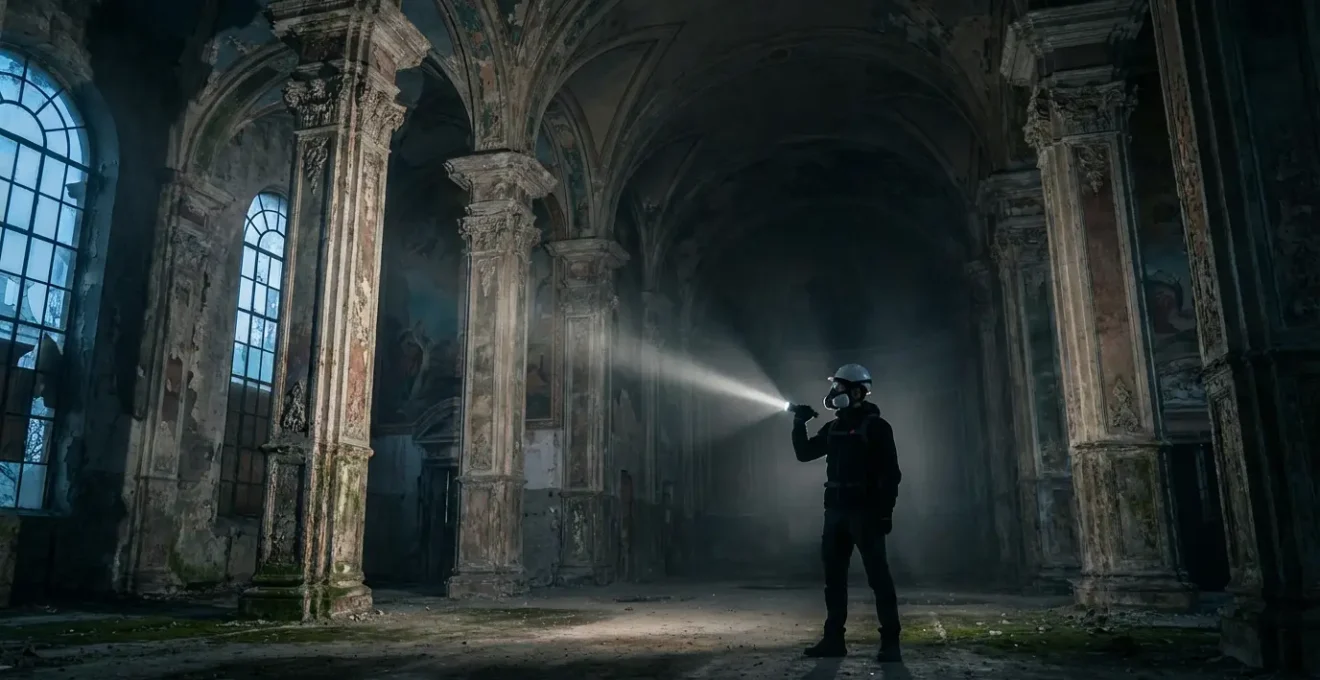
Legally, urban exploration exists in a grey area where a simple misstep can lead to serious consequences, but the distinction between a civil dispute and a criminal charge is critical.
- Understanding the difference between civil trespass (a property dispute) and criminal trespass (an act with malicious intent or defiance) is your primary legal shield.
- Your physical safety depends on spotting signs of structural failure and invisible environmental hazards, not just avoiding security.
Recommendation: The most defensible and ethical approach is to reframe the hobby as an act of digital preservation and proactively seek formal, legal access to document historic sites.
The allure of a decaying facade, the silent history held within a collapsing roof—these are the siren songs for the urban explorer. For those drawn to historic ruins, the hobby is a blend of adrenaline, photography, and amateur archaeology. Yet, a persistent and crucial question looms over every crumbling wall and rusted fence: is any of this legal? The common answer, a simplistic “no,” fails to capture the complex legal reality. The line between a civil infraction and a criminal offense is often finer than a spider’s thread in a dusty window pane.
Many explorers operate under the well-intentioned but legally naive mantra of “take only pictures, leave only footprints.” While this ethic is the cornerstone of responsible exploration, it doesn’t grant a legal pass. The law, however, is not a monolithic beast; it considers intent, damage, and context. This guide moves beyond the platitudes. It is a framework, built from a lawyer’s perspective and a veteran explorer’s experience, for navigating the legal and physical risks inherent in this pursuit. It’s about understanding the real consequences of stepping over a fence and recognizing that the greatest dangers aren’t always a security guard or a police officer.
This is not a guide to breaking the law. It is a guide to understanding it. We will dissect the difference between civil and criminal trespass, learn to read the language of structural decay, and identify the hidden environmental hazards that many ignore. Ultimately, we will explore the path from a legally ambiguous hobby to a respected form of digital heritage preservation, one where permission isn’t an obstacle, but the objective. The goal is to transform your approach from one of risk-taking to one of calculated, informed, and defensible documentation.
This article provides a comprehensive legal and practical framework for the responsible urban explorer. We will cover the ethical foundations of the hobby, methods for remote reconnaissance, the critical legal distinctions of trespass, and a detailed analysis of physical, human, and environmental risks, before concluding with strategies for gaining legal access.
Summary: A Legal & Practical Framework for Historic Urban Exploration
- Why Photographing Decaying Buildings Is a Form of Digital Preservation?
- How to Use Satellite Imagery to Identify Accessible Historic Ruins?
- Civil Law vs Criminal Law: What Is the Real Consequence of Entering a Fence?
- The Floor Rot Signs That Mean You Should Turn Back Immediately
- When Do Security Guards Typically Change Shifts at Industrial Sites?
- The Hidden Danger in Berlin’s Forests That Explorers Ignore
- The ‘Simple Wall Removal’ That Can Collapse Your Second Floor
- Accessing Abandoned Berlin Industrial Districts for Photography Without Trespassing Fines?
Why Photographing Decaying Buildings Is a Form of Digital Preservation?
Before analyzing the risks, it’s essential to establish the core ethos of responsible exploration. Far from being mere thrill-seeking, the methodical documentation of decaying structures is a vital act of digital heritage preservation. Every day, historic buildings are lost to demolition, neglect, or natural disaster. Often, the only records that will remain are the photographs and videos captured by explorers. This act of documentation creates a permanent, accessible archive of a place’s final state, preserving its architecture, textures, and story for future generations.
This philosophy has been adopted by prominent figures in the community. The urban exploration duo behind the YouTube channel “The Proper People” explicitly view their work as a mission of digital preservation. They recognize they cannot physically save the sites, but they can immortalize them on film, creating a lasting record long after the structures have turned to dust. This elevates the hobby from a personal pursuit to a public service, providing a powerful moral and ethical framework. It’s a perspective that can be crucial if ever required to explain your presence on a site.
The practice is gaining traction in academic and heritage circles as well. Advanced photogrammetry techniques are now used to create highly detailed virtual models of historic sites. For instance, research on digital preservation shows that over 78 3D models were created using photogrammetry to document cultural scenes, proving the value of digital capture. While most explorers lack this equipment, the principle remains the same: your high-resolution photos contribute to a collective, informal archive, preserving what society has chosen to forget. This is not just an excuse; it is a foundational purpose.
How to Use Satellite Imagery to Identify Accessible Historic Ruins?
A responsible exploration begins long before you arrive on site. The most powerful tool in a modern explorer’s arsenal is Open-Source Intelligence (OSINT), primarily through satellite imagery. This remote reconnaissance phase is not about finding “secret” locations but about assessing accessibility, activity levels, and potential risks from a safe distance. Using tools like Google Maps, Google Earth, and crowdsourced platforms like Wikimapia can reveal crucial details.
When analyzing a potential site from above, you’re looking for tell-tale signs of abandonment and accessibility. Key indicators include:
- Vegetation Overgrowth: Nature reclaims abandoned sites quickly. Trees growing through roofs, large bushes obscuring entrances, and unkempt grounds are strong signs of long-term neglect.
- Structural Decay: High-resolution satellite views can often reveal partially collapsed roofs, missing walls, or debris fields around a building, giving you a preliminary assessment of its structural state.
- Lack of Activity: The absence of vehicles in parking lots over multiple days (checked via historical imagery), clear paths, or recent landscaping suggests the property is not actively managed.
- Perimeter Integrity: You can often trace the fence line to identify potential breaches, open gates, or natural access points where the perimeter has failed.
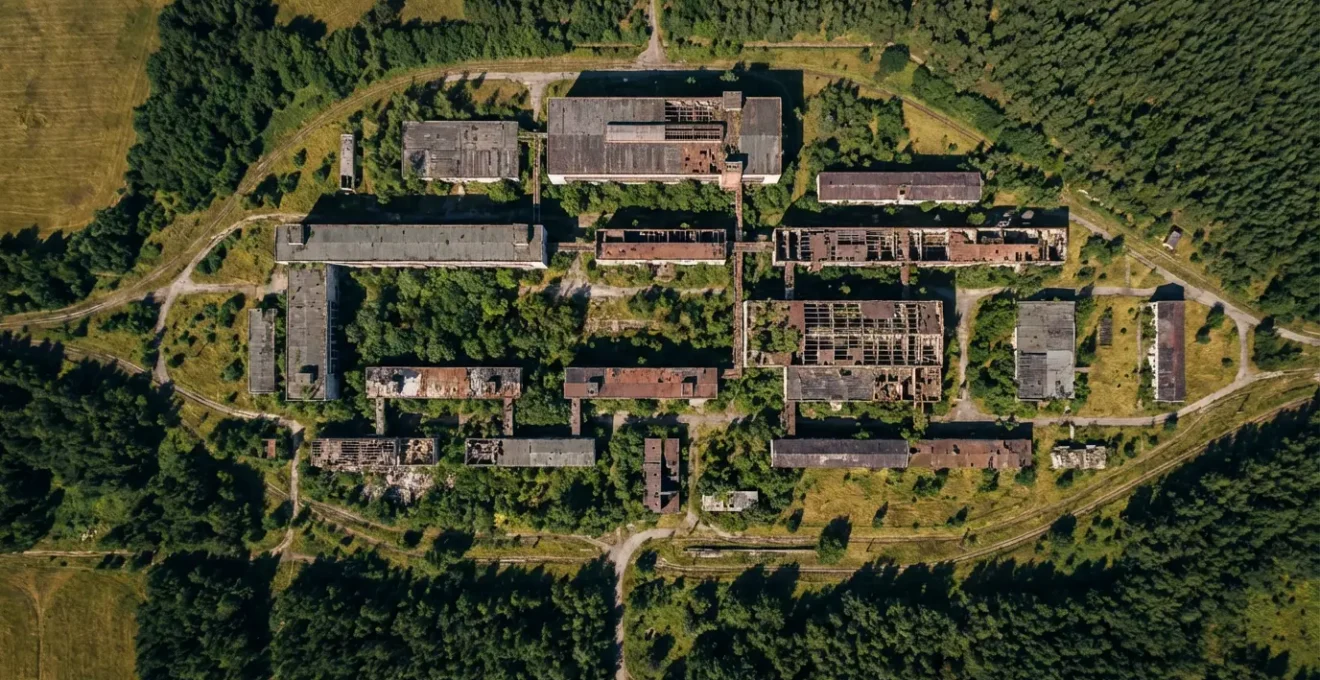
As the aerial view shows, the patterns of decay and natural reclamation are often clearly visible from above. This perspective allows you to build a comprehensive entry and exit plan, identify potential surveillance blind spots, and decide if the site is even worth a visit. This methodical, intelligence-led approach minimizes surprises and demonstrates a level of preparation that separates a serious documentarian from a casual trespasser.
Civil Law vs Criminal Law: What Is the Real Consequence of Entering a Fence?
The most significant point of confusion for urban explorers is the legal nature of their actions. The word “trespass” is often used as a catch-all, but in the eyes of the law, there is a monumental difference between civil trespass and criminal trespass. Understanding this distinction is the single most important piece of legal knowledge an explorer can possess. Civil trespass is essentially a dispute between a property owner and an individual who has entered their land without permission. It is a tort, not a crime, and the owner’s remedy is typically to sue for damages.
Criminal trespass, on the other hand, is a public offense prosecuted by the state. It requires a higher burden of proof and, crucially, a specific level of intent. Generally, to be guilty of criminal trespass, you must have knowingly entered or remained on a property without consent, often after being given clear notice (e.g., “No Trespassing” signs, a verbal warning) or with the intent to commit another crime. For many explorers, fines for trespassing typically range from $200 to $1,000, but this can escalate dramatically with aggravating factors.
To clarify these critical differences, a side-by-side comparison is essential. The following table, based on information from a detailed legal analysis, breaks down the key aspects of each.
| Aspect | Civil Trespass | Criminal Trespass |
|---|---|---|
| Definition | Entering or remaining on land without legal right, focus on intentional entry even if mistaken about property lines. | Being on someone else’s property without consent or authorization, requiring proof of two main elements. |
| Intent Required | No need to prove intent to cause harm. | Deliberate disregard for property rights, often accompanied by damage, theft, or other illegal activities. |
| Standard of Proof | Preponderance of evidence (more likely than not). | Beyond a reasonable doubt. |
| Basic Penalties | Compensatory damages for repairs, nominal damages for violation of rights, punitive damages to discourage repeat offenses. | Fines from a few hundred to several thousand dollars, imprisonment for severe or repeat cases. |
| Aggravating Factors | Not applicable | Possession of a deadly weapon, carrying a dangerous weapon or firearm, act resulting in significant physical injury, previous convictions, causing property damage. |
| Maximum Penalties | Property owner can recover compensation for losses. | Up to 10 years prison for restricted government areas with aggravating factors. Class 5 felony for agricultural land: up to $100,000 fine and 3 years imprisonment. |
The key takeaway is that your conduct on the property is paramount. If you cause no damage, carry no tools for theft or vandalism, and act respectfully, your actions are more likely to be viewed through the lens of civil law. However, ignoring clear signage or a direct order to leave can elevate the situation, demonstrating the “knowing defiance” often required for a criminal charge.
The Floor Rot Signs That Mean You Should Turn Back Immediately
While legal risks can be managed, physical risks can be fatal. The most immediate and common danger in any decaying structure is the integrity of the surfaces you walk on. Years of water damage, neglect, and freeze-thaw cycles can render floors and stairs deceptively fragile. An explorer must learn to read the subtle language of decay and recognize the critical warning signs of structural failure before committing their weight. Trusting your eyes is not enough; you must use all your senses.
Before stepping onto any questionable surface, especially wooden floors in buildings with roof damage, conduct a thorough assessment. A trekking pole is an invaluable tool, not for hiking, but for probing. Tapping the floor ahead of you can reveal “sponginess” or a hollow sound that signals advanced rot beneath. Pay close attention to auditory clues: a structure that is silent under no load but creaks and pops loudly under your weight is actively failing. Any sound of trickling sand or dust from the ceiling above is a red-alert, often indicating a shifting load that could precede a collapse.
Visually, look for sagging ceilings, buckling walls, or large, active structural cracks. Water is the primary enemy; trace the paths of stains on walls and ceilings to predict where the most severe water damage has occurred. In the words of Michael from “The Proper People,” in a YouTube Millionaires interview, you must assume the worst:
The vast majority of these buildings are going to contain asbestos and mold.
– The Proper People (Michael), YouTube Millionaires Interview
This same logic applies to structural integrity. Assume every floor is compromised until proven otherwise. If you encounter any of these red flags—spongy floors, continuous creaking, visible movement in static structures—the only correct action is to turn back immediately. No photograph is worth a catastrophic fall.
When Do Security Guards Typically Change Shifts at Industrial Sites?
The title of this section asks a common but misguided question. Trying to time security shifts is an amateur’s game and a fool’s errand. Modern security is often unpredictable, involving random patrols, silent motion sensors, and remote surveillance. Instead of trying to “beat” security, a professional explorer plans for the inevitability of an encounter. The goal is not evasion, but de-escalation and demonstrating harmless intent. Your conduct during an encounter is what will define its outcome: a polite request to leave, a fine, or an arrest.
The moment you are approached by security or law enforcement, your role changes from explorer to cooperative documentarian. Be polite, non-threatening, and comply with all lawful orders. Do not run. Do not argue. Presenting yourself as a photographer interested in historical architecture is far more effective than trying to invent a complex lie. Having business cards identifying yourself as a photographer can lend credibility to this. If you managed to obtain any form of permission, have it ready. Your primary objective is to show you are not a threat, a vandal, or a thief.

If the encounter escalates and law enforcement is involved, it is crucial to know your rights but exercise them respectfully. You should state that you do not wish to answer questions without an attorney present. Anything you say can be used to establish criminal intent. The best strategy is often to say as little as possible while remaining compliant. This professional approach to interactions is a critical part of a risk mitigation strategy.
Action Plan: Pre-Exploration Security & Encounter Protocol
- Reconnaissance Phase: Use OSINT and satellite imagery to map known camera locations, patrol routes (if visible), and motion sensor placements. Note all potential entry and exit points.
- Gear & Identity Check: Pack only photographic equipment. Leave anything that could be construed as a tool for breaking and entering (crowbars, bolt cutters) at home. Carry identification and, if applicable, a photography business card.
- Initial Site Observation: Before entering, conduct a discreet observation from a distance to check for recent signs of activity (parked cars, fresh tracks, active security presence).
- Encounter Protocol: If encountered, immediately stop, make your hands visible, and communicate clearly and calmly. State your purpose as documenting the site’s history. Do not be argumentative.
- Legal Escalation Plan: If detained, comply with lawful orders. State your name and provide identification, but clearly state you will not answer further questions without consulting an attorney.
The Hidden Danger in Berlin’s Forests That Explorers Ignore
While the example of Berlin’s forests highlights a specific regional risk (unexploded ordnance from WWII), it serves as a powerful metaphor for a broader category of dangers that explorers often neglect: invisible environmental hazards. The most dramatic risks may be structural collapse or security patrols, but the most insidious threats are the ones you cannot see, smell, or immediately feel. Abandoned industrial, medical, and military sites are frequently contaminated with a cocktail of toxic substances.
The most common and dangerous of these are asbestos and mold. Asbestos, used for decades as a fire retardant and insulator, becomes highly friable (easily crumbled) as buildings decay. When disturbed, its microscopic fibers become airborne and, if inhaled, can cause fatal lung diseases years later. Similarly, the black mold that thrives in damp, dark environments releases mycotoxins that can cause severe respiratory issues. A simple dust mask is woefully inadequate for this. You need a respirator with a proper seal and the correct filters. According to safety experts, NIOSH-approved P100 respirators filter 99.97% of particles and are the minimum standard for these environments.
Beyond these, a site’s former use is a clue to its hidden dangers. A former wool mill might harbor anthrax spores. An old hospital is a biohazard zone. The soil around a chemical plant or mine could be saturated with heavy metals. Your pre-exploration research should always include identifying the site’s history to build a specific hazard profile. This includes ecological traps: what appears to be solid ground could be an unmapped mine shaft hidden by vegetation, or a seemingly stable floor could be rotted through by invasive plant root systems.
Your environmental hazard assessment framework should include:
- Personal Protective Equipment (PPE): A half-face respirator with P100/organic vapor cartridges, safety glasses, and durable gloves are non-negotiable.
- Historical Research: Identify the site’s past functions to anticipate specific chemical, biological, or physical hazards.
- Biohazard Awareness: Treat any site with extensive water damage or a history of biological use (hospitals, labs) as a high-risk environment for fungal spores like Histoplasmosis.
- Ground Stability: Be extremely cautious in areas reclaimed by nature, as vegetation can mask sinkholes, wells, or unstable ground.
The ‘Simple Wall Removal’ That Can Collapse Your Second Floor
The title of this section, borrowed from the world of home renovation, illustrates a critical and often fatal misjudgment in urban exploration: the “load-bearing illusion.” In a soundly constructed building, engineers clearly distinguish between load-bearing walls that support the structure and partition walls that merely divide space. In a decaying building, these rules no longer apply. Years of stress, water damage, and partial collapses redistribute forces in unpredictable ways. A wall that was never intended to be structural may now be providing critical bracing that prevents a catastrophic cascade failure.
A cascade failure is a chain reaction where the failure of one element triggers the collapse of adjoining elements, leading to a disproportionately large collapse. In a precariously balanced ruin, a minor disturbance—slamming a door, dislodging a brick, or even your own footfalls—can be the trigger. The entire structure exists in a state of fragile equilibrium, and you are an unknown variable. This is why veteran explorers move slowly, deliberately, and with extreme caution, constantly assessing the building’s response to their presence.
Understanding Cascade Failure in Compromised Structures
In decaying buildings, even non-load-bearing walls can provide critical bracing against collapse. The “load-bearing illusion” means normal architectural rules do not apply. Minor disturbances like dislodging a brick can trigger chain reaction collapses in precariously balanced structures. Visual indicators of imminent failure are crucial to recognize. These include diagonal shear cracks, stepped cracks that follow mortar joints, and wide horizontal cracks that signal a wall is bowing under a load it was not designed to bear.
Learning to identify these visual cues is as important as watching your step. Shear cracks, often running diagonally from corners of windows or doors, indicate that the wall is being twisted or pulled apart. Stepped cracks in brick or block walls show that one part of the structure is settling or sinking faster than another. A horizontal crack, especially one that is wider in the middle, is a terrifying sign that a wall is buckling outwards and may be on the verge of total failure.
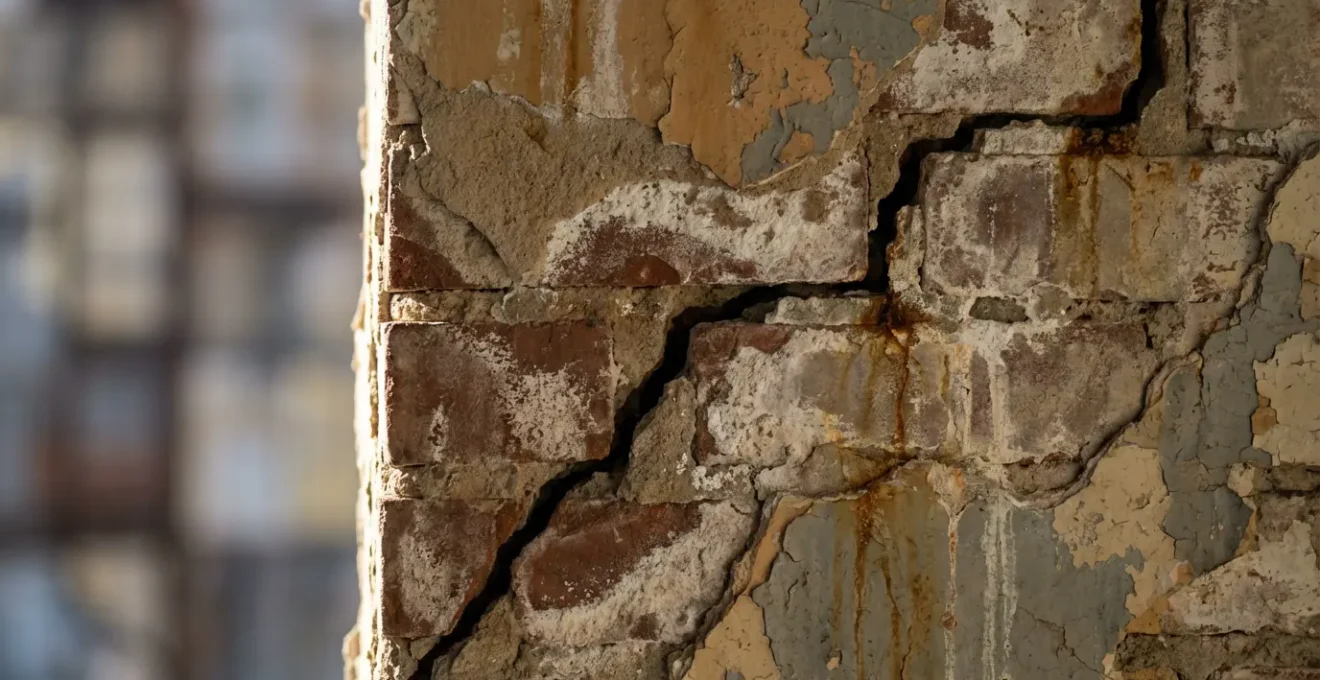
When you enter a ruin, you are entering an environment where the laws of physics are actively and unpredictably reasserting themselves. You must assume every component is interconnected and that your every action has a potential reaction. Your goal is to be an observer, not a catalyst.
Key Takeaways
- The line between civil and criminal trespass is intent; understanding this is your primary legal defense.
- Structural and environmental dangers (rot, asbestos, collapse risk) are often invisible and require a trained eye, not just courage.
- The ultimate goal of responsible exploration is securing legal access, transforming the hobby from a liability into a documented service.
Accessing Abandoned Berlin Industrial Districts for Photography Without Trespassing Fines?
This question, while specific to Berlin, encapsulates the ultimate goal for any serious urban explorer: moving from the legal grey zone of trespass to the clear, defensible position of authorized access. While the thrill of infiltration is part of the initial appeal for many, the mature explorer understands that the best and most rewarding experiences come with permission. It eliminates legal risk, reduces physical danger (as owners can advise on hazards), and allows for unhurried, thorough documentation.
Securing permission is not as simple as knocking on a door, but it is far from impossible. It requires a professional, methodical approach. The first step is identifying the property owner, which can be done through public land registry records. Once you have a name—be it an individual, a corporation, or a property management company—you can craft a formal request. Presenting yourself as a photographer offering a documentation service is key. Many owners of derelict properties may be interested in high-quality photos for insurance, sales, or historical purposes. Offering to share your work for free, in exchange for access, is a powerful value proposition.
Your pitch should be formal, respectful, and clear about your intentions. It helps to have a portfolio or website showcasing your work. Offering to sign a liability waiver or even carrying your own liability insurance can further assuage an owner’s concerns. This approach has proven successful for many explorers and opens doors to sites that would otherwise be inaccessible. Other avenues include reaching out to local historical societies, which may have connections to property owners, or even attending sanctioned historical or paranormal tours of sites that are partially open to the public. For example, sites in the U.S. like the Eastern State Penitentiary and the Trans-Allegheny Lunatic Asylum offer legal access to stunningly decayed architecture through paid tours.
The final and most crucial step is to get any permission in writing. A simple email exchange can serve as a legal document specifying the dates, times, and areas you are permitted to access. This written proof is your definitive protection against any misunderstanding or future claims of trespass.
Ultimately, responsible urban exploration is an exercise in diligence. By understanding the law, respecting the physical and environmental dangers, and striving for authorized access, you not only protect yourself but also elevate the practice. To truly master this discipline, it is essential to never forget the legal foundations that govern every step you take. For a lasting and rewarding journey into the world’s forgotten places, begin by building a robust legal and ethical framework for your explorations.