
Contrary to popular belief, building muscle over 40 is not about lifting heavier; it’s about generating smarter, higher-quality mechanical tension to stimulate growth without overloading your joints.
- True mechanical tension feels like a deep muscle stretch under load, not the superficial “burn” of metabolic stress.
- Mastering the eccentric (lowering) phase of a lift with a slow, controlled tempo is the safest way to increase time under tension and trigger hypertrophy.
Recommendation: Shift your focus from the weight on the bar to the quality of every repetition. Prioritize perfect form and controlled tempo to load the muscle, not the connective tissues.
For the dedicated lifter over 40, the gym can become a place of frustrating paradoxes. You know that progressive overload and high mechanical tension are the cornerstones of muscle growth, yet your joints and tendons increasingly protest with every attempt to add another plate to the bar. The fear of a debilitating injury starts to outweigh the desire for progress, leading to plateaus, frustration, and the nagging question: is it still possible to build significant muscle mass without paying the price in chronic pain or a serious setback?
The conventional wisdom often falls short. Advice like “just lift heavy” or “push through it” is not only unhelpful but dangerous for a mature athlete. Many lifters pivot to “chasing the burn” with high-rep, low-weight training, mistakenly believing this sensation is a proxy for effective, muscle-building work. This approach often prioritizes metabolic stress over the very stimulus needed for growth: true, high-threshold mechanical tension.
But what if the solution wasn’t about simply choosing between heavy, risky lifts and light, ineffective ones? The real key lies in a more sophisticated approach: maximizing the *quality* of mechanical tension, not just the quantity of the load. It’s about understanding the biomechanics of movement to ensure that every ounce of force is directed into the muscle belly, not diverted into vulnerable joints and tendons. This requires a shift in mindset from an ego-driven focus on weight to an expert-level focus on execution.
This guide will deconstruct the principles of intelligent tension management for the older lifter. We will explore how to differentiate real tension from the misleading “burn,” master eccentric control to amplify your results with safer weights, and select exercises that are biomechanically superior for your body, all while protecting your long-term joint health.
To help you navigate these crucial concepts, this article is structured to build your expertise from the ground up. Here is a summary of what you will learn to transform your training for longevity and results.
Summary: A Biomechanical Approach to Lifelong Muscle Growth
- Why “The Burn” Is Not an Indicator of Mechanical Tension?
- How to Control the Eccentric Phase to Double the Time Under Tension?
- Leg Press vs Squat: Which Maintains Constant Tension on Quads Safely?
- The Form Breakdown That Shifts Tension from Muscle to Tendon
- How to Use Tempo Training to Increase Tension With Lighter Weights?
- How to Hinge at the Hips Correctly to Protect Your Lower Back?
- Walking vs Cycling: Which Is Better for Leg Flush Without Joint Impact?
- Which Compound Strength Movements Build the Most Mass in Under 45 Minutes?
Why “The Burn” Is Not an Indicator of Mechanical Tension?
One of the most pervasive myths in resistance training is equating the “burn” with an effective, muscle-building set. This sensation, while intense, is primarily a result of metabolic stress—the buildup of metabolites like lactate and hydrogen ions in the muscle. While metabolic stress can play a secondary role in hypertrophy, it is not the primary driver. The most critical factor for stimulating muscle growth, especially with heavier loads, is mechanical tension.
Mechanical tension is the force exerted on muscle fibers when they are stretched under load, which directly activates pathways leading to muscle protein synthesis. High levels of tension are required to recruit the largest, most growth-prone motor units. As research from Chris Beardsley shows that only heavy loads and fatigue can achieve the high levels of motor unit recruitment necessary for significant hypertrophy. Simply chasing a burn with light weights and fast reps often fails to create sufficient tension to trigger this response.
Think of a thick rubber band. You can create a “burning” friction by rubbing it quickly, but to make it grow stronger and more resilient, you must stretch it deliberately and with significant force. The same applies to your muscles. True mechanical tension feels less like a fire and more like the deep, powerful stretch of the muscle belly being challenged from origin to insertion. Learning to feel this distinction is the first step toward more productive training. You must focus on creating this deep, stretching tension rather than simply accumulating metabolic byproducts.
By shifting your focus from the burn to the quality of contraction and load, you align your efforts with the primary mechanism of muscle growth, ensuring every set is maximally effective.
How to Control the Eccentric Phase to Double the Time Under Tension?
The eccentric phase of a lift—the lowering or “negative” portion—is arguably the most important and underutilized variable for experienced lifters. While the concentric (lifting) phase generates force, the eccentric phase is where the muscle is under tension while lengthening. This process is uniquely potent for creating the microscopic muscle damage that signals repair and growth. For older lifters, mastering the eccentric is a strategic tool to increase total time under tension (TUT) without needing to increase the weight on the bar.
Instead of letting gravity do the work, you consciously resist it. A typical repetition might have a one-second concentric and a one-second eccentric. By simply extending the eccentric phase to four seconds, you double the total time the muscle is under load for that repetition (1 second up, 4 seconds down). This dramatically increases the hypertrophic stimulus of each set. In fact, a 2025 meta-analysis demonstrates that 4-second eccentric durations enhanced strength gains in trained individuals, confirming this method’s efficacy.
This deliberate control not only boosts muscle growth but also significantly enhances safety. Slowing down the eccentric movement improves your mind-muscle connection and reinforces proper motor patterns. It forces you to control the weight through the entire range of motion, reducing the likelihood of momentum-based form breakdown that can shift stress onto joints and tendons. Starting with machines before progressing to free weights can help you safely master this technique.
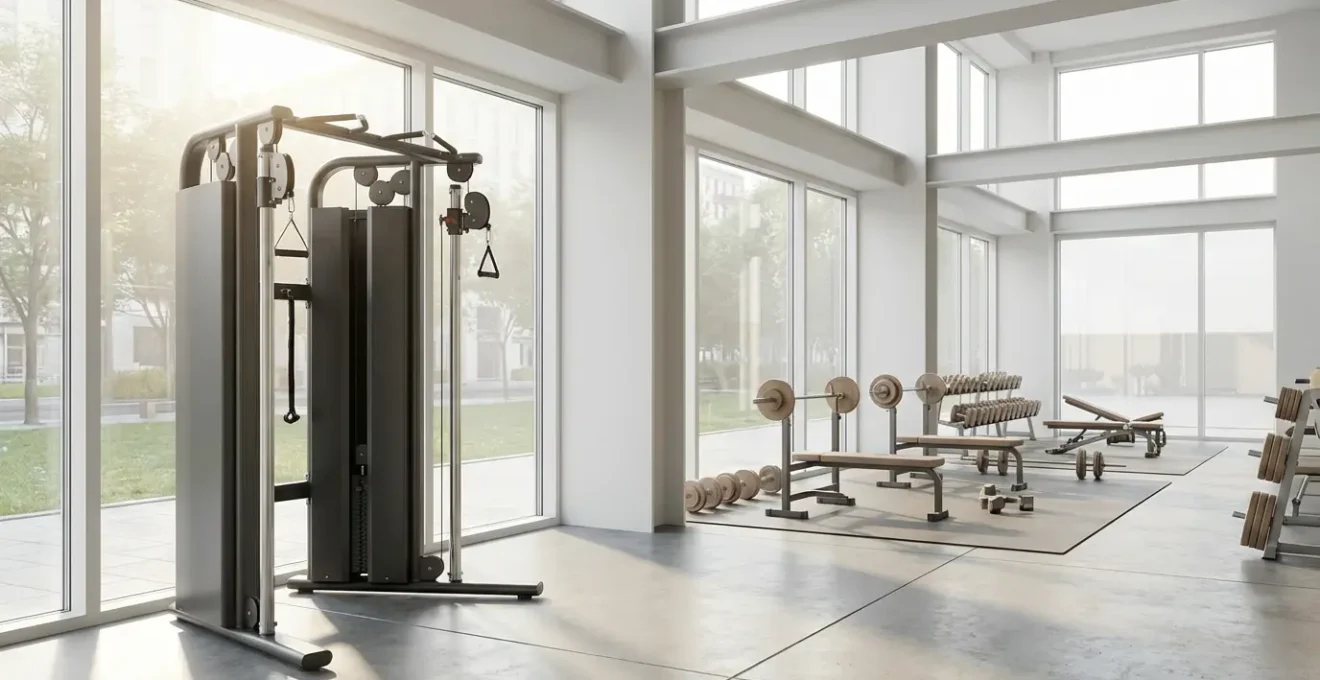
As the image above illustrates, you can begin by ingraining the slow eccentric pattern on a guided machine, like a cable row, before applying the same principle to more demanding free-weight movements. This progressive approach ensures you build both the strength and the neuromuscular control needed to execute perfect, tension-focused reps every time.
Ultimately, a controlled eccentric is not just about going slow; it’s about owning every inch of the repetition and transforming a standard set into a powerful growth stimulus.
Leg Press vs Squat: Which Maintains Constant Tension on Quads Safely?
The squat is often hailed as the “king of exercises,” and for good reason. It builds functional strength, engages the core, and stimulates systemic growth. However, for older lifters or those with pre-existing knee or back issues, the high stability demands and compressive forces of a heavy barbell squat can be problematic. The leg press, on the other hand, offers a biomechanically stable alternative that allows for a focus on maintaining constant tension specifically on the quadriceps with reduced systemic stress.
The primary advantage of the leg press is the external stability provided by the machine. This removes the need to balance, allowing you to focus entirely on driving force through your legs. Furthermore, it can often allow for a deeper range of motion safely. As noted by Sjöberg et al. in *Frontiers in Sports and Active Living*, a deep range of motion is a critical factor for quadriceps hypertrophy:
A deep rather than shallow knee-inflexion point appears to be a key factor for strength development and hypertrophy of the quadriceps muscle. Greater muscle-tendon forces over the knee joint and longer knee-extensor muscles have been postulated as the main stimuli. Thus, for strength training of the quadriceps muscles, flywheel leg press might be preferable to flywheel squat.
– Sjöberg et al., Frontiers in Sports and Active Living
This ability to achieve deep knee flexion in a supported position can make the leg press a superior choice for targeting the quads, especially when joint health is a priority. The key is to perform the movement without locking out at the top, thus maintaining constant tension on the muscle throughout the set and preventing the stress from shifting to the knee joint.
The following table, based on biomechanical research, breaks down the key differences to help you make an informed choice for your programming. A comparative analysis published in Frontiers highlights these distinctions clearly.
| Factor | Leg Press | Squat |
|---|---|---|
| Knee Flexion Depth | 11° deeper | More restricted |
| Quadriceps Activity | Similar | Similar |
| Joint Stress | Lower | Higher TF/PF forces |
| Stability Requirement | Minimal (guided) | High (balance needed) |
| Recommended For | Joint sensitivity | Functional strength |
While the squat remains a phenomenal tool for overall strength, the leg press stands out as a strategic choice for safely applying high, constant tension directly to the quadriceps, making it an invaluable asset in the older lifter’s arsenal.
The Form Breakdown That Shifts Tension from Muscle to Tendon
For a mature lifter, the goal of a set should be to reach technical failure, not absolute muscular failure. Technical failure is the point at which you can no longer perform a repetition with perfect form. Pushing beyond this point is where the risk-to-reward ratio skyrockets. When form breaks down, the load is no longer being managed by the target muscle; instead, it’s shunted to connective tissues like tendons and ligaments, as well as synergist muscles that aren’t prepared for the load. This is the precise mechanism that leads to strains, sprains, and chronic tendonitis.
This “tension leak” is a subtle but critical event. Imagine a bicep curl: in the final, grinding reps, you might start to swing your body or raise your shoulder to complete the lift. At that moment, the tension has shifted from the bicep to the lower back and the front deltoid tendon. You completed the rep, but you compromised the stimulus and dramatically increased your injury risk. True muscle-building tension requires that the target muscle fibers remain the primary movers throughout the entire set.

Maintaining this perfect alignment, as visualized in the muscle fibers above, is paramount. The moment you feel stress concentrating in a joint or a tendon insertion point instead of the muscle belly, the set is over. This requires intense focus and honesty, leaving your ego at the door. Terminating a set one or two reps “early” with perfect form is infinitely more productive and safer than grinding out sloppy reps that do more harm than good.
Action Plan: Auditing Your Form for Tension Leaks
- Monitor for lower back rounding during rows – indicates shift from lats to rhomboids and bicep tendon
- Watch for shoulder rolling forward on pressing movements – tension shifts from chest to front deltoid
- Feel for stress moving from muscle belly to joint – immediate signal to end the set
- Use mirror or video to catch subtle form degradation before it becomes dangerous
- Apply the ‘first rep rule’ – stop at the very first rep where form compromises
By defining failure by technique rather than by sheer effort, you ensure that every set you perform contributes to muscle growth, not the gradual erosion of your joint health.
How to Use Tempo Training to Increase Tension With Lighter Weights?
Tempo training is one of the most powerful tools for an older lifter. It allows you to manipulate the stimulus of an exercise without having to add more weight. By assigning a specific count to each phase of the lift (eccentric, pause, concentric), you can dramatically increase the time under tension and force your muscles to work harder with loads that are significantly more joint-friendly. This method directly challenges the muscle fibers while giving your connective tissues a much-needed break from maximal loads.
A common tempo prescription is “3-1-1-0,” which translates to a 3-second eccentric (lowering), a 1-second pause at the bottom, a 1-second concentric (lifting), and no pause at the top. This deliberate pacing eliminates momentum and forces the muscle to stay engaged throughout the entire range of motion. The physiological benefits are significant; recent research published in 2024 confirms that an 8-week eccentric training program significantly increases muscle fascicle length, a key architectural adaptation associated with both strength and injury resilience.
This means that not only are you building muscle more safely, but you are also making the muscle itself more robust. One effective application of this principle is the “3-3-3” or “Tricon” method, which combines multiple stimuli into a single set to maximize hypertrophy with lighter weights.
Case Study: The 3-3-3 Training Method for Older Lifters
The 3-3-3 training method, highlighted by Men’s Health, is specifically designed to help men over 50 build muscle with joint-friendly weights. A single nine-rep set is broken into three distinct phases: three explosive concentric reps to target fast-twitch fibers, three isometric holds at the point of peak contraction to extend time under tension, and finally, three very slow and controlled eccentric reps to increase metabolic stress and muscle damage. This ‘Tricon’ method packs multiple growth stimuli into one efficient set, delivering significant hypertrophy without the need for heavy, potentially injurious loads, making it perfectly suited for the mature lifter.
Tempo training effectively shifts the focus from “how much” you lift to “how well” you lift, proving that intelligent execution can be a far more potent driver of muscle growth than brute force alone.
How to Hinge at the Hips Correctly to Protect Your Lower Back?
The hip hinge is a fundamental human movement pattern, yet it is one of the most poorly executed in the gym. A correct hip hinge—the foundation for exercises like Romanian Deadlifts (RDLs), good mornings, and kettlebell swings—involves pushing the hips backward while maintaining a neutral, straight spine. The movement should be initiated by the glutes and hamstrings, not the lower back. For the older lifter, mastering the hip hinge is non-negotiable, as it is the primary mechanism for protecting the lumbar spine from injurious shear forces.
Many people mistakenly turn a hinge into a squat by bending their knees too much, or they flex their spine by rounding their lower back to reach the floor. This immediately shifts the load from the powerful posterior chain (glutes and hamstrings) to the vulnerable spinal erectors and intervertebral discs. The goal is to feel a deep stretch in the hamstrings as your hips travel backward, a clear sign that the tension is in the right place.
To learn or re-groove this pattern, it’s essential to prime the movement before loading it. Performing a sequence of activation drills can help “wake up” the glutes and teach your body the correct motor pattern. Think of it as reminding your nervous system of its job before you ask it to perform under load.

As this image metaphorically shows, your hips should act as the pivot point, like a door hinge, while your spine remains rigid and straight like the door itself. The following priming sequence can help you master this feeling:
- Wall Taps: Stand with your back a few inches from a wall. Keeping your spine straight, hinge at the hips to tap your glutes against the wall. This trains the proper hip-first movement.
- Glute Bridges: Lie on your back and perform 10-15 reps to activate the glutes as the primary hip extensors.
- Leg Swings: Perform dynamic forward/backward and side-to-side leg swings (10 each direction) to improve hip mobility.
- Bodyweight RDLs: Practice the Romanian Deadlift with no weight, focusing exclusively on pushing your hips back as far as possible while maintaining a flat back.
By investing time in mastering the hip hinge, you not only unlock the potential of powerful posterior chain exercises but also build a resilient foundation that protects your lower back in and out of the gym.
Walking vs Cycling: Which Is Better for Leg Flush Without Joint Impact?
Active recovery is a critical component of a sustainable training program, especially for older lifters. Low-intensity sessions, often called “flushes,” help increase blood flow to sore muscles, clearing out metabolic waste and delivering nutrients to aid in repair. This can reduce delayed onset muscle soreness (DOMS) and improve your readiness for the next heavy training day. When it comes to flushing the legs, the two most common options are walking and cycling. The best choice depends on your specific needs and potential joint sensitivities.
Walking is the most natural and accessible form of human movement. It engages the entire leg musculature in a functional pattern. However, the impact, while low, can still be an issue for those with sensitive knees, hips, or ankles, particularly when walking on hard surfaces like concrete. A brisk walk on a softer surface like a track or trail is often an excellent choice.
Cycling, especially on a stationary bike, offers a true zero-impact alternative. It allows for a high degree of control over resistance and cadence, making it perfect for promoting blood flow without any jarring forces on the joints. This makes it an ideal choice after a grueling leg day. The main caveat with cycling is the importance of proper bike fit; a poorly adjusted seat or handlebar position can lead to knee or back pain, negating the benefits.
To make the best decision for your recovery, it’s helpful to compare these and other low-impact options. The following table provides a quick overview of the pros and cons of common recovery modalities for mature lifters.
| Activity | Joint Impact | Recovery Benefits | Hidden Risks |
|---|---|---|---|
| Walking | Low-Moderate | Natural movement pattern | Hard surfaces aggravate joints |
| Cycling | Zero | Excellent blood flow | Poor bike fit causes pain |
| Aqua-jogging | Zero | Hydrostatic pressure aids recovery | Pool access required |
| Elliptical | Zero | Smooth gliding motion | Unnatural movement pattern |
Ultimately, the “better” option is the one you can perform consistently and pain-free. For maximum joint protection, cycling or aqua-jogging are superior, but a mindful walk in the right environment remains a simple and effective recovery tool.
Key Takeaways
- Tension Over Burn: Prioritize deep, stretching mechanical tension over the superficial “burn” of metabolic stress for optimal muscle growth.
- Master the Eccentric: A controlled, 4-second negative is a non-negotiable tool for increasing time under tension safely and effectively.
- Train to Technical Failure: For older lifters, the set ends when form breaks, not when the muscle gives out. This is the key to loading muscle, not joints.
Which Compound Strength Movements Build the Most Mass in Under 45 Minutes?
For the time-crunched lifter, efficiency is everything. Building and maintaining muscle mass is a crucial defense against age-related decline; according to the Office on Women’s Health, adults can lose 3-5% of their muscle mass per decade after age 30. A full-body routine focused on the six fundamental human movement patterns is the most time-efficient way to stimulate all major muscle groups and trigger a powerful hormonal response for growth.
Rather than dedicating entire days to specific body parts, a full-body workout structured around these patterns ensures you get maximum bang for your buck in under 45 minutes. The six patterns are: a horizontal push (like a chest press), a horizontal pull (like a row), a vertical push (like a shoulder press), a vertical pull (like a lat pulldown), a squat/knee-dominant movement (like a leg press), and a hinge/hip-dominant movement (like an RDL). By pairing opposing movements into supersets (e.g., a push followed immediately by a pull), you can minimize rest time and increase workout density.
A critical consideration for older lifters is managing training volume and intensity. While high effort is required for growth, pushing every set to absolute failure can cause excessive muscle damage and CNS fatigue, hindering recovery. A more strategic approach is to limit true-to-failure sets to just one or two per exercise on big compound lifts, with the majority of your work being done one or two reps shy of technical failure. This provides a potent stimulus without overwhelming your recovery capacity.
Here is a sample workout structure that covers all essential movement patterns efficiently:
- Superset A (3 sets):
- A1: Horizontal Push (e.g., Chest Press Machine) – 8-12 reps
- A2: Horizontal Pull (e.g., Seated Cable Row) – 8-12 reps
- Superset B (3 sets):
- B1: Knee-Dominant (e.g., Leg Press or Goblet Squat) – 10-15 reps
- B2: Hip-Dominant (e.g., Romanian Deadlift or Back Extension) – 10-12 reps
- Superset C (2 sets):
- C1: Vertical Push (e.g., Dumbbell Shoulder Press) – 10-12 reps
- C2: Vertical Pull (e.g., Lat Pulldown) – 10-12 reps
By implementing this efficient, pattern-based approach and intelligently managing your intensity, you can build and maintain significant muscle mass with just a few focused sessions per week, proving that longevity and results can go hand-in-hand.