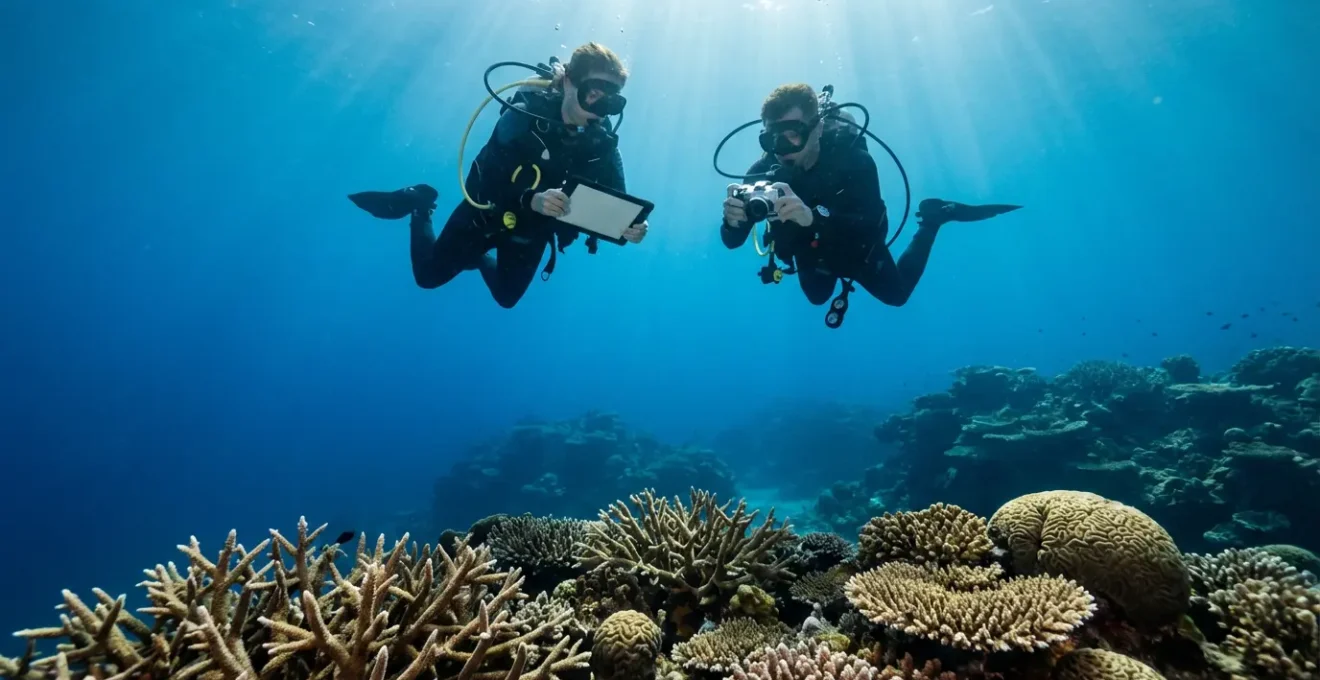
In summary:
- Your impact as a diver goes beyond “do no harm”; it’s about making informed, targeted contributions.
- Understanding the science behind threats like chemical sunscreen pollution and bacteria transfer transforms your actions from simple rules into powerful conservation tools.
- Mastering advanced skills like neutral buoyancy and safe net removal techniques allows you to actively restore and protect, not just observe.
- Your choices on land, from the tour operator you book to your digital photo storage, have a significant and often overlooked impact on marine ecosystems.
For anyone who has experienced the silent, weightless world beneath the waves, the connection to the ocean is profound. You’ve witnessed the intricate dance of a cleaner shrimp, the gentle sway of a sea fan, and the vibrant chaos of a healthy coral reef. But with this privilege comes a shared concern, a feeling of helplessness as news of coral bleaching, plastic pollution, and biodiversity loss becomes more frequent. The greatest threat remains climate change, but local stressors dramatically weaken the ocean’s resilience.
Many well-intentioned divers follow the standard advice: don’t touch marine life, pick up visible trash, and choose a “reef-safe” sunscreen. While these actions are important, they represent the baseline, the bare minimum. They often fail to address the complexity of the problems and can sometimes even be counterproductive if performed without a deeper understanding. The desire to do more, to contribute in a meaningful way, is a powerful current running through the dive community.
But what if the key to impactful conservation isn’t about becoming a marine biologist overnight, but about elevating your existing passion with specific knowledge? This guide moves beyond the platitudes. It’s about transforming you from a passive visitor into an active, effective ocean steward. We will explore the hidden science behind common dive practices, learn the precise techniques that make a difference, and scrutinize the choices we make to ensure our efforts truly count.
This article will guide you through a series of practical, science-backed strategies. We will dissect why some “reef-safe” products fail, detail the professional methods for removing hazardous ghost nets, and evaluate which citizen science apps provide the most valuable data. By understanding the “why” behind each action, you can turn every dive into a targeted mission for the ocean’s future.
Summary: From Passive Observer to Active Ocean Steward
- Why Your “Reef-Safe” Sunscreen Might Still Be Bleaching Corals?
- How to Safely Remove Fishing Nets Without Damaging the Reef Structure?
- iNaturalist vs CoralWatch: Which App Actually Helps Researchers?
- The Bacteria Transfer That Kills Coral After a Single Touch
- How to Master Hovering to Take Macros Without Crashing into the Bottom?
- Sanctuary or Zoo: How to Tell if an Animal Encounter Is Ethical?
- Why Your Cloud Storage Has a Carbon Footprint Equal to the Airline Industry?
- Which Reef Restoration Projects Actually Deliver Measurable Biodiversity Returns?
Why Your “Reef-Safe” Sunscreen Might Still Be Bleaching Corals?
The term “reef-safe” has become a familiar sight on sunscreen bottles, a reassuring label for the eco-conscious diver. However, this term is largely unregulated, and many products that claim to be safe still contain chemicals harmful to marine life. The issue isn’t just a drop in the ocean; between 8,000 and 16,000 tons of sunscreen wash into coral reef areas each year. The core of the problem lies in specific UV-filtering chemicals, most notoriously oxybenzone and octinoxate.
Scientific research has laid bare the devastating impact of these compounds. One landmark study showed that oxybenzone becomes acutely toxic to coral larvae at incredibly low concentrations. Worse, when exposed to sunlight in the water, it transforms from a protective filter into a compound that damages coral DNA. This means the very process it’s designed for—absorbing UV light—is what makes it so lethal to the reef’s youngest and most vulnerable inhabitants. The “reef-safe” label can be misleading if it only omits one or two banned chemicals while including others with similar harmful properties.
True reef-safe sunscreens rely on non-nanotized mineral filters, like zinc oxide or titanium dioxide. These create a physical barrier on the skin rather than a chemical one. However, the most effective way for a diver to protect both their skin and the reef is to minimize sunscreen use altogether. Wearing a full-body rash guard, a dive skin, and a wide-brimmed hat on the boat provides superior UV protection without introducing any foreign substances into the water. When sunscreen is absolutely necessary, a thorough check of the active ingredients for anything other than non-nano zinc oxide or titanium dioxide is crucial. This shift in habit from chemical reliance to physical barriers is a simple but powerful act of conservation.
Case Study: The Hope of Safer Sunscreen Polymers
The challenge of creating effective and truly reef-safe sunscreens is driving innovation. Researchers at Tsinghua University developed a new polymeric UV filter that may offer a solution. In tests, this polymer not only protected skin from UV damage but also proved non-hazardous to coral and algae. While corals exposed to oxybenzone bleached and died within days, those exposed to the new polymer remained healthy. This research highlights a promising future where dermatological needs and marine conservation are no longer in conflict.
How to Safely Remove Fishing Nets Without Damaging the Reef Structure?
Among the various forms of marine debris, lost or abandoned fishing gear, known as “ghost nets,” are the most insidious. These nets, designed to be durable and efficient at catching marine life, continue to do so for decades after being lost. They entangle everything from fish and turtles to dolphins and even whales. For coral reefs, they are a physical menace, breaking fragile coral branches with the constant motion of currents and smothering entire sections of the reef, blocking sunlight and causing tissue death. The scale of the issue is staggering; the NOAA marine debris team has removed over 2 million pounds of these nets from the Northwestern Hawaiian Islands alone.
Simply pulling on a ghost net is one of the most damaging things a well-intentioned diver can do. The nets are often deeply integrated into the reef structure, and yanking them can cause a “slingshot effect,” breaking vast swaths of decades-old coral. Proper removal is a surgical procedure, not a tug-of-war. It requires specialized tools, training, and a patient, methodical approach. The primary goal is to minimize collateral damage to the living reef.
Professional removal teams use tools like ceramic-bladed net cutters and trauma shears that can slice through thick nets without rusting. The process involves a team of divers with specific roles: assessing tension points, carefully cutting the net into smaller, manageable sections, and meticulously removing any entrapped marine life before lifting a single piece. For the average recreational diver, the most responsible action is often not to remove the net themselves but to document and report it. Taking clear photos, recording the exact GPS coordinates, and reporting the findings to local authorities or a conservation group like Project AWARE is an invaluable contribution. It allows trained professionals to tackle the job safely and effectively.
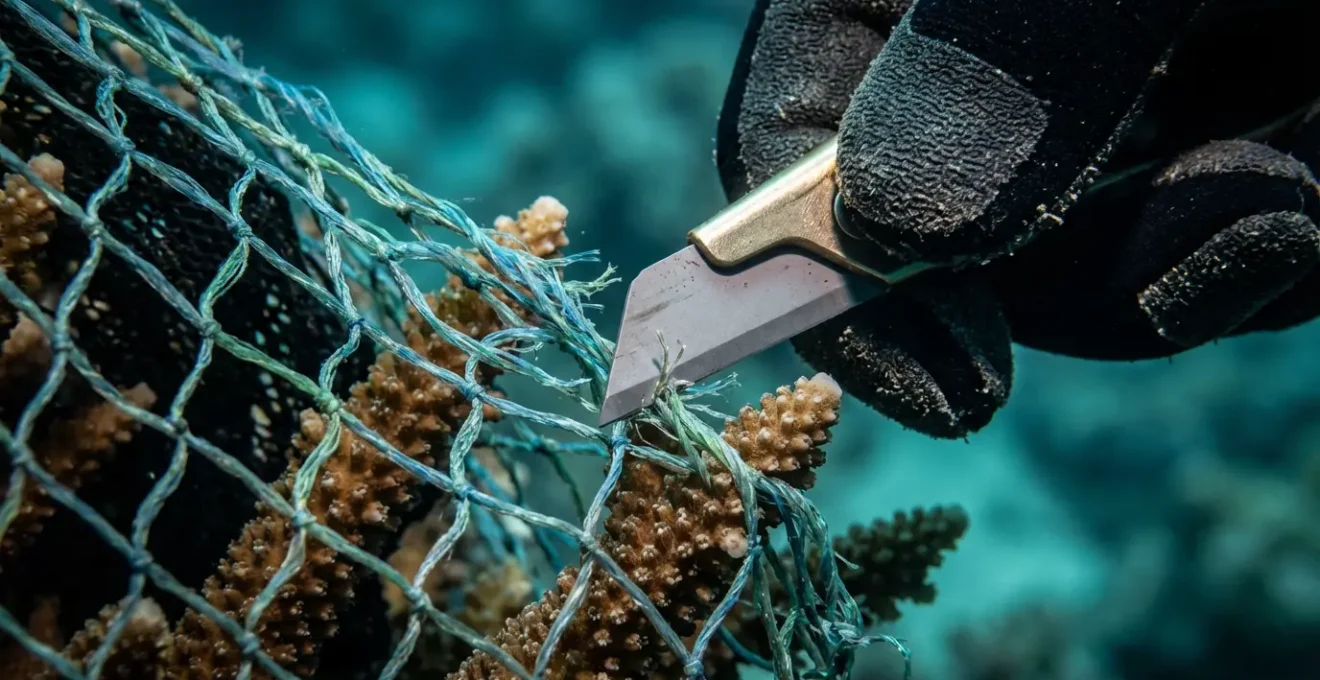
This image captures the precision required for conservation work. The diver isn’t just pulling; they are using a specialized tool to make a calculated cut, a perfect illustration of how skill and knowledge are more important than brute force. This careful technique ensures the living coral entwined in the net remains unharmed.
Your Action Plan: Safe Ghost Net Assessment
- Assess & Report: Evaluate the net’s entanglement and size. Is it a small piece you can safely remove, or a large, embedded net needing a pro team? Document the exact location with GPS and report it to local dive operators or conservation authorities.
- Gear Up: For small-scale removal, inventory your tools. A good dive knife is a start, but specialized ceramic-bladed cutters are far more effective and safer for the reef. Never attempt a large removal without the right equipment.
- Free the Fauna: Before making a single cut, meticulously inspect every part of the net for trapped marine life. Carefully free any living creatures, paying close attention to stressed or injured animals.
- Analyze & Plan: If you decide to proceed, work with your buddy. Analyze the net’s tension points. Plan your cuts to avoid a “slingshot” effect that could snap back and destroy adjacent coral colonies.
- Document & Dispose: Photograph the net in place and the debris you remove. Once on shore, weigh the collected material if possible and report the data to a global database like Project AWARE’s Dive Against Debris®.
iNaturalist vs CoralWatch: Which App Actually Helps Researchers?
The smartphone has become a powerful tool for conservation. For divers, citizen science apps offer a direct channel to contribute valuable data to global research projects. However, not all apps serve the same purpose. Choosing the right tool for the job is essential to ensure your efforts are genuinely useful. As Earthwatch scientist Zach Boakes notes, many divers are immersed in the beauty of the ocean, but “only a small percentage contributes to its conservation.” These apps bridge that gap.
A large percentage of scuba divers enjoy being underwater because they feel immersed in the beauty of the marine environment. Despite this, only a small percentage contributes to its conservation.
– Zach Boakes, Earthwatch Restoring Coral Reefs expedition scientist
Two of the most prominent platforms for marine observation are iNaturalist and CoralWatch, but they answer fundamentally different research questions. Understanding their differences is key to becoming an effective citizen scientist. iNaturalist is a biodiversity census. Your goal is to photograph and identify as many different species as possible. This data helps scientists map species distribution, track the spread of invasive species, and identify biodiversity hotspots. It answers the question: “What lives here?”
CoralWatch, on the other hand, is a health monitoring system. It’s not about identifying coral species, but about assessing their health through color. Using a standardized color chart held up against the coral, you record its color, which is a proxy for the level of bleaching. This data helps researchers track the progression and severity of mass bleaching events in real-time. It answers the question: “How healthy is this reef?” Choosing which app to use depends on your objective: are you documenting the richness of life, or are you sounding the alarm about a reef in distress?
| Feature | iNaturalist | CoralWatch |
|---|---|---|
| Primary Purpose | Biodiversity Census – Species distribution mapping | Health Monitoring – Coral bleaching tracking |
| Data Type | Photos for species identification | Color chart readings for bleaching assessment |
| Validation Method | Community verification system | Standardized methodology |
| Research Application | Maps species distribution patterns | Tracks bleaching events over time |
| User Requirements | Smartphone with camera | Color chart kit and training |
The Bacteria Transfer That Kills Coral After a Single Touch
“Don’t touch the coral” is the first rule every diver learns. But it’s often presented as a general precaution against breaking fragile structures. The reality is far more insidious and microscopic. A single touch can initiate a chain of events that leads to disease and death for the coral colony, a critical issue when global assessments show that 14% of the world’s coral has been lost since 2009. The threat isn’t just from the physical pressure of a hand or fin, but from the invisible transfer of bacteria.
Corals are covered in a thin, protective layer of mucus. This layer is their first line of defense against pathogens, much like our skin. It’s teeming with a beneficial microbiome that helps keep the coral healthy. When a diver touches a coral, even gently, they strip away this essential mucus layer. This action does two things: it exposes the vulnerable coral tissue beneath and, more alarmingly, it can transfer foreign bacteria from the human skin or dive gear directly onto that exposed tissue.
This is not a theoretical risk. Scientists have documented the direct link between physical contact and coral disease. In areas with high diver traffic, incidences of coral diseases like Stony Coral Tissue Loss Disease (SCTLD), a fast-acting and highly lethal plague, are often more prevalent. The bacteria we carry, which are harmless to us, can be catastrophic pathogens to a stressed coral polyp. Mastering perfect buoyancy isn’t just about avoiding breakages; it’s a critical biosecurity protocol to prevent the spread of disease. Every dive is an exercise in sterile technique, where maintaining distance is paramount to the reef’s health.
Case Study: NOAA’s Photogrammetry Reveals Hidden Damage
In the Northwestern Hawaiian Islands, NOAA scientists used advanced photogrammetry to create 3D models of reefs and track changes over time. Their findings were stark: areas with even minor, incidental contact from divers and their equipment showed significant increases in coral mortality and structural damage. The research visually confirmed that contact removes the protective mucus, creating an open wound for bacterial infection and colonization by deadly pathogens. This work makes the invisible threat of bacterial transfer visible and undeniable.
How to Master Hovering to Take Macros Without Crashing into the Bottom?
Mastering neutral buoyancy is the mark of a skilled diver, but for an underwater photographer or a conservation-minded observer, it is the absolute foundation of ethical interaction. It’s the practical application of the “do not touch” principle discussed previously. The goal is to become a weightless, stable platform, capable of observing and photographing delicate marine life without making any contact with the reef or stirring up sediment that can smother corals. This is especially crucial for macro photography, which requires getting extremely close to tiny subjects.
Achieving this level of control goes beyond basic buoyancy checks at the start of a dive. It involves a suite of advanced “trim” and propulsion techniques. Perfect trim means being perfectly horizontal in the water, with your fins elevated to prevent accidental contact or kicking up sand. This is achieved through careful weight placement, not just the total amount of weight you carry. Techniques like “sculling” with your hands for micro-adjustments, using subtle “helicopter turns” initiated by your core and breath, or “back-finning” to move away from a subject without turning around are essential skills.
The most important tool, however, is your own lungs. Small, controlled changes in lung volume allow you to make minute adjustments in depth, ascending or descending a few inches to frame the perfect shot without ever moving your hands or fins. The “one-finger rule”—anchoring yourself with a single finger on a patch of non-living substrate—should be a last resort, used only after verifying the spot is bare rock or sand. The ultimate goal is to approach, photograph, and depart from a subject while remaining completely suspended in the water column, leaving no trace of your presence.
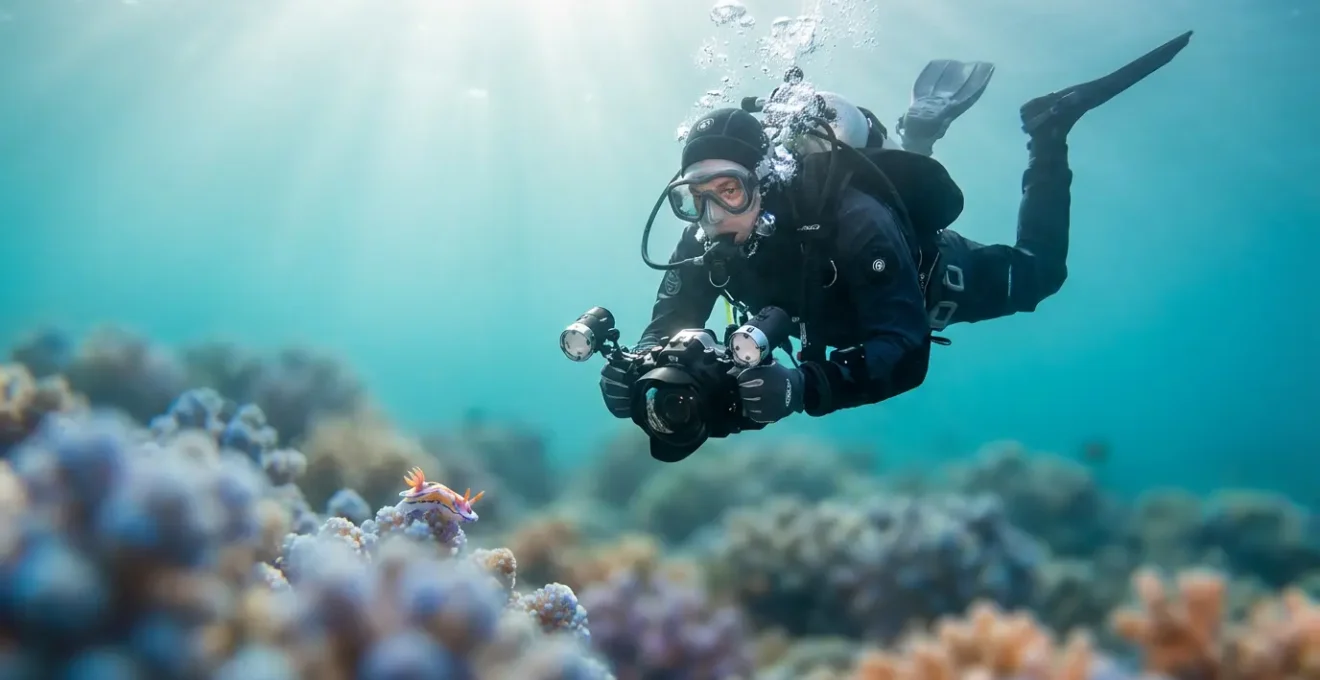
This image is the embodiment of reef-safe diving. The photographer is perfectly horizontal, fins up and away from the delicate corals below. Their calm focus and precise positioning show that photography and conservation can go hand-in-hand. This motionless hover is the result of countless hours of practice and is the gold standard for every diver to aspire to.
- Master ‘sculling’: Use gentle, figure-eight motions with your hands for tiny forward, backward, or rotational adjustments without using your fins.
- Practice ‘helicopter turns’: Use your breath and subtle body twists to rotate 360 degrees on the spot, allowing you to scan your surroundings without forward movement.
- Learn ‘back-finning’: Develop the ability to use a reverse frog kick or flutter kick to move backward, away from a subject or wall, without stirring sediment.
- Achieve photographer’s trim: Use trim weights on your tank band or shoulders to achieve a perfect horizontal position in the water, keeping your fins elevated.
- Use your lungs as a BCD: Practice making small 1-2 foot ascents and descents using only your breath control for fine-tuning your position near the reef.
- Apply the ‘one-finger rule’ sparingly: Only use a single finger or a muck stick to stabilize on a piece of verified non-living substrate, never on live coral or rock.
- Plan your approach: Start planning your photographic composition from 10 feet away to minimize the time you need to hover close to the fragile ecosystem.
Sanctuary or Zoo: How to Tell if an Animal Encounter Is Ethical?
Diving with majestic creatures like manta rays, sharks, or turtles is often a peak life experience. This demand has fueled a boom in marine wildlife tourism. But there is a fine line between an ethical encounter that supports conservation and a harmful one that prioritizes profit over animal welfare. As a conscious diver, your choice of operator is a powerful vote for one or the other. You have the power to support operations that function as genuine sanctuaries, and to avoid those that are little more than underwater zoos.
The first and most significant red flag is any operator that guarantees an animal interaction. Wildlife is, by its nature, wild and unpredictable. A guarantee almost always implies that the animals are being baited with food or otherwise habituated to human presence. Baiting fundamentally alters natural feeding behaviors, can create dependency, and may lead to aggressive interactions. An ethical operator will brief you on what you *might* see but will never promise a specific animal sighting.
Dig deeper into the operator’s conservation credentials. Do they proudly and transparently state what percentage of their revenue goes directly to local conservation projects? Legitimate eco-tourism operators are partners in conservation and will have specific projects and results to share. Also, ask about their operational limits. Do they restrict the number of boats, divers, or snorkelers at a site at any given time? Strict limits are a clear sign that they are managing for animal stress levels, not just maximizing customer throughput. As the policy statement of one sustainable operator puts it, the experience should be about seeing animals that are “truly wild and free.”
We believe that diving is most magical when the marine life we see is truly wild and free.
– Let’s Dive Tulamben, Sustainable diving operator policy statement
Your responsibility doesn’t end when you book the trip. During the briefing and the dive itself, pay close attention to the rules. Are there strict guidelines on maintaining distance? Are there rules against chasing or blocking an animal’s path? The best operators empower their guides to strictly enforce these rules, even if it means cutting an encounter short. By choosing operators who put the animal’s welfare first, you are directly funding the protection of the very species you hope to see.
Why Your Cloud Storage Has a Carbon Footprint Equal to the Airline Industry?
As divers, we are keenly aware of the physical threats to the ocean, like the estimated 500,000 to 1 million tons of ghost gear that enter the ocean annually. But one of our most significant environmental impacts is one we can’t see: our digital footprint. In the age of high-definition underwater cameras, a single dive trip can generate hundreds of gigabytes of photos and 4K video. We upload these to the cloud for safekeeping and sharing, but where is “the cloud”? It’s not an ethereal mist; it’s a network of massive, power-hungry data centers around the world.
These data centers require a colossal amount of energy to run servers and, critically, to keep them cool. Collectively, the world’s data centers consume so much electricity that their carbon footprint is comparable to that of the entire airline industry. Every photo and video you store contributes to this energy demand. That stunning 10-minute 4K video of a whale shark isn’t just a file; it’s a persistent energy liability that requires power 24/7, for years. While the impact of one diver’s photos may seem small, the collective digital weight of millions of divers is substantial.
This doesn’t mean you should stop capturing the beauty of the underwater world. Sharing these images is vital for raising awareness. The solution lies in becoming a conscious digital curator. Instead of uploading everything, take the time to edit your files. Delete the blurry shots and the duplicates. Create short, compelling highlight reels instead of storing hours of raw footage. Compress large 4K video files to a more manageable 1080p for long-term storage. Use local hard drives for your primary archive and be selective about what you keep in the cloud. By cleaning up your digital dive log, you can significantly reduce your personal contribution to this massive energy demand, a novel but important way to protect the planet you love to explore.
- Review your cloud storage monthly and delete blurry, duplicate, or uninteresting underwater photos and videos.
- Compress large 4K video files to 1080p resolution before uploading them for long-term cloud storage.
- Instead of storing entire raw video clips, edit them into shorter, more engaging highlight reels.
- Use local external hard drives as your primary archive for raw files, using the cloud only for your edited finals and select favorites.
- When sharing, send links to compressed video clips rather than attaching and sending full-resolution files.
- Research your cloud provider and consider switching to one that is publicly committed to powering its data centers with renewable energy.
Key Takeaways
- True conservation is about informed action; understand the science behind the rules to maximize your positive impact.
- Your role extends beyond the dive; ethical operator selection and even digital file management are crucial conservation acts.
- Mastering advanced skills like precision buoyancy and proper assessment techniques transforms you from a passive observer to an active protector of the reef.
Which Reef Restoration Projects Actually Deliver Measurable Biodiversity Returns?
Faced with the decline of coral reefs, many divers are eager to support restoration projects. We see compelling images of “coral gardening,” where small fragments of coral are grown in nurseries and then “outplanted” back onto the reef. While born from a great passion for the ocean, not all restoration projects are created equal. The most critical question to ask is: does this project deliver measurable returns in biodiversity and ecosystem function, or is it just creating pretty patches of a single coral species?
Traditional metrics for success often focus on simple numbers: the percentage of planted coral fragments that survive or the total area covered. While these are important, they don’t tell the whole story. A successful reef is a complex, thriving city of countless species, not just a monoculture of one type of fast-growing coral. A truly effective project must be measured by more advanced Key Performance Indicators (KPIs) that reflect the return of a functioning ecosystem.
These advanced metrics look beyond mere coral survival. They measure things like the functional biodiversity index, which assesses the variety of roles that different species play in the ecosystem. They track the rate of wild coral recruitment, which shows if the restored patch is healthy enough to attract new, naturally settling coral larvae. They monitor the return of key species, like herbivorous fish that graze on algae and keep the reef clean for coral to grow. They also measure the genetic diversity of the planted corals to ensure the new reef has the resilience to withstand future stressors like warming waters. As a potential volunteer or donor, your job is to ask projects tough questions about how they measure success beyond simple survival rates.
| Metric Type | Traditional Measure | Advanced KPI | Why It Matters |
|---|---|---|---|
| Success Rate | Coral survival rate (%) | Functional biodiversity index | Measures ecosystem recovery, not just coral survival |
| Reproduction | Number of fragments planted | Wild coral recruitment rate | Shows if restoration attracts natural colonization |
| Genetic Health | Single species focus | Genetic diversity scoring | Ensures resilience against future stressors |
| Ecosystem Function | Coral coverage (%) | Herbivorous fish return rate | Indicates complete ecosystem restoration |
By shifting your perspective from simply following rules to understanding the science and ethics behind them, you transform yourself. You are no longer just a tourist visiting the underwater world; you are a citizen scientist, a skilled technician, and a conscious consumer. You are a crucial part of a global community of divers dedicated to protecting the ocean we love, armed with the knowledge to make every single dive count.
Frequently Asked Questions About Ethical Marine Encounters
Are animal interactions guaranteed by the operator?
If yes, this is a red flag indicating possible baiting or habituation that alters natural behavior. Ethical operators never guarantee wildlife sightings.
What percentage of revenue goes to local conservation projects?
Legitimate conservation-focused operators should proudly share specific percentages and project details. Look for at least 10-15% contribution to conservation.
Is there a limit on number of boats/divers at encounter sites?
Ethical operations enforce strict limits to prevent overcrowding and stress on animals. Unlimited access indicates profit over welfare priorities.