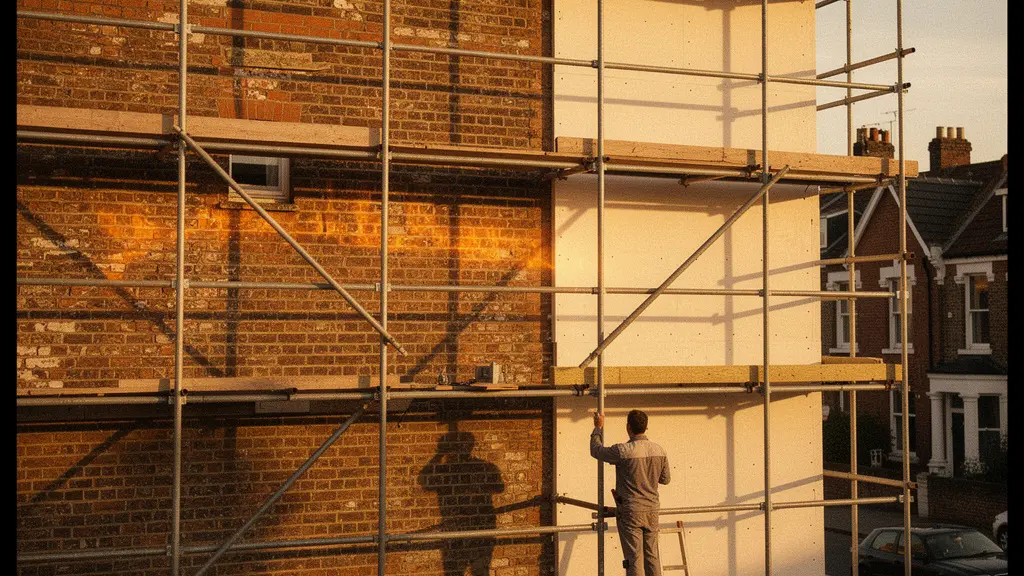
The true return on investment for exterior insulation on solid walls isn’t just about bill savings; it’s about re-engineering the building into a high-performance thermal system.
- Stopping heat loss through solid walls requires eliminating “thermal bridges,” something internal insulation often fails to do.
- Making a house airtight creates a new challenge—condensation—which must be managed with proper ventilation and moisture-permeable materials.
Recommendation: Approach your home as an interconnected system. The calculation of ROI must balance the long-term financial payback with the immediate, significant gains in comfort and property health.
If you own an older home with solid brick or stone walls, the winter chill is a familiar, unwelcome guest. You feel drafts even when the windows are closed, and energy bills climb relentlessly. The common advice is often to add insulation, but the standard approach of placing it between interior studs is fundamentally flawed for this type of construction. It fails to address the core physics of how your house loses heat, leaving you with a partial solution and continued discomfort.
The problem is that heat doesn’t just pass through the empty spaces; it travels directly through the solid materials of the structure itself—the bricks, stone, and timber frames. This phenomenon, known as thermal bridging, acts like a network of highways for heat to escape your home. Simply filling in some gaps while ignoring these highways is an inefficient strategy.
This guide reframes the entire question of exterior thermal insulation (ETI). Instead of a simple upgrade, we will treat it as a fundamental re-engineering of your home’s entire thermal envelope. The true ROI isn’t found in a single savings number but in understanding how the walls, windows, air-tightness, and ventilation work together as an interconnected system. By adopting this efficiency-focused, mathematical approach, you can accurately assess the payback, not just in dollars, but in a permanently warm and comfortable living space.
This article will walk you through the critical calculations and system-based decisions needed to evaluate the true return on investment for your property. The following sections break down each component of a successful exterior insulation strategy.
Summary: The System-Based ROI of Insulating a Solid Wall Home
- Why Insulating Between Studs Fails to Stop Heat Loss Through Wood?
- Stucco System or Foam-Backed Siding: Which Seals Air Leaks Better?
- The Condensation Risk of Sealing an Old House Too Tightly
- How to Calculate How Many Years Until Insulation Pays for Itself in Bill Savings?
- When to Combine Insulation with Window Replacement for Maximum Grants?
- Solar Integration vs Smart Meters: Which Reduces Tenant Utility Costs More?
- How a Rain Screen Cladding System Prevents Mold in Your Walls?
- Triple Glazing vs Double: Is the Extra Cost Worth the Sound and Heat Benefits?
Why Insulating Between Studs Fails to Stop Heat Loss Through Wood?
The primary reason conventional insulation methods are inefficient in older homes lies in a concept called thermal bridging. A thermal bridge is a path of lower resistance for heat to travel across a thermal barrier. In a solid wall or a traditionally framed wall, the structural elements—such as wood or steel studs, concrete lintels, and window reveals—are much more conductive than the insulation material itself. Heat bypasses the insulation by traveling through these bridges, significantly undermining the wall’s overall performance.
Wood studs, for example, are better insulators than steel but still allow significant heat transfer compared to high-performance insulation. The effect is even more dramatic with metal components; some research shows that thermal bridging through steel profiles can increase the overall U-value (a measure of heat loss) of a wall assembly by as much as 178%. By placing a continuous layer of insulation on the exterior, you effectively wrap the entire structure in a thermal blanket, cutting off these heat-loss highways at the source.
This “continuous insulation” approach is the only way to truly address the inherent weakness of the building’s structure. Further analysis of solid wall buildings shows that junctions, especially around windows, are critical weak points. A detailed study highlighted that properly insulating the window reveals is the most impactful intervention, capable of achieving a 41% reduction in heat loss from that specific thermal bridge. Neglecting these junctions is like leaving a window open after insulating the walls.
Stucco System or Foam-Backed Siding: Which Seals Air Leaks Better?
Once you commit to exterior insulation, the next decision is the finish system. This choice is not merely aesthetic; it’s critical to another key performance metric: airtightness. A well-sealed home prevents uncontrolled air leakage, which is a major source of heat loss and drafts. Two common systems, Stucco/EIFS (Exterior Insulation and Finish System) and foam-backed siding, approach airtightness in fundamentally different ways.
An EIFS system creates a monolithic, continuous barrier across the wall surface. Its strength lies in its seamless nature on flat planes, but its weak points are the joints around windows, doors, and other penetrations, which rely on sealant for their integrity. Foam-backed siding, conversely, consists of many individual panels. The primary air barrier is typically a house wrap with taped seams installed behind the siding, while the siding itself provides the insulation and weather protection.
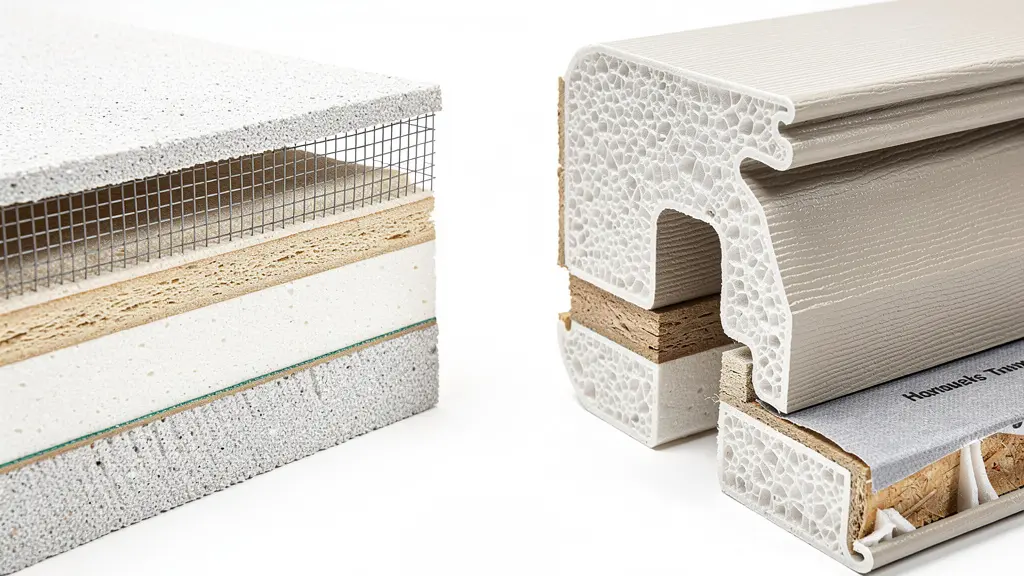
The long-term performance and maintainability of these systems differ significantly. The sealant joints in an EIFS system can degrade over time and require diligent maintenance to prevent failure. Foam-backed siding relies on mechanical fastening and an integrated drainage plane, which can be more durable and forgiving. The table below outlines the key differences in their approach to sealing the thermal envelope.
| Feature | Stucco/EIFS System | Foam-Backed Siding |
|---|---|---|
| Air Barrier Type | Monolithic on flat surfaces | House wrap with taped seams |
| Weak Points | Sealant joints at windows/penetrations | Multiple seams between panels |
| Repairability | Small cracks require immediate repair | Individual panels replaceable |
| Long-term Performance | Dependent on sealant maintenance | Mechanical fastening more durable |
| Drainage Capability | Face-sealed, limited drainage | Rainscreen gap provides superior drainage |
The Condensation Risk of Sealing an Old House Too Tightly
Achieving a high level of airtightness is a primary goal of ETI, but it introduces a critical, often-overlooked risk in older, solid-wall homes: interstitial condensation. Older homes were built to be “leaky,” allowing moisture from cooking, breathing, and bathing to escape naturally through cracks and gaps. When you seal this envelope tightly, you trap that moisture inside. This is a significant problem, as highlighted by a case study from ROCKWOOL on the Wilmcote House renovation:
Wilmcote House flats, an iconic Portsmouth landmark, had become blighted by mould, damp and condensation with many residents in fuel poverty
– ROCKWOOL Case Study, External Wall Insulation Success Stories
When you add exterior insulation, you make the original solid wall colder. The “dew point”—the temperature at which water vapor in the air condenses into liquid water—can now occur inside the brick or stone itself. If the wall cannot dry out, this trapped moisture can lead to mould, material degradation, and a failure of the entire wall system. Therefore, a “build tight, ventilate right” strategy is not optional; it is mandatory.
This strategy involves creating controlled paths for moisture to escape. This can range from simple trickle vents in windows to more sophisticated Mechanical Extract Ventilation (MEV) or even Mechanical Ventilation with Heat Recovery (MVHR) systems. Furthermore, the choice of insulation is critical. Vapor-open insulation materials, like mineral wool or wood fiber, allow the wall to “breathe” and dry out, whereas closed-cell foam insulations can trap moisture. Managing indoor humidity and providing a path for moisture to escape are as important as stopping heat loss.
How to Calculate How Many Years Until Insulation Pays for Itself in Bill Savings?
The most common question homeowners ask is about the financial return on investment (ROI). The simple payback period is calculated by dividing the total project cost by the annual energy savings. While straightforward, this calculation depends heavily on a range of variables, including local energy costs, climate, and the initial thermal performance of your home. For exterior wall insulation, industry analysis in the UK suggests payback periods can range from 15 to 25 years in a typical scenario.

To make this more concrete, we can look at specific examples. According to analysis from the Centre for Sustainable Energy, insulating a typical 3-bedroom semi-detached house with solid walls could generate significant savings. A home using gas heating might save around £398 per year on heating bills, while a larger detached house could see savings of around £488 per year. If the total installation cost is, for instance, £10,000, the simple payback for the semi-detached house would be just over 25 years (£10,000 / £398).
However, a purely mathematical ROI calculation misses a crucial part of the value equation: comfort. The elimination of cold spots, the reduction of drafts, and the creation of a stable indoor temperature are immediate benefits that have significant, albeit unquantifiable, value. Furthermore, ETI can increase the property’s market value and curb appeal, and it protects the building’s structural fabric from weathering. A true ROI assessment must therefore weigh the long-term financial payback against these immediate and substantial improvements to your quality of life.
When to Combine Insulation with Window Replacement for Maximum Grants?
Treating the house as a system means recognizing that walls and windows are two parts of the same thermal envelope. Old, inefficient windows can act as massive thermal bridges, undermining even the best wall insulation. Therefore, planning window replacement in conjunction with your ETI project is a strategic move that can maximize both performance and financial incentives, as many grants reward a “whole-house” approach to energy efficiency.
The key is sequencing. It is almost always more effective to insulate the walls first. This dramatically reduces the overall heating demand of the house, which might mean that expensive triple-glazed windows are no longer necessary; high-performance double-glazing might suffice. By reducing the load on the windows, you can potentially lower the cost of that part of the project.
If you do decide to replace windows, the optimal time is during the ETI installation. This allows the installers to wrap the insulation material right up to and around the new window frames, creating a perfect, continuous thermal envelope and completely eliminating the thermal bridge at this critical junction. Attempting to replace windows after the ETI is installed is far more complex and risks damaging the new cladding system. Planning these upgrades as a single, coordinated project is the most efficient and effective path.
Action Plan: Phased Retrofit Strategy for Walls and Windows
- Assess First: Install the Exterior Thermal Insulation (ETI) first to drastically reduce the building’s overall heating demand.
- Re-evaluate Need: After the wall insulation is complete, assess if the performance of your existing windows is now acceptable or if an upgrade is still required.
- Synchronize Installation: If replacing windows, coordinate the work to happen simultaneously with the ETI installation to perfectly seal the window-to-wall junctions.
- Detail the Wrap: Ensure the ETI plan includes wrapping insulation material around the window frames to create a seamless thermal envelope.
- Maximize Incentives: Research and apply for combined grants that reward whole-house energy efficiency improvements rather than single-measure upgrades.
Solar Integration vs Smart Meters: Which Reduces Tenant Utility Costs More?
Once your home’s thermal envelope is highly efficient thanks to ETI, the focus of energy savings shifts from reducing demand (insulation) to optimizing supply and use. For homeowners, especially those with tenants, the next question is where to invest for the best return on utility cost reduction. The two primary options are energy generation (Solar PV) and energy optimization (smart controls).
A Solar PV system passively generates electricity, directly offsetting consumption from the grid. Its effectiveness is greatest once the home’s base load energy demand has already been minimized by the ETI. In essence, the insulation makes the solar investment more powerful, as a smaller, less expensive PV system is needed to cover a larger percentage of the home’s reduced energy needs. The ROI for solar is typically longer-term but provides a steady, passive reduction in bills.
Smart controls, such as smart thermostats and monitoring systems, work by actively optimizing when and how energy is used. They rely on user engagement to learn patterns and reduce waste. Their ROI is generally much faster than solar, but their effectiveness is highly dependent on occupant behavior. In a post-ETI house, the heating system runs for shorter periods, making the optimization potential of smart controls less critical than in a leaky, uninsulated home. The following table compares these two post-ETI investments.
| Investment Type | Solar PV System | Smart Controls |
|---|---|---|
| Nature of Savings | Generation (Passive) | Optimization (Active) |
| Works Best When | Base load already reduced by ETI | User engaged with monitoring |
| Typical ROI | 6-10 years | 2-4 years |
| ETI Synergy | Smaller system needed post-ETI | Less critical after ETI |
| Dependency | Weather/location dependent | Behavior dependent |
How a Rain Screen Cladding System Prevents Mold in Your Walls?
We’ve established the risk of condensation when sealing an old home. The most robust engineering solution to this problem is not just ventilation, but a specific type of cladding assembly known as a rainscreen system. This system is designed to manage any moisture that gets behind the cladding, whether from wind-driven rain or internal vapor, and actively dry it out.
A rainscreen works by creating a ventilated air gap (typically 20-40mm) between the back of the exterior cladding and the face of the insulation. This gap is open at the bottom and top, creating a “chimney effect.” As air in the cavity is warmed by the sun or by heat escaping the building, it rises and draws in cooler, drier air from the bottom. This constant, passive air circulation actively dries the back of the cladding and the face of the insulation, preventing moisture from ever accumulating.
This design also neutralizes wind-driven rain through pressure equalization, preventing water from being forced into small cracks and joints. The successful renovation of Wilmcote House, which suffered from severe damp, utilized this principle. The project improved thermal performance and airtightness by fitting a 300-400mm deep external insulation system that incorporated a rainscreen, which helped to reduce draughts, condensation, and mould. A rainscreen is more than just a wall covering; it is an active moisture management system that ensures the long-term health and durability of the entire wall assembly.
Key Takeaways
- The primary enemy of insulation in older homes is “thermal bridging,” where heat escapes through the solid structure. Only continuous exterior insulation can stop this.
- Sealing an old house airtight is essential for efficiency but creates a significant condensation risk. A “build tight, ventilate right” strategy, ideally with vapor-open materials, is mandatory.
- The ROI calculation is twofold: a long-term financial payback (15+ years) and an immediate, high-value return in occupant comfort and property health.
Triple Glazing vs Double: Is the Extra Cost Worth the Sound and Heat Benefits?
The final component in your home’s thermal system is the glazing. After wrapping your walls in a high-performance thermal blanket, your windows become the weakest link. The question then becomes: is the significant extra cost of triple glazing worth it over high-performance double glazing? The answer depends entirely on the performance of your newly insulated walls and your specific priorities.
If your ETI has resulted in a wall with an exceptionally low U-value (e.g., below 0.15 W/m²K), then triple-glazed windows are needed to match that performance and create a truly uniform thermal envelope. In very cold climates or homes with a large window-to-wall ratio, triple glazing’s superior performance will deliver a noticeable difference. However, in a more moderate climate or with a lower window-to-wall ratio, modern, low-e, argon-filled double glazing may be perfectly sufficient and offer a much faster financial payback.
The decision also comes down to comfort and acoustics. As one building science expert noted in an advanced window study:
The inner pane of a triple-glazed window stays close to room temperature, eliminating radiant cold spots and downdrafts, effectively increasing the usable living space of a room.
– Building Science Expert, Advanced Window Performance Study
This benefit is crucial for comfort-oriented homeowners. If you live near a noisy road or airport, the superior sound insulation of triple glazing can be a deciding factor on its own. The decision matrix below can help you determine which option is right for your post-ETI home.
| Decision Factor | Favors Triple Glazing | Favors Double Glazing |
|---|---|---|
| Wall U-value Post-ETI | Below 0.15 W/m²K | Above 0.25 W/m²K |
| Climate Zone | Heating degree days >5000 | Moderate climate |
| Window-to-Wall Ratio | Above 25% | Below 15% |
| Noise Environment | Near highways/airports | Quiet residential |
| Comfort Priority | Eliminate cold spots completely | General comfort sufficient |
To apply this system-thinking approach to your property, the next logical step is to commission a professional energy audit. An audit will provide specific calculations for your home’s heat loss, model the precise savings from different ETI systems, and give you a clear, data-driven path to maximizing both your financial ROI and your daily comfort.