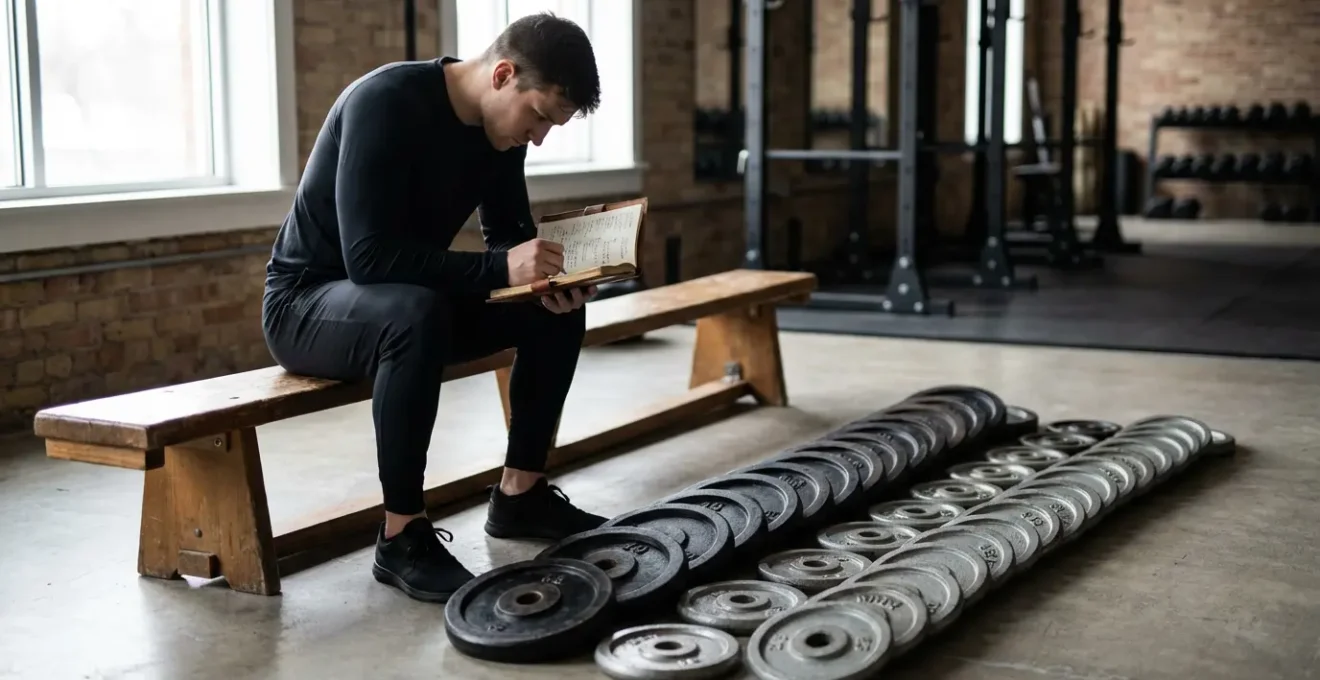
Consistent progress with an inconsistent schedule is possible by shifting from a rigid, calendar-based plan to a flexible, workout-based progression model.
- Progress is tracked by “workout type” (e.g., Heavy, Volume) rather than by the day of the week, creating a “floating” schedule.
- Daily readiness is assessed using tools like Reps in Reserve (RIR) to apply an appropriate level of stress, preventing burnout or undertraining.
Recommendation: Adopt an A/B/C workout archetype model. Log your performance for each workout independently and aim to progress the next time that specific session appears, regardless of how many days have passed.
The classic Monday-Wednesday-Friday training plan is a beautiful thing—in theory. For busy professionals, parents, and anyone juggling a chaotic schedule, it often becomes a source of frustration. You miss Monday, feel like the whole week is a write-off, and tell yourself you’ll “start fresh next week.” This all-or-nothing mindset is the number one enemy of long-term progress. Most advice defaults to “just do a full-body workout whenever you can,” but this lacks a crucial element: a structured way to progress.
The common understanding of progressive overload is linear: add 5 lbs or one more rep every week. But what happens when “every week” isn’t guaranteed? What if you train twice one week and four times the next? The key isn’t to abandon structure but to adopt a more fluid and intelligent one. This is where the concept of “Floating Progression” comes in—a system that decouples your progress from the calendar.
Instead of thinking in terms of days, you start thinking in terms of workout archetypes. Your “Heavy Squat Day” can happen on a Tuesday or a Friday; what matters is that you progress from your *last* Heavy Squat Day. This guide will teach you how to build this resilient training framework. We’ll explore how to use auto-regulation to make smart daily decisions, structure your training around flexible models, and manage the inevitable missed sessions without losing momentum. It’s time to build a plan that adapts to your life, not one that your life has to constantly adapt to.
This article provides a complete blueprint for structuring your training around a chaotic schedule. The following sections break down the essential components, from mindset and daily tools to long-term strategy and recovery.
Summary: A Flexible Approach to Progressive Overload
- Why Hitting a Plateau Is a Necessary Part of the Adaptation Cycle?
- How to Use Reps in Reserve (RIR) to Ensure Overload on Tired Days?
- Linear vs DUP: Which Progression Model Fits a Chaos Schedule Better?
- The 5lb Jump That Causes Technique Failure in Overhead Presses
- How to Adjust Your Cycle After Missing a Week of Training?
- How to Determine Your Maximum Recoverable Volume (MRV) per Muscle Group?
- Treadmill Desk vs Evening Walk: Which Habits Stick Long-Term?
- Why Isolation Exercises Fail to Trigger Systemic Muscular Growth in Natural Athletes?
Why Hitting a Plateau Is a Necessary Part of the Adaptation Cycle?
First, we need to reframe a common fear: the plateau. In a rigid training plan, a plateau feels like failure. Your numbers stop going up, and motivation plummets. But in a flexible system, a plateau is not a dead end; it’s a consolidation period. It’s a sign that your body has successfully adapted to a previous stressor and now requires a new or different kind of stimulus to continue changing. This is a normal and expected part of the process for everyone.
In fact, research shows that athletes commonly experience performance plateaus after about 6-8 weeks of a consistent training block. For someone with an irregular schedule, these plateaus might seem to appear more randomly, but the principle is the same. Instead of panicking, view this as an opportunity. A consolidation period is the perfect time to audit your technique, work on mobility, or solidify your mastery of a certain weight before pushing for more.
When progress on your main lift stalls, you’re not failing. You’re being given a chance to reinforce the foundations. Is your squat depth consistent? Is your bench press arch stable? Use this time to record your sets and analyze your form. Often, the very act of focusing on technique for a week or two is enough to break through the plateau when you return to pushing the load. This mindset shift is critical: a plateau isn’t a wall; it’s a landing where you can catch your breath and plan your next ascent.
How to Use Reps in Reserve (RIR) to Ensure Overload on Tired Days?
The single most powerful tool for a flexible training schedule is Reps in Reserve (RIR). RIR is a method of auto-regulating your training intensity by rating how many more reps you *could have* done at the end of a set. A 1 RIR means you could have done one more rep before failure; a 3 RIR means you could have done three more. This subjective measure allows you to adjust your workout based on how you feel on a given day, rather than sticking to a rigid percentage of a one-rep max (1RM) that might be unrealistic.
On days when you’re well-rested and energetic, you can push closer to failure (0-1 RIR). On days when you’re tired, stressed, or recovering from a poor night’s sleep, you can work at a higher RIR (3-4 RIR), still accumulating quality volume without digging yourself into a recovery hole. This adaptive approach ensures you’re always applying an appropriate, productive level of stress. While it sounds subjective, studies demonstrate that RIR estimates reach nearly 90% accuracy when lifters are gauging sets that are 1-2 reps from failure.
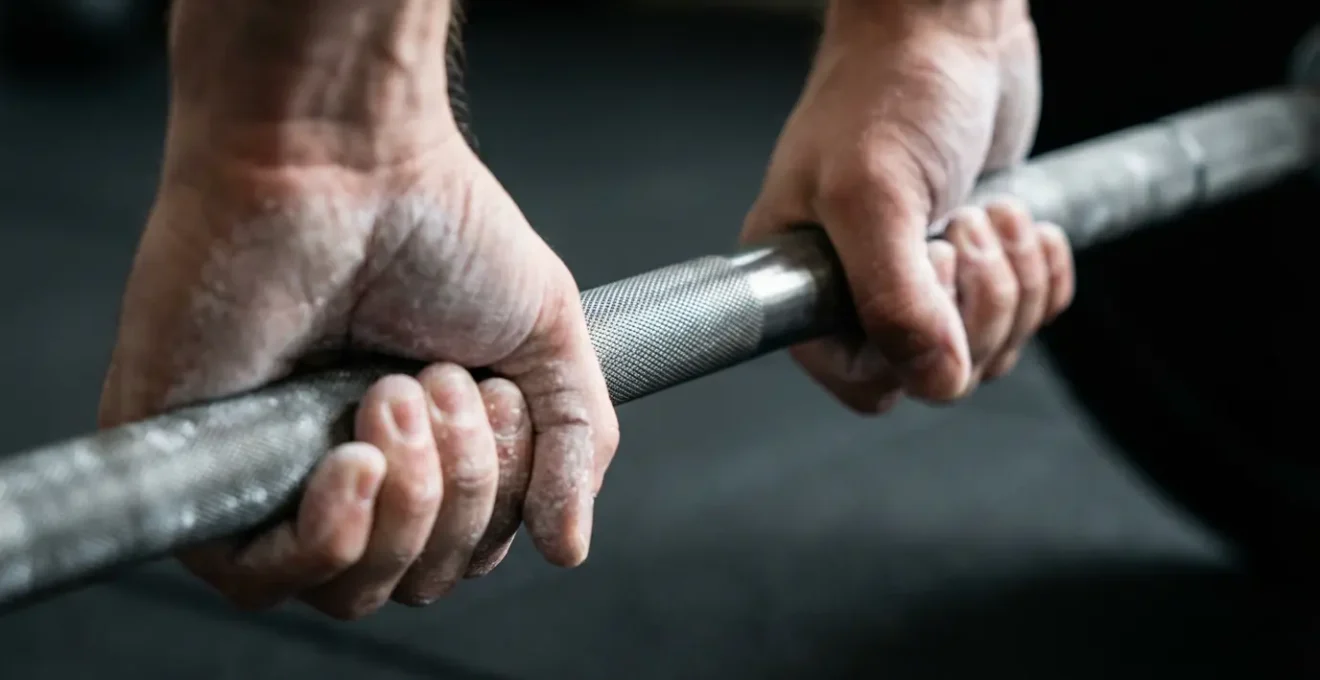
As the image of a controlled lift suggests, RIR isn’t about guessing; it’s about paying close attention to bar speed and effort. The last “good” rep before form breaks down or the bar slows dramatically is your guide. The following table provides a practical decision-making framework based on your fatigue levels and how long it’s been since you last trained.
This decision tree, based on a model from GymAware, helps translate your daily feeling into an actionable training target. It’s the core of making “adaptive overload” a practical reality.
| Days Since Last Workout | High Fatigue | Moderate Fatigue | Low Fatigue |
|---|---|---|---|
| 1-2 days | 3-4 RIR | 2-3 RIR | 1-2 RIR |
| 3-4 days | 2-3 RIR | 1-2 RIR | 0-1 RIR |
| 5+ days | 2 RIR (Re-entry) | 1 RIR | 0 RIR |
Linear vs DUP: Which Progression Model Fits a Chaos Schedule Better?
Now that we have a tool for daily intensity (RIR), we need a long-term strategic framework. For a chaotic schedule, traditional Linear Progression (adding a small amount of weight to every lift, every session) is too rigid. It assumes a predictable rate of recovery that busy people rarely have. A much better fit is a “floating” version of Daily Undulating Periodization (DUP).
In classic DUP, you vary the focus of your training each session within a week—for example, a heavy/strength day, a moderate/hypertrophy day, and a light/speed day. Our “floating” version takes this a step further: these workout archetypes aren’t tied to days of the week. You simply rotate through them whenever you can get to the gym. If you train on Monday, you do Workout A. If your next session is on Thursday, you do Workout B. If you train again on Saturday, you do Workout C. Your goal is to beat your performance from the *last time* you did that specific workout type.
This model is incredibly resilient. It allows for variable rest days between sessions without derailing progress, as each workout type progresses on its own independent timeline. You’re not trying to force a strength adaptation on a day you feel worn out; you’re simply executing the next workout in your rotation and using RIR to adjust the load appropriately. This is the heart of the “Floating Progression” system.
Your Action Plan: The A/B/C Workout Rotation Model
- Workout A (Heavy): Structure sets in the 3-5 rep range at a low RIR (e.g., 1-2 RIR), focusing on neural adaptation with major compound lifts.
- Workout B (Volume): Structure sets in the 8-12 rep range at a moderate RIR (e.g., 2-3 RIR) to accumulate metabolic stress and drive muscle growth.
- Workout C (Light/Speed): Use lighter loads for 6-8 reps, focusing on moving the weight with maximum velocity to improve power and technique.
- Track Independently: In your log, create separate entries for A, B, and C. When you complete Workout A, your only goal is to improve upon your last Workout A.
- Progress When Ready: Progression is event-based, not calendar-based. You progress each workout type when you complete it, regardless of the days between sessions.
The 5lb Jump That Causes Technique Failure in Overhead Presses
The “Floating Progression” model works on a macro level, but its principles also solve common micro-level frustrations. Take the overhead press (OHP), a lift notorious for stubborn plateaus. You’re pressing 100 lbs for 5 reps, but jumping to 105 lbs causes your form to collapse on the second rep. This isn’t just a strength issue; it’s often a velocity and technique issue.
As you approach your limit, the speed of the barbell inevitably slows down. When you add that extra 5 lbs, the bar moves even slower from the start. Research indicates that a velocity loss greater than 20% from your first rep to your last is a strong predictor of impending technical failure. That 5 lb jump can push you past this threshold immediately, causing compensations like an excessive back arch or incomplete lockout. You’re not just failing the lift; your body is protecting itself from an unstable movement pattern.
To break through this, you need to build strength and confidence *at the target weight* and specifically at your sticking point. Instead of repeatedly failing at 105 lbs from the bottom, you can use “bridge lifts” to acclimate your body to the new load in a controlled range of motion. This builds both the specific strength and the neural confidence needed to complete the full lift.
- Step 1: Identify Your Sticking Point. Is failure at the bottom (delts), the midpoint (triceps), or lockout (stability)?
- Step 2: Implement a Bridge Lift. Set up a pin press or partial press in a rack starting just below your sticking point. Work with the target weight (105 lbs) for sets of 3 reps in this shorter range.
- Step 3: Use Cluster Sets. With the target weight, perform 4 reps of the full OHP, then rack the bar and rest for 20-30 seconds. Unrack it and complete a final, difficult 5th rep. This gets you a “win” at the target reps.
- Step 4: Micro-load. The jump from 100 to 105 is a 5% increase. Using 1.25 lb plates to jump to 102.5 lbs (a 2.5% increase) is a much more manageable step.
How to Adjust Your Cycle After Missing a Week of Training?
Life happens. You get sick, go on vacation, or a stressful work week completely wipes you out. In a rigid plan, a missed week feels like a total reset. With a flexible mindset, it’s just a brief pause. The fear of losing all your gains is largely unfounded for short breaks. The principle of “muscle memory” is real; research on detraining shows that strength and size are largely maintained after short-term breaks (under 4 weeks), and adaptations are regained much faster upon returning to training.
The key is not to jump back in exactly where you left off. Your nervous system will be slightly “de-tuned,” and your work capacity will be lower. Trying to hit your old numbers immediately is a recipe for excessive soreness, frustration, or even injury. Your first session back is a “re-entry” workout. Its only goal is to re-establish the mind-muscle connection and signal to your body that it’s time to work again. It’s about shaking off the rust, not setting personal records.

Your re-entry strategy should depend on *why* you took the break. A relaxing vacation has a different physiological impact than a week battling the flu. The following table provides a clear protocol for your first one or two workouts back, helping you ramp up safely and effectively.
This structured approach removes the guesswork and anxiety from returning to the gym. It acknowledges the break and provides a clear, encouraging path back to your previous performance levels.
| Break Type | Session 1 Load | Session 2 Target | Recovery Focus |
|---|---|---|---|
| Passive (vacation) | 80-90% of pre-break | Match pre-break | Standard recovery |
| Active (illness) | 70-80% of pre-break | 90% of pre-break | Extended recovery |
| Stress-related | 75-85% of pre-break | 95% of pre-break | Monitor HRV/sleep |
How to Determine Your Maximum Recoverable Volume (MRV) per Muscle Group?
While RIR manages daily intensity, Maximum Recoverable Volume (MRV) helps you manage your weekly workload. MRV is the highest amount of training volume (sets x reps x weight) you can perform for a muscle group and still successfully recover from. Exceeding your MRV consistently leads to burnout, systemic fatigue, and stalled progress. For someone with a chaotic schedule, understanding your personal MRV is crucial because your recovery resources (sleep, nutrition, stress levels) are also variable.
You don’t need complex spreadsheets to estimate your MRV. A more practical approach for a busy individual is to use a combination of performance and subjective feedback. Think of your MRV as a “recovery budget.” Your job, family, and life stress all draw from this budget. Training is another withdrawal. Sleep and good nutrition are the primary deposits. Your goal is to keep the budget balanced.
Start by tracking these three simple metrics in your training log for a few weeks:
- Performance: Are your lifts progressing? If you’re consistently failing to add reps or weight on your “floating” A/B/C workouts, your volume may be too high. This is the most objective sign.
- Soreness (DOMS): Are you still significantly sore when it’s time for your next session? While some soreness is normal, debilitating soreness that impacts your next workout or daily life is a red flag.
- Mood and Motivation: Do you dread going to the gym? Do you feel perpetually tired and irritable? This systemic fatigue is a classic sign of exceeding your MRV.
If you’re seeing negative signs in two or more of these categories, your volume is likely too high. Reduce the number of sets for your main muscle groups by 10-20% for a week or two and see how you respond. Conversely, if you feel fresh, are never sore, and are progressing easily, you may have room to slowly add a set here and there. This process of observation and adjustment helps you find the sweet spot for your unique lifestyle.
Treadmill Desk vs Evening Walk: Which Habits Stick Long-Term?
Recovery isn’t just passive; it’s an active process. The habits you build outside the gym are just as important as the work you do inside it. However, in the spirit of a realistic strategy, we must prioritize habits with low “friction.” A high-friction habit requires significant setup, willpower, or disruption to your daily routine, making it less likely to stick long-term.
Consider two popular “active recovery” options: using a treadmill desk while working versus taking a 20-minute walk after dinner. The treadmill desk seems like a great way to multitask, but it has high friction. It requires a specific equipment setup, can be distracting from deep work, and keeps your body in a low-level state of sympathetic (“fight or flight”) arousal. An evening walk, on the other hand, has almost zero friction. You just need shoes and a door. It actively shifts your nervous system towards a parasympathetic (“rest and digest”) state, which directly enhances recovery and improves sleep quality.
When your recovery budget is already strained by a busy life, you must choose activities that *add* to your recovery, not draw from it. The goal is to find the most effective, lowest-effort habits that you can perform consistently. A simple analysis shows why some habits are far more sustainable than others for a time-crunched individual.
The table below breaks down the “friction cost” versus the recovery benefit of common activities, illustrating why simple, accessible habits are usually the winning bet.
| Activity | Setup Friction | Stress Impact | Recovery Contribution | Adherence Rate |
|---|---|---|---|---|
| Evening Walk | Near-zero | Parasympathetic (+) | Enhances recovery | High (85%+) |
| Treadmill Desk | High setup required | Low-level sympathetic | Draws from budget | Moderate (40-60%) |
| Morning Stretching | Low | Neutral | Moderate benefit | High (70%+) |
Choosing a low-friction habit like an evening walk or 10 minutes of morning stretching provides a far better return on investment for your limited time and energy. It’s not about doing everything; it’s about consistently doing the few things that matter most.
Key Takeaways
- Shift your mindset from a rigid calendar to a flexible “Floating Progression” model based on workout archetypes.
- Use Reps in Reserve (RIR) as your daily guide to apply the right amount of intensity based on your energy and recovery levels.
- Treat plateaus and missed weeks not as failures, but as planned opportunities for consolidation and safe re-entry.
Why Isolation Exercises Fail to Trigger Systemic Muscular Growth in Natural Athletes?
The final piece of our strategy is prioritization. When time is your most limited resource, your exercise selection must be ruthless. The foundation of any effective program for a natural athlete is compound movements—squats, deadlifts, presses, and rows. These multi-joint exercises stimulate a large amount of muscle mass, trigger a significant hormonal response, and allow for the most straightforward application of progressive overload.
Isolation exercises like bicep curls or tricep pushdowns have their place, but they are a poor foundation for a time-crunched lifter. They create a lot of local fatigue in a small muscle but do very little to trigger the systemic, body-wide signal for growth. You could spend 20 minutes doing various arm exercises and create less of an anabolic stimulus than you would from one hard set of 5 heavy pull-ups. As a busy professional, you need the most “bang for your buck” from every minute spent in the gym.
As expert Jeff Nippard states, the primary driver of growth is mechanical tension. In his guide on building muscle, he emphasizes:
We need to apply progressive tension increases to the muscle itself. This means we need to lift with good consistent technique while using progressive overload to push the level of intramuscular tension up over time.
– Jeff Nippard, How To Build Muscle (Explained In 5 Levels)
This progressive tension is most efficiently and effectively applied through heavy compound lifts. A better approach is the “Compound + Finisher” model. You dedicate the majority of your energy to one primary compound lift for the day, focusing on progressive overload. Then, if you have time and energy remaining, you can add one or two “finisher” isolation exercises to target the main movers of that day’s lift. This ensures the most important work gets done first.
This flexible, resilient approach to training is your path to long-term success. Stop letting a chaotic schedule derail your goals. Start by logging your next workout as “Workout A,” and build from there. The path to consistent progress begins not with a perfect calendar, but with a single, well-executed session.