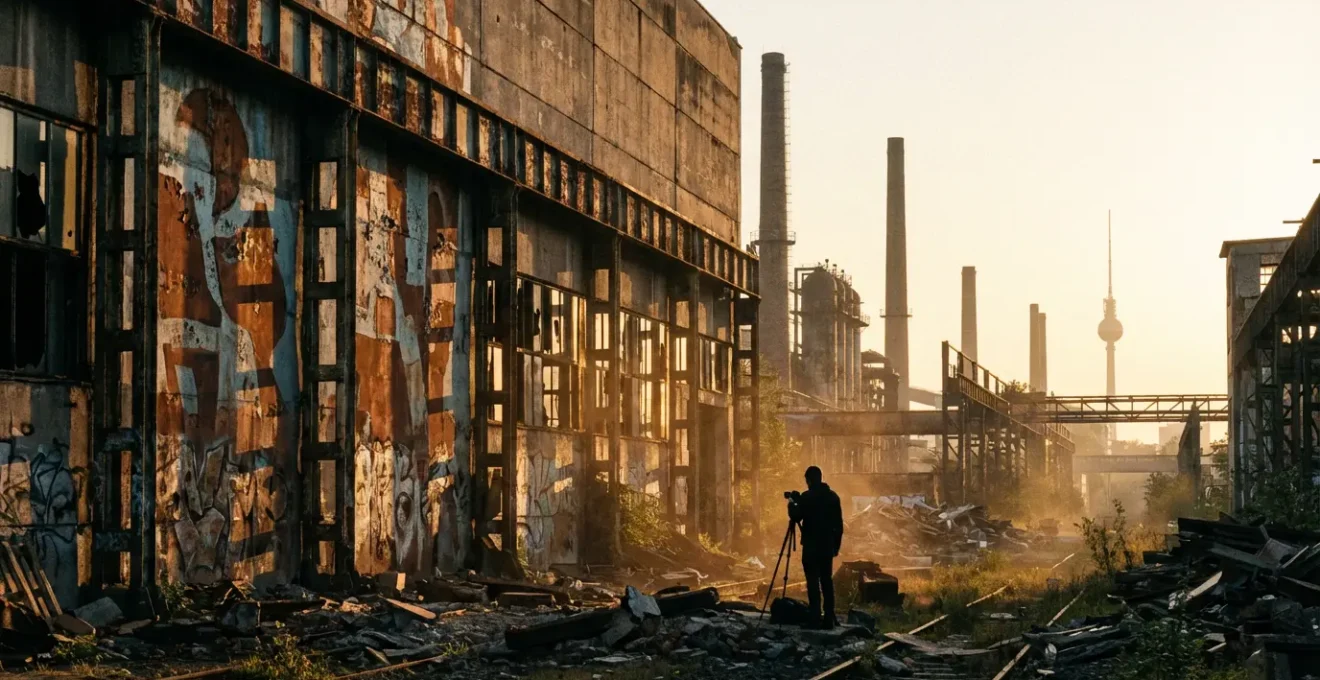
Stop romanticizing the “jump the fence” approach to urban exploration. The true art of capturing Berlin’s industrial decay lies in mastering operational access—a strategic game of digital reconnaissance, permit negotiation, and technical skill. This guide bypasses the generic tourist spots to give you the fixer’s playbook for getting the shot legally and professionally, turning bureaucracy and low light into your creative advantages.
Every photographer in Berlin feels the pull. The city is a graveyard of concrete giants, monuments to a fractured history sleeping just beyond a chain-link fence. You see the epic shots online—the NSA spy station on Teufelsberg, the ghostly corridors of Beelitz-Heilstätten—and the first thought is always, “How do I get in?” The common advice is a dangerous cocktail of “be sneaky” and “don’t get caught.” This is amateur hour, and it will land you with a hefty fine or worse.
Forget the clichés. This isn’t about trespassing. That’s a tourist’s game. For the serious artist, the challenge isn’t the fence; it’s the system. The real craft is in the hustle, the meticulous planning, and the professional approach that opens doors closed to the reckless. It’s about understanding the new decay economy, where ruins are assets, and access is a currency you can earn. It’s about swapping a crowbar for a well-worded email and a liability insurance form.
This guide isn’t another list of places you already know. This is the methodology. We’re moving beyond the *what* and focusing entirely on the *how*. We will break down the strategies for digital reconnaissance to find promising locations, the art of “system hacking” to secure legal permits, and the technical mastery needed to sculpt light in the darkest of concrete tombs. This is your playbook for operating like a professional, not a punk.
To navigate the world of Berlin’s lost places like an insider, you need a clear strategy. This article breaks down the essential steps, from finding your target to capturing the perfect shot without breaking the law.
Summary: The Real Rules of Photographing Berlin’s Industrial Ruins
- Why the NSA Spy Station in Berlin Is Now a Street Art Gallery?
- How to Contact Property Management Firms for Legal Photo Shoot Permits?
- Sanatorium or Theme Park: Which Offers Better Atmospheric Lighting?
- The Hidden Danger in Berlin’s Forests That Explorers Ignore
- How to Shoot Handheld in Dark Bunkers Without Grainy Noise?
- How to Use Satellite Imagery to Identify Accessible Historic Ruins?
- How Banksy Changed the Rules of Street Art Monetization?
- Why Contemporary Cultural and Artistic Expression Confuses Traditional Collectors?
Why the NSA Spy Station in Berlin Is Now a Street Art Gallery?
Teufelsberg, the iconic “Devil’s Mountain,” is the perfect case study in the evolution of abandoned spaces. What was once a symbol of Cold War espionage, left to rot and be reclaimed by graffiti artists, is now a prime example of the decay economy. The reason it’s Europe’s largest street art gallery and not just a pile of rubble is simple: it’s a business. This transformation wasn’t funded by the state but built on a model that turns urban decay into a cultural commodity.
The entire operation is 100% privately funded through tours, events, and film shoots. This financial independence is what allows the site’s management to preserve the location while curating the art. It’s no longer a free-for-all canvas. The site operates as a formal museum, and artists wanting to paint a mural must submit an application, a process that can take years due to immense demand. The art is in constant flux, with new pieces painted over old ones, creating a living, breathing gallery where the architecture is as much a part of the art as the paint itself.
This curated approach means that for photographers, the experience is less about illicit discovery and more about documenting a specific moment in the site’s artistic timeline. You are not capturing a forgotten ruin; you are capturing a managed, ever-changing exhibition. Understanding this shift is key to appreciating why access is controlled—it’s not just to keep people out, but to protect the asset and the art within it.
How to Contact Property Management Firms for Legal Photo Shoot Permits?
The secret to legal access isn’t a secret at all; it’s a process. While some explorers prefer the adrenaline of the illicit, the professional understands that a little research and a professional approach can open more doors than a bolt cutter ever will. The key is to reframe your request: you’re not a trespasser, you are an artist offering a service—documentation. As photographer Martin Boemer notes, the path of permission is often more viable than people think.
Urban exploring isn’t always illicit. Sometimes authorities on-site can be convinced to allow access, or permission can be granted beforehand. Some abandoned spaces are now open for public tours, as well.
– Martin Boemer, Interview with The Berliner
Getting that “yes” requires a strategic approach. It’s about identifying the right people and presenting yourself as a professional, not a hobbyist. You need to demonstrate that you are an asset, not a liability. This means having your documents in order and your pitch polished. The goal is to make it easy for them to say yes by removing any perceived risk on their part.
Action Plan: Securing a Legal Photo Permit
- Research Ownership: Use public records (Grundbuchamt) or local city planning offices to identify the legal owner or property management firm.
- Initial Contact: Attempt to contact on-site security or caretakers first; they can sometimes grant limited access or provide the correct contact for the management company.
- Prepare Your Portfolio: Assemble a professional portfolio (a clean website or PDF) that showcases your best architectural or documentary work.
- Show Proof of Insurance: This is non-negotiable. Include a copy of your liability insurance (Haftpflichtversicherung) in your application to show you are covering your own risk.
- Frame the Request: Pitch your project not as a personal whim, but as a proposal to document the “current state of their property,” offering them a copy of the final images for their own records.
Sanatorium or Theme Park: Which Offers Better Atmospheric Lighting?
Once you have access, the environment dictates the shot. Two of Berlin’s most legendary sites, Beelitz-Heilstätten (a former sanatorium complex) and Spreepark (an abandoned amusement park), offer wildly different canvases for a photographer. The choice between them often comes down to one critical factor: light. The way light interacts with the architecture—long, dusty corridors versus skeletal ride structures—defines the atmosphere you can capture. One is a study in shadow play and interior drama, the other in silhouette and open-air melancholy.
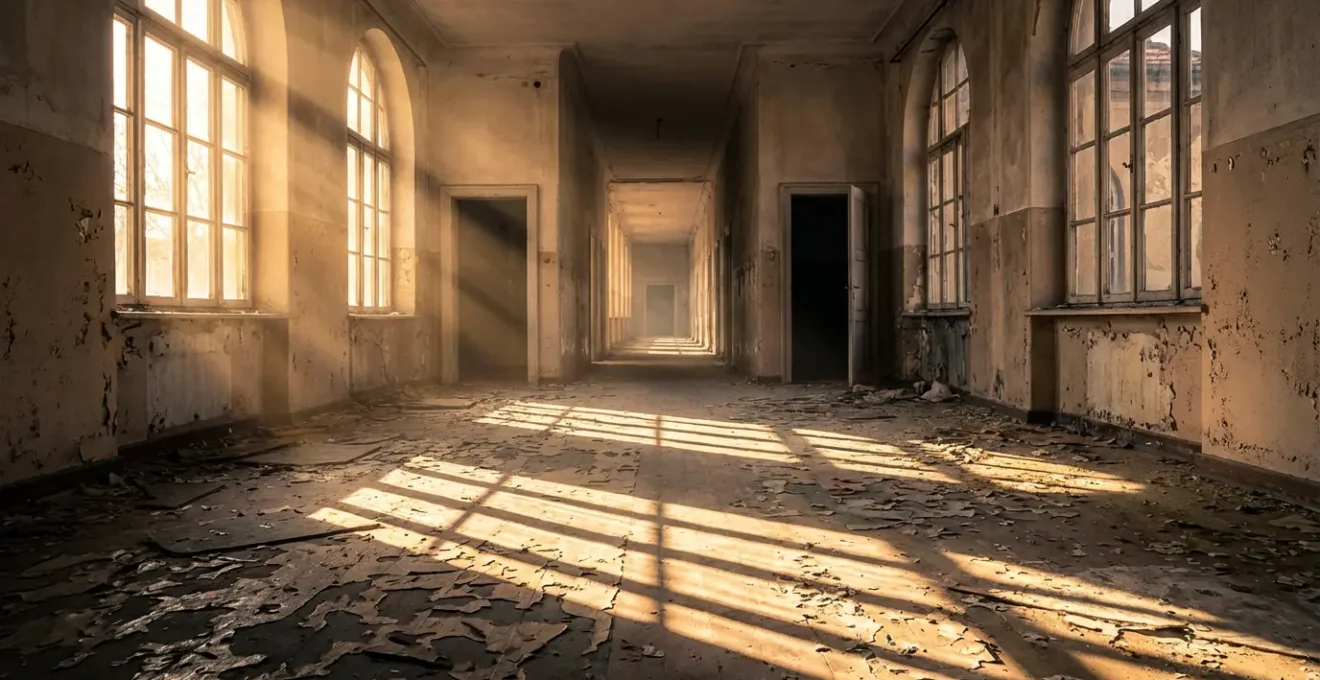
As the image above demonstrates, a location like Beelitz-Heilstätten is made for light sculpting. Its long hallways and massive windows turn the golden hour into a theatrical performance, with sharp beams of light cutting through the dusty air. Spreepark, on the other hand, offers its best light during the blue hour, when the skeletal remains of the Ferris wheel and roller coasters create stark, graphic silhouettes against the fading sky. Your decision should be based on the mood you want to create.
The following table, based on a comparative analysis of Berlin’s lost places, breaks down the key lighting differences to help you plan your shoot.
| Aspect | Beelitz-Heilstätten | Spreepark |
|---|---|---|
| Best Time | Golden hour through large windows | Blue hour for ride silhouettes |
| Architecture | Long corridors with dramatic shadows | Open skeletal structures |
| Seasonal Variation | Winter’s low sun more dramatic | Summer foliage affects light quality |
| Access Type | Legal tours available | Guided tours only (site under renovation) |
The Hidden Danger in Berlin’s Forests That Explorers Ignore
The focus on trespassing fines often overshadows a far more immediate threat: the buildings themselves. Many of Berlin’s most alluring ruins are hidden deep in the forests of Brandenburg, where they have been slowly surrendering to nature for decades. The romantic image of ivy-covered walls hides a serious reality. According to safety warnings for Berlin’s lost places, the danger of collapse and falling parts poses a significant and often underestimated risk.
These are not movie sets. Floors are water-damaged, ceilings are compromised, and metal is rusted through. The silence of these places is not peaceful; it’s the sound of gravity winning a slow, patient war. Every step must be deliberate, and you must constantly read the environment for signs of instability—cracks, water stains, and sagging structures. The most dangerous spots are often the most photogenic. A testimony from one explorer highlights just how quickly things can go wrong.
While I was exploring an abandoned hotel in New York, the floor suddenly gave way under my weight. Luckily, I could stop my fall with my elbows and climb back up. The hall below me was 5-6 meters high… Moreover, it’s important that a friend or family knows where you are and when they need to worry if you don’t come back.
– Anonymous Explorer Testimony
This isn’t just about your safety. It’s about respecting the place. A responsible explorer leaves no trace and takes no unnecessary risks that could lead to a site being sealed off for good. Always have a partner, tell someone your exact location and planned return time, and carry a first-aid kit. The best shot is never worth a broken bone or worse.
How to Shoot Handheld in Dark Bunkers Without Grainy Noise?
Tripods are often impractical or forbidden on official tours. This leaves you with a common challenge: shooting in near-total darkness without cranking your ISO into a grainy mess. Mastering handheld low-light photography is a core skill for any urban explorer. It’s a combination of physical technique and leveraging your camera’s technology. The goal is to turn your own body into a stable platform, a “human tripod,” to allow for slower shutter speeds than you thought possible.
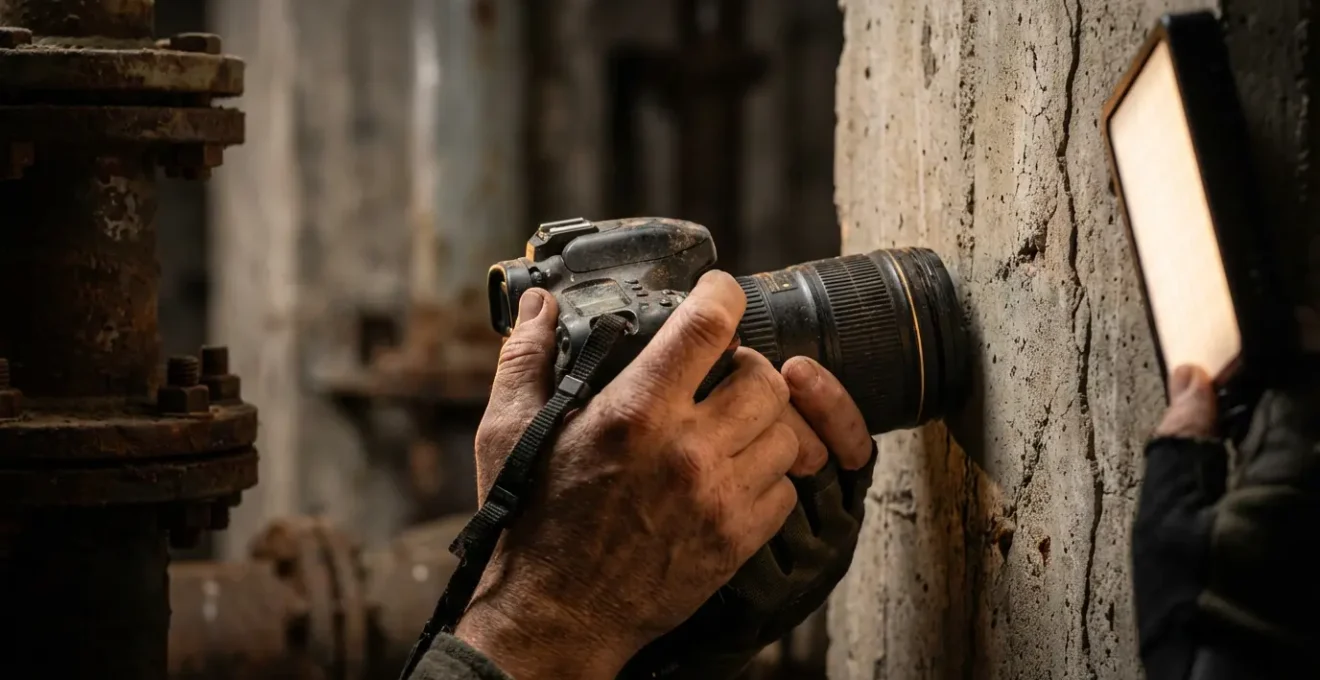
The key is stability. By controlling your stance and breath, you can minimize the micro-movements that cause blur. Many photographers report being able to shoot at 1/45s or even 1/30s using high-speed burst mode; the theory is that one of the shots in the burst will be sharp, captured in the instant between your movements. It’s a numbers game that often pays off. Combine this with proper physical form for the best results.
Follow these steps to create a stable shooting platform with your body:
- Find Your Stance: Stand with your legs shoulder-width apart, one foot slightly forward for balance.
- Tuck Your Elbows: Brace your elbows firmly against your ribs. Do not hold them out like wings; this creates instability.
- Support the Lens: Use your non-shooting hand to cradle the lens from underneath, providing a solid base for the camera body.
- Control Your Breath: Take a deep breath, exhale slowly, and gently press the shutter at the calm point between breaths.
- Use Burst Mode: Fire a short burst of 3-5 shots. One of them is likely to be sharper than a single exposure.
- Brace Against Structures: Whenever possible, lean against a solid wall, doorframe, or pillar to add an extra point of contact and increase stability.
How to Use Satellite Imagery to Identify Accessible Historic Ruins?
The best locations are rarely found on a “Top 10” list. The real work, the digital reconnaissance, happens before you ever leave your apartment. Tools like Google Maps and Google Earth Pro are the single most powerful resources for an urban explorer. This is ground zero for your mission planning. Instead of searching for named places, you are hunting for visual signatures of decay from above.
The process starts broadly. Scan satellite views of areas known for specific histories: former Soviet military zones in Brandenburg, old industrial districts along the Spree, or the outskirts where development stalled after the Wall fell. You’re looking for tell-tale signs that a structure has been abandoned. These visual cues are often subtle but become obvious with practice:
- Overgrown Vegetation: Nature is the first to reclaim a space. Look for parking lots where trees are growing through the asphalt or buildings where the roof is covered in green.
- Collapsed Roofs: A partially or fully collapsed roof is a definitive sign of abandonment. On satellite view, this often appears as a dark, irregular hole in the building’s structure.
- Lack of Activity: Scan for cars in the parking lot, maintained pathways, or any signs of recent human traffic. The absence of these is a strong indicator.
- Boarded Windows: While harder to see from directly above, switching to 3D or Street View in some areas can reveal boarded-up windows and doors, confirming a building is sealed.
Use specific search terms directly within Google Maps to narrow your hunt. Phrases like “verlassene Fabrik” (abandoned factory) or “ehemaliges Krankenhaus” (former hospital) combined with a region can yield surprising results that aren’t on any mainstream blog. This is the first step in building a private list of potential targets for further, on-the-ground investigation.
How Banksy Changed the Rules of Street Art Monetization?
The shift from vandalism to valued art, famously accelerated by figures like Banksy, has fundamentally altered the landscape for urban artists and explorers. Banksy demonstrated that street art could have immense commercial value, not just cultural impact. This created a new paradigm: if art in a derelict space is valuable, the space itself becomes valuable. This is the principle that underpins the “Decay Economy” and explains the business model of places like Teufelsberg.
Case Study: The Teufelsberg Business Model
Teufelsberg’s management explicitly states that since the project is privately owned, it receives no state support. Revenue from visitors is used not only for site maintenance but also to actively support artists by providing materials and opportunities for new creations. A leaseholder officially opened the gates in 2011, establishing the curated gallery, and by 2018, the site was listed as a historical monument, cementing its transition from a ruin to a protected cultural asset. This journey from illegal graffiti spot to a monetized, curated, and historically recognized monument is a direct consequence of the market value now assigned to ephemeral art.
This commercialization is a double-edged sword. On one hand, it saves iconic locations from demolition and creates a safe, legal environment for artists and photographers. On the other, it formalizes and, some would argue, sanitizes the raw, anti-authoritarian spirit of classic graffiti. For the photographer, it means that access is now often a transaction. You are a customer or a contractor, not an outlaw. This requires a shift in mindset, from one of rebellion to one of professional negotiation, mirroring the very change that Banksy’s career helped to pioneer.
Key Takeaways
- Legal access is a strategic process of research and professional communication, not a matter of luck.
- The physical dangers of structural collapse in abandoned buildings are a greater risk than trespassing fines.
- Mastering handheld low-light techniques is a non-negotiable skill for shooting in dark, tripod-restricted locations.
Why Contemporary Cultural and Artistic Expression Confuses Traditional Collectors?
The art world’s traditional collectors often struggle with the ethos of urban exploration and street art because it defies their core tenets of ownership, permanence, and pristine condition. How do you collect a mural painted on a crumbling wall? How do you assign value to an experience—the act of discovery and documentation—rather than a physical object? This disconnect is at the heart of the confusion. The value is not in the “thing” but in the story and the ephemeral moment it represents.
Urban exploration photography is a historical act. As photographer Martin Boemer puts it, “Urban exploration also teaches us a lot about history – giving us the chance to see buildings that have been untouched for years or even decades.” For the artist, the photograph is the artifact, a record of a place’s final chapter. For a traditional collector, who sees a decaying building, the artist sees a time capsule. This growing interest from a new generation of tourists, photographers, and explorers is turning Berlin’s abandoned heritage into a mainstream cultural phenomenon, further blurring the lines for a market built on exclusivity.
This new form of expression prioritizes authenticity over polish. The rust, the decay, the peeling paint—these are not imperfections to be restored; they are the very subject of the art. It’s a celebration of entropy, a concept alien to a market that obsesses over preservation. The confusion arises because the art isn’t just the photo; it’s the entire process: the research, the access, the risk, and the final captured image. It is performance, history, and photography all rolled into one, a package that doesn’t fit neatly into a gilded frame.
Ultimately, capturing these spaces legally and respectfully is not just about avoiding a fine; it’s about ensuring these places remain accessible for the next generation of artists. The next step is to start your own digital reconnaissance and build a professional request for access.